

As Sweetwater’s resident keyboard guru, I get a ton of keyboard-related questions. The questions I get most often have to do with what many consider the most important factor to consider when buying a keyboard — the “touch” or “feel.” Everyone wants to know which digital piano has the most realistic acoustic-piano feel or action.
“I’m trying to decide between keyboards X and Y. Which one has a lighter/heavier touch?”
After years of trying to answer those questions with my own subjective opinion (by going and trying out the keyboards in our store), I attempted to answer this question objectively and impartially with science! This is why I dreamed up the nerdiest, coolest keyboard touch experiment in all of history, and then, with the help of Lynn Fuston — Sweetwater’s Manager of Written Content and a total audio geek in his own right — I actually did it! I trust you’ll find the results of our experiment enlightening or, at the very least, mildly amusing.
In this article, we’ll discuss:
- What “keyboard touch” means
- The experiment we devised to measure and compare keyboard weight
- Our findings after we measured the keyboards
- What I learned
What Does “Keyboard Touch” Mean?
The “touch,””feel,” or “action” of a digital piano is the perceived resistance and response of the keys when they are played. It is directly linked to the force required to depress a piano’s keys. You typically hear players say things like, “this keyboard feels heavy,” meaning that it seems the keys offer more resistance, which causes the player to need more force to depress the keys. If someone comments, “this keyboard feels light,” they might think the keys have relatively low resistance and therefore require less force to push down. You may hear a multitude of other adjectives like “springy,” “bouncy,” “plastic-y,” “loud,” and so forth. As you can see, this is a very subjective and personal way of describing and comparing keyboard feel. And, since all players are different, no two people would characterize the keyboard action the same way. That’s one of the reasons why we wanted to comparatively quantify the differences in keyboard touch between digital pianos.
Keybed
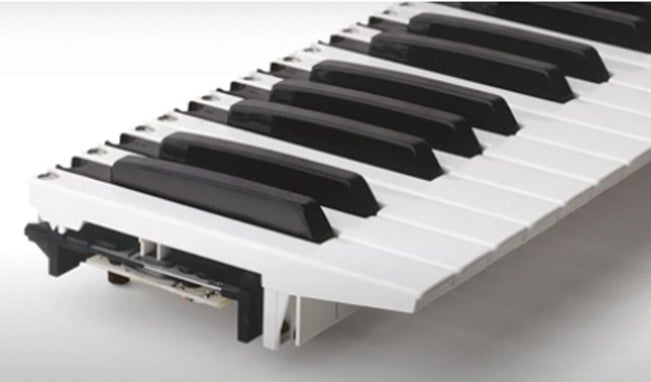
The feel of a keyboard is a result of its keybed. Some keybeds are made by the same company that designed the keyboard, but others have a keybed that was made by a different company, such as Fatar. Check out the video below to learn more about keybeds.
In modern digital keyboards, the keybed determines many aspects:
- The action of the keys — fully weighted, semi-weighted, or unweighted/synth action. They can have hammer action, meaning the key mechanism is replicating the same action found on acoustic pianos; or graded action, also called scaled or progressive action, meaning the feel of the keys is heavier in the lower end and lighter in the top end of the keyboard like an acoustic piano. Check out this video to learn more about weighted and unweighted keys.
- The escapement mechanism — the mechanism in a piano that allows the hammer to fall away from the string after the key is pressed. Electric keyboards with “piano action” use weights and other methods to simulate this behavior found in acoustic pianos.
- The style or texture of the keys — whether they are full-size keys, like an acoustic piano, mini keys, or waterfall keys, like those on an organ.
- The materials of the keys — they can be constructed to have a special feel, such as synthetic ivory, or they can be made of plastic or wood.
Our Experiment
It’s not rocket science! But it is… keyboard science. Or quasi-science, at least. We are key-busters! Or myth-boarders! Or something like that.
What did we measure?
As we started experimenting for our test, Clete Goens, Sweetwater Music Store’s resident piano specialist, contributed his expertise and calibrated gram weights. We discovered that the best indicator for showing the differences between keyboards was the weight (in grams) required to push down the middle C key and sustain the note.
How much is a gram?
I didn’t know either. We found a single gram is equivalent to two large paper clips. It’s a small weight, but one that was very revealing in these tests. If you don’t have any paper clips nearby, a headphone adapter weighs about 6 grams.
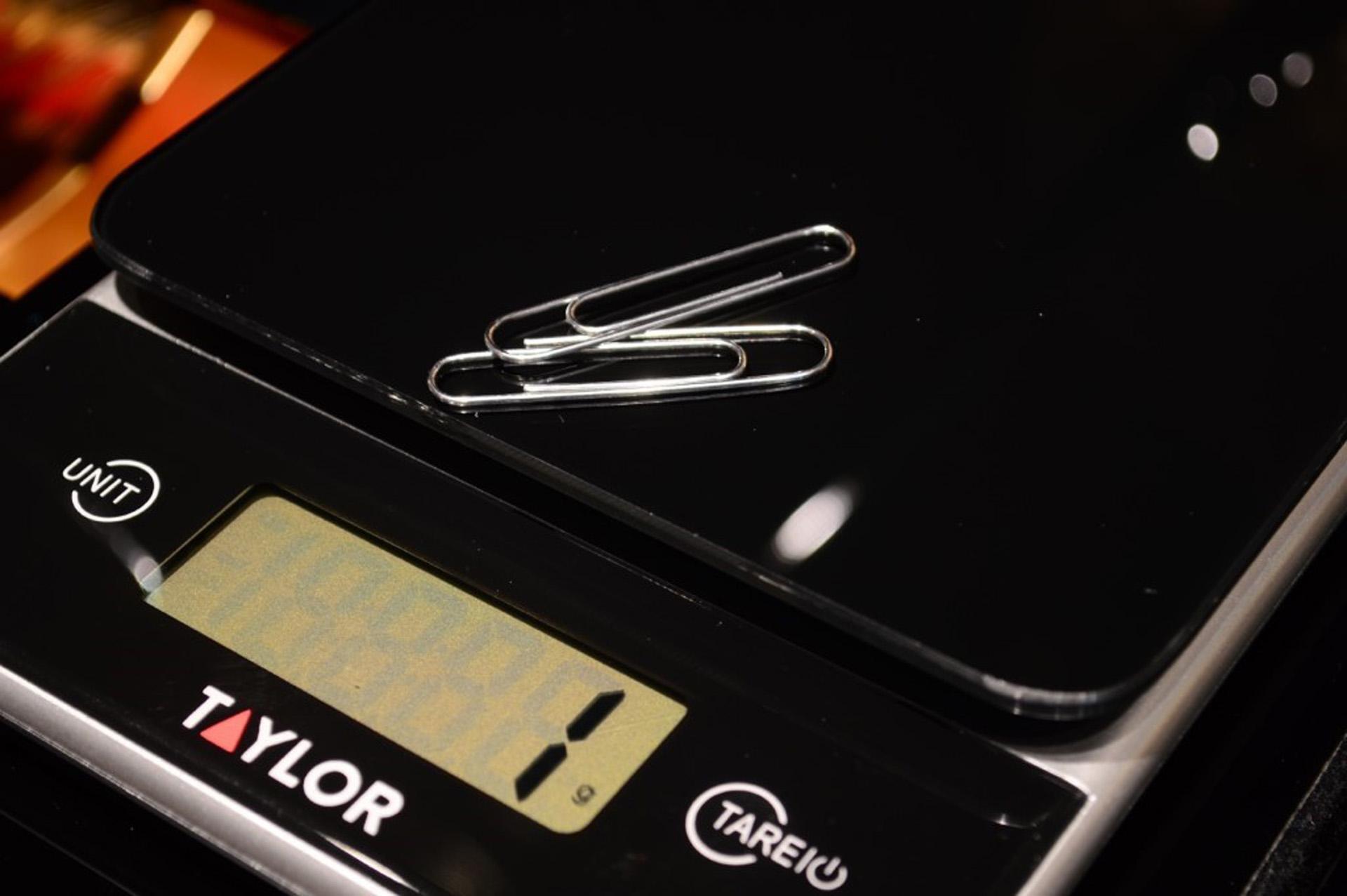
Two large paper clips equal about 1 gram.

A headphone adapter weighs about 6 grams.
How did we do it?
We used a brass gram weight set that is calibrated from 64 grams down to 1 gram. These are the weights that are used on acoustic pianos by piano technicians. We placed these gram weights on middle C while holding the key in the neutral position, as pictured in the first photo below.
We then released the key and allowed it to drop to the depressed position and listened for middle C to sound. We used headphones since these notes were at incredibly low volumes.
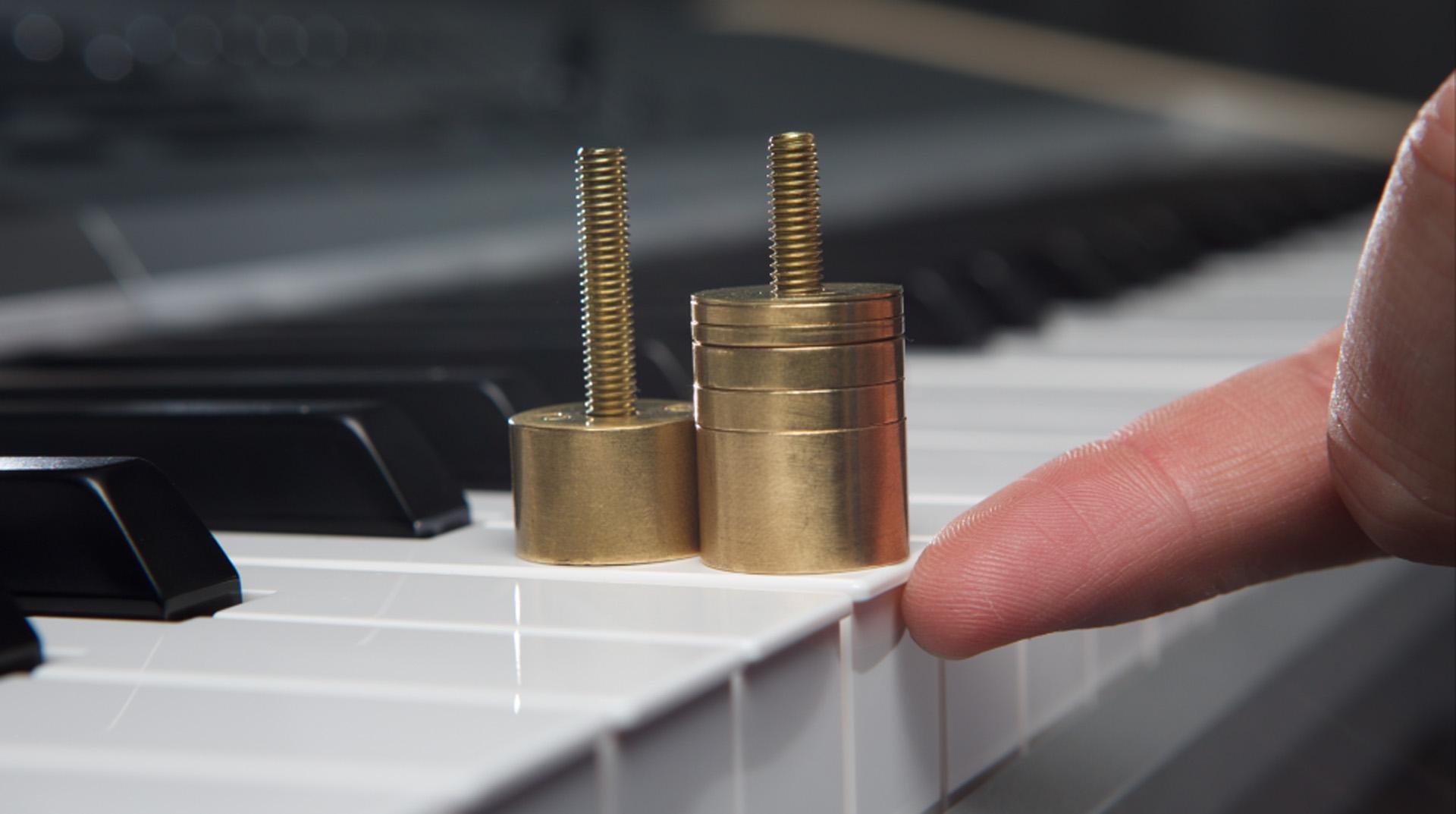
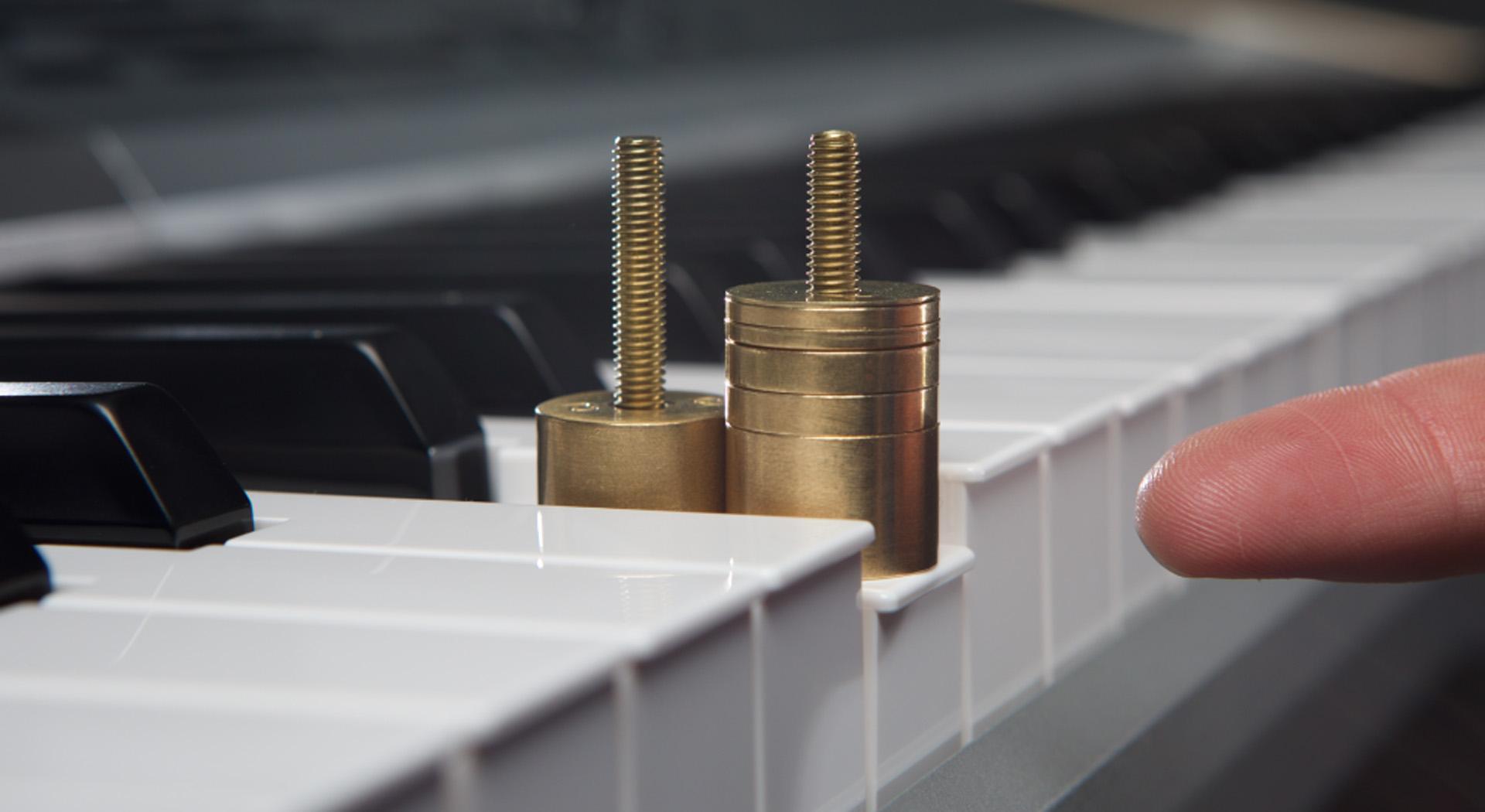
We started with a light weight (typically 64 grams) and continued to add weight (in increments of 1 gram) until we found the lowest weight that would both sound and sustain middle C. Once we had that combination of weights, we used a digital scale to measure the final weight and record it. In the photo above we ended with weights totaling 95 grams.
Our Findings
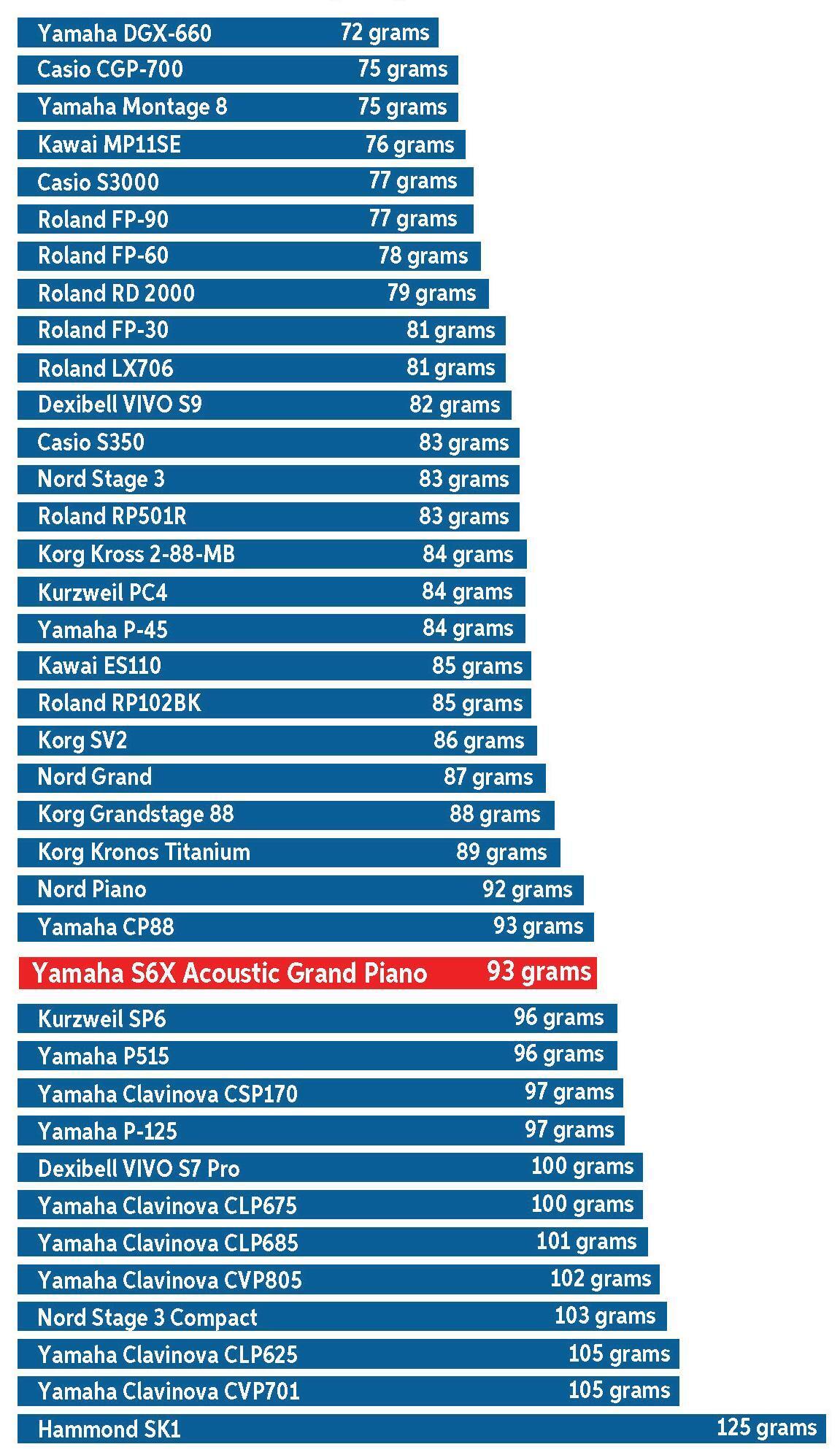
We performed the test on 37 digital keyboards and included a Yamaha S6X acoustic grand piano as a reference. The results are sorted in the table below from low (lightest action) to high (heaviest action). Please review our notes section below the results.
| Vendor | Model | Weight (grams) |
| Yamaha | DGX-660 | 72 |
| Casio | CGP-700 | 75 |
| Yamaha | Montage 8 | 75 |
| Kawai | MP11SE | 76 |
| Casio | PX-S3000 | 77 |
| Roland | FP-90 | 77 |
| Roland | FP-60 | 78 |
| Roland | RD-2000 | 79 |
| Roland | FP-30 | 81 |
| Roland | LX-706 | 81 |
| Dexibell | VIVO S9 | 82 |
| Casio | CDP-S350 | 83 |
| Nord | Stage 3 | 83 |
| Roland | RP-501R | 83 |
| Korg | Kross 2-88-MB | 84 |
| Kurzweil | PC4 | 84 |
| Yamaha | P-45 | 84 |
| Kawai | ES110 | 85 |
| Roland | RP-102 | 85 |
| Korg | SV-2 | 86 |
| Nord | Grand | 87 |
| Korg | Grandstage 88 | 88 |
| Korg | Kronos Titanium | 89 |
| Nord | Piano 4 | 92 |
| Yamaha | CP88 | 93 |
| Yamaha | S6X acoustic grand piano | 93 |
| Kurzweil | SP6 | 96 |
| Yamaha | P-515 | 96 |
| Yamaha | CSP-170 | 97 |
| Yamaha | P-125 | 97 |
| Dexibell | VIVO S7 Pro | 100 |
| Yamaha | CLP-675 | 100 |
| Yamaha | CLP-685 | 101 |
| Yamaha | CVP-805 | 102 |
| Nord | Stage 3 Compact | 103 |
| Yamaha | CLP-625 | 105 |
| Yamaha | CVP-701 | 105 |
| Hammond | SK1 | 125 |
Notes
Variables
You may recall from school that scientific experiments have variables and constants. Ours were:
- Variable — weight in grams
- Constant — sustaining the note
Multiple Keys
We determined that the difference in weight between multiple notes on the same keyboard (including graded keyboards) was marginal, so we decided to only test middle C.
Sound Settings
Every keyboard was set to a default piano sound; no other sounds were used.
Sound – Triggered vs. Sustained
Our test was to measure the weight required to both trigger the sound and sustain middle C. For most of the keyboards, a specific weight value would produce both results — striking and sustaining the sound. However, a few keyboards reacted to our test in a surprising way. Some keyboards would produce a quick, staccato strike on middle C but not sustain the note. More weight was needed before the note would strike and sustain. Therefore, some keyboards needed two different weight values, one to produce the striking and one to sustain. You may ask, as we also asked — which value more accurately represents the keyboard in the results?
We ultimately couldn’t determine a definitive, clear-cut answer, but we did decide this anomaly was worth explaining and reporting. You will find the keyboards with two values below:
| Keyboard | Trigger Weight (grams) | Sustain Weight (grams) |
| Korg Kronos Titanium | 81 | 89 |
| Kurzweil PC4 | 76 | 84 |
| Kurzweil SP6 | 77 | 96 |
| Nord Grand | 74 | 87 |
| Yamaha P-125 | 71 | 97 |
| Yamaha P-45 | 71 | 84 |
Velocity
During the course of planning out the experiment, we considered whether velocity and velocity settings on different keyboards were a determining factor for the feel. We compared various velocities on different keyboards and ultimately decided it was not a factor. “Why not?” we anticipate you asking.
A default velocity setting produces a linear relationship between input and output; if you play a note and the keyboard reads a velocity of 60, then the keyboard will produce a sound with a velocity of 60. However, let’s say you have a velocity setting that reads a velocity of 60 but outputs a higher velocity of 90. You have changed the resulting sound, but the input velocity was still recorded as 60. That initial reading is not altered. Regardless of the output settings, the initial velocity is what triggers the sound. In our test, we were only interested in when a sound was triggered and sustained, not how loud or soft the sound was. Therefore, output velocity and velocity settings are irrelevant to this test.
But you might be thinking, “Velocity settings can improve how a player feels about the touch of the keyboard. I’ve played keyboards that I didn’t like initially, changed the velocity curve, then loved it.” Well, that is true for many players, but, again, your velocity settings don’t change the base feel and resistance of the keys.
To demonstrate: play a keyboard with the power off. That is really how it “feels.” To choose the right keyboard, you really need to like that playing experience first. Especially because so many people will say, “I like a keyboard with a heavy touch” or “I like a lighter touch.” Those things are independent of any factors relating to the resulting sound or the expressive response of a keyboard.
Other Variables
Now, you might also be thinking, “If each keyboard’s response to the gram weight test is linked to its unique internal mechanics, sensors, action, the entire keybed, etc., and that affects when a sound will be triggered and sustained, then aren’t there too many variables for this test to be useful at all?”
Our answer is simple: These differences are the very thing we wanted to reveal. Yes, these keyboards are different. That’s why there was a noticeable divergence in the data.
That being said, let’s be clear — is this test perfect or the “end-all” for comparing keyboard action weight? Of course not. There are many other factors to consider when comparing keyboards. Does this test cast some keyboards as right/wrong or good/bad? Absolutely not! It just shows that they are different.
We started out by posing a question — can keyboard touch be measured and compared objectively? Then, we developed a test, performed it, and displayed the results. That’s it. You may use this article as a shopping tool to inform your next keyboard purchase or as a learning tool to expand your knowledge of digital pianos in general; but you should also be willing to take it for what it is — a fun and interesting test performed by two nerds who love thinking, exploring, tinkering, and trying new things. Our hope is that you find it as fascinating as we do.
What I Learned
I expected the results of this test to show a significant variance between all the keyboards, considering they span many different brands and keybed types, including fully or semi-weighted, hammer action, etc. Here’s what I discovered.
- While some keyboards were within 1 or 2 grams of one another or even the same value, some others were 20–30 grams apart, such as between the Kawai MP11SE and Yamaha CVP-701 (my glasses weigh about 25 grams). I found both extremes to be revealing.
- Keyboards of the same brand or type tended to be close on the chart, like the Yamaha Clavinovas and the Rolands. This makes sense since their designs are similar.
- Semi-weighted doesn’t necessarily mean “less resistance” than fully weighted. For example, the Nord Stage 3 Compact has semi-weighted organ-style keys, while the Nord Stage 3 has fully weighted piano-style keys. You would think the Compact would have the lower value, right? Actually, the Compact required more weight to depress, sound, and sustain a note than the Stage 3. This surprised me.
- Furthermore, the other semi-weighted organ-centric stage piano on the list, the Hammond SK1, had the highest weight overall. This did surprise me initially. After playing them consecutively, I perceived a similarity in the action of the Nord Stage 3 Compact and the SK1 that the other digital pianos did not possess. When I played them, I found both keyboards to have a “springy” feel to them that made it seem as if the key was literally trying to push back up. This could explain why these two semi-weighted instruments required more weight than any of the fully weighted instruments.
In Conclusion
We hope you found this test interesting and informative — because we sure did! If you want to learn more about the digital pianos in this article, feel free to contact your Sweetwater Sales Engineer at (800) 222-4700.