From the telephones and radio of the late 19th century to the cellphones and broadcast systems that we use today, the technology of communication has come a long way in the last century and a half. As our needs have advanced, so has the technology we use. Communication is essential in all parts of our lives; live event production is no different.
What Is an Intercom?
The word “intercom” is a compound word that comes from the merging of the words “internal communication,” which was coined to describe telephone communication systems within a single building. These systems were integral to successful business operation, just as modern intercom systems are essential for successful event operation.
Intercom systems, as we know them now, are communication networks that allow technicians to connect in real time. Prior to the 1960s, crews for live events and broadcasts were using telephone communication systems that required users to hold handsets, limiting their ability to move around and complete other tasks. While communication was bidirectional in these cases, it was still limited to the people on the team who were able to hold a wired handset, and only two people could speak to each other at once. Not to mention, the sound quality and volume were inadequate for loud environments. Early headsets were created to help accommodate the need for range of motion and to combat loud environments, but they were often heavy and uncomfortable.
As technology advanced and the needs of production crews changed, smaller and lighter headsets were built with more sensitive microphones that were powered by the communication line as opposed to having separate power supplies. Older systems were centered around a power source that supplied the electrical current to send and receive audio signals from various people on the team, often called a party line. Think of it like a group chat. Those intercom systems could only be shared between two people at once, not unlike early text messages. In the intercom world, these would be simplex and duplex communication systems, “simplex” referring to one-way communication at a time (like a walkie-talkie) and “duplex” referring to simultaneous send and receive communication (like a telephone). With group chats, we can now have multiple people texting each other at once. (Party line intercoms can be just as busy, too!)
Why Do I Need an Intercom System?
Clear communication between teams during a live event is critical to its success. Timing is everything. Therefore, a reliable and fast means of communicating is non-negotiable. The way you design a communication system depends on the needs of each crew or venue. Sweetwater customers frequently ask why cell phones cannot be used for this application. The short answer is that they can, but they just aren’t reliable enough to support communication to this degree and still require prep and setup for conference calls, headsets, charged batteries, and more. If you’ve ever struggled to get a cell signal inside a building or away from cell towers, then you know how frustrating it can be. That’s not something you want to struggle with in a professional application where a reliable system is paramount. Cell phones can work in a pinch but are simply not practical in the long term.
System Design & Application
What Do I Need?
Intercom systems can be as big or as small, as complex or as simple, as you need them to be. In many cases, they can be expanded in the future, which allows serious flexibility. To start, you’ll need to decide a few basic things:
- Who, among respective teams, needs to talk to each other?
- How many different teams may need to communicate? (Lights, video, audio, stage, to name a few.)
- Do they need to communicate internally, externally, or both?
- Do any of those people need to be able to walk around the venue while communicating?
- Are there any intercom systems already installed in the space, whether analog or IP-based, that can be potentially expanded?
Once you answer these questions, choosing a suitable intercom system is easy.
Basic Components of an Intercom System
Here are the basic components that will be required:
- Base stations
- Beltpacks
- Headsets
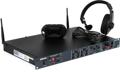
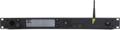
Base stations are the central point of most of these systems, whether wired or wireless. In a wired system, the base station provides power and routes audio to remote sources, including beltpacks, rackmounted stations, wall stations, or tabletop stations. In a wireless system, the base station communicates with remote beltpacks using radio frequency (RF) transmission, Bluetooth, DECT, cellular, or Wi-Fi. Often, these base stations are also able to incorporate wired components into their systems for a well-balanced and easily expandable design.
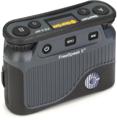
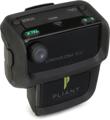
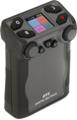
Beltpacks are the most frequently used endpoints in these systems. They have features including talk buttons, volume knobs, and headset connections. These are the parts of the system that users need to communicate with one another and will be kept on their person, generally clipped to their belt, allowing them to operate hands-free.
Other endpoints are rackmounted stations, wall stations, and tabletop stations. These all have the same features as a beltpack but solve different needs. Each also offers a built-in speaker and microphone in addition to a headset connection. In some cases, such as for dressing rooms, performers need to be paged by a stage manager, but they cannot wear a headset due to makeup, wigs, or other costume limitations.
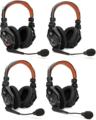
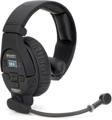
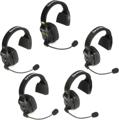
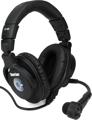
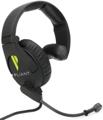
Headsets are commonly used in conjunction with beltpacks. They have a built-in microphone that is powered by the beltpack or a separate battery pack, depending on the wireless system. Some headsets are self-contained and do not need a beltpack. This means that they have receivers and transmitters incorporated into them and can communicate with other wireless headsets or beltpacks on the same system.
How Are Intercom Systems Used?
As previously stated, production environments require impeccable timing, which in turn requires seamless communication. Modern components give us the tools to be flexible when building and using intercom systems.
Let’s consider one of the most common setups in live events. There are three main teams in most middle-of-the-road productions: audio, lighting, and video.
The audio team will generally have at least two technicians: an A1, the lead tech (mixer) based at the front-of-house (FOH) position or in monitor land, and an A2, the assistant audio technician that is in charge of running microphones to and from the stage, RF coordination, and the like. Sometimes there is a separate monitor mixer who camps out at the side of the stage and is responsible for making sure the talent onstage can hear themselves in the monitor speakers.
The A1 is usually tethered to the console as the mix engineer. This means they can potentially work with a wired beltpack and a headset. The A2, on the other hand, will often need to move to and from the stage. This means they will need to be wireless or else they will be “off comms,” which means they are unreachable, which is not ideal. These two technicians need to communicate back and forth when troubleshooting. Let’s say there is an issue with a signal coming to the console, and the A1 isn’t getting any signal. The A2 will make their way to the stage to figure out whether the issue may be with a cable, a microphone, or some other piece of equipment in the line. The A1 will need to be able to let them know when the problem is fixed — and vice versa!
Let’s be honest: in most small-to-mid-scale productions, the lighting team is usually only one person. Sometimes they get help from stagehands, who are either on wireless “comms” or are using a wall-mounted station backstage. But spotlight operators will need “cues” relayed from the lighting director.
The video team will commonly have at least two types of technicians: a camera operator responsible for running the camera and getting the shot just right, and a video switcher, sometimes also referred to as a show caller or a V1. This person manages the video feed for the screen and/or stream. The camera operator often requires mobility and will therefore need a wireless setup, whether an all-in-one headset or a wireless beltpack with a cabled headset.
Link up at Sweetwater!
The key is to build and deploy a system that will facilitate the needs of your various teams, better yet if it is a system that can be scaled up with more stations in the future. There are lots of options, and understanding your requirements will ensure you get a system that covers your needs, both now and in the future. To make sure you get the best system, contact your Sweetwater Sales Engineer today at (800) 222-4700 to discuss your options, system components, your team’s current and growth needs, and how we can help outfit you with the perfect intercom system.