

I was playing with a child’s wooden train set the other day, and it got me thinking. The craftsman had put magnets on the front and back of each car (except the engine and the caboose!) to allow the railcars to be strung together and pulled along the track. If I reversed one of the cars, the connecting system didn’t work, as the magnet was repelling the cars instead of attracting them. I was struck by how this idea illustrates how a speaker works by converting magnetic energy into motion or attraction. When I commented on this to my colleague, they looked at me like I had two heads… so, I decided to inflict my analogy on you instead! More on that later.
Let’s Start with Some Physics
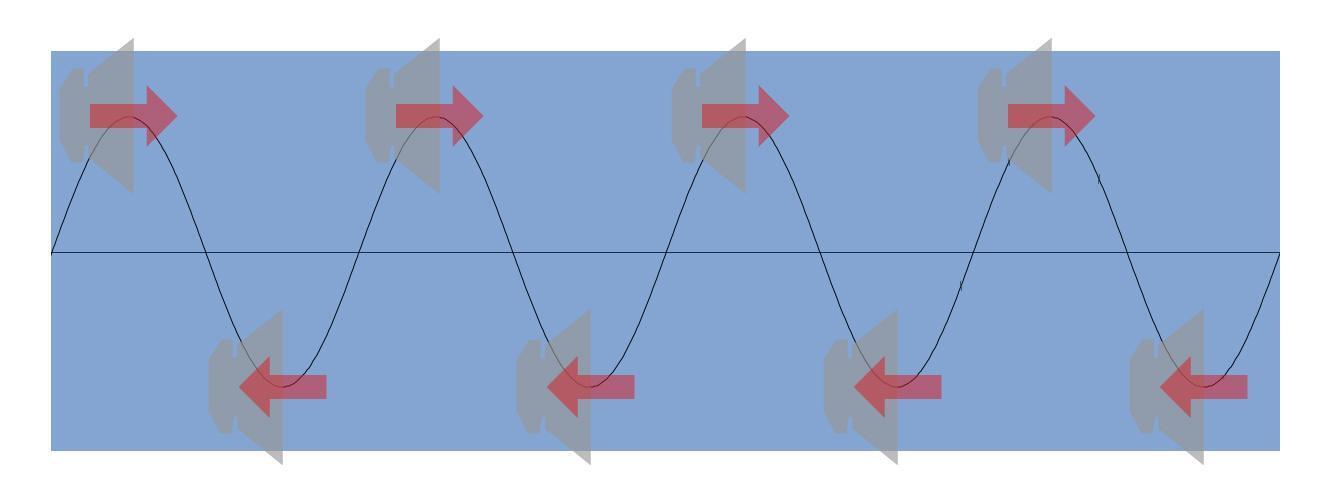
At the most basic level, a speaker is a transducer. A transducer is any device that converts one form of energy to another. In this case, it is transducing electrical energy into acoustic energy. The electrical pulses (that come from a power amp) determine the direction that a speaker will move. A positive pulse will cause the speaker to move forward, and a negative pulse will cause the speaker to move backward. The resulting acoustic energy moves the air by causing air molecules to bunch into groups (compression) and to separate into zones of fewer air molecules (rarefaction). The graphic below shows how a vibrating medium like a violin string or a speaker causes the air to move.

Your eardrum vibrates according to these pressure changes, and your brain translates this motion into sound in much the same way as a microphone changes air pressure into electrical impulses. A speaker functions like an engine that moves the molecules to create these air-pressure changes.
Parts of a Speaker
While there is a host of different types of drivers in speakers, like ribbons and electrostatic elements, the preponderance of speakers comprises traditional, piston-driven devices.
Here are the components found in a piston-driven loudspeaker.
- Cone
- Dust Cap
- Surround
- Basket
- Magnet
- Voice Coil
- Spider
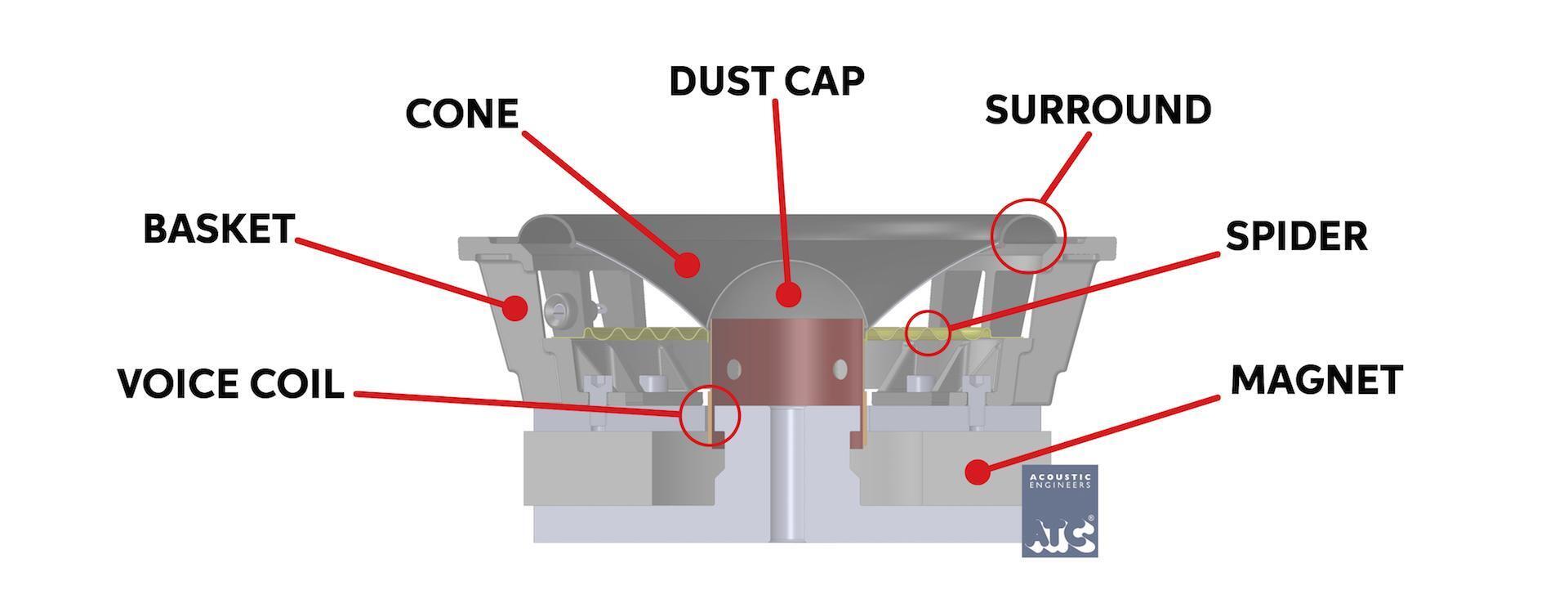
All of these piston-driven speakers have a couple of common components that allow them to create the air-pressure changes that our brains convert into sound. The visible part at the front of a speaker is the cone. It can be made of simple material like paper or something more complex like Kevlar, but its job is really to be a diaphragm that moves air. It shifts forward and backward to create pressure waves.
The dust cap is the piece in the center of the cone that covers the voice coil. As its name suggests, it keeps foreign objects from getting into the portion of the speaker where the voice coil resides. While its shape and construction can impact the way a speaker generates sound (particularly in high-frequency response), it is primarily there to protect the speaker’s innards. Because a bigger speaker requires a voice coil with a larger diameter, this dust cap is larger in bigger speakers.
The piece around the perimeter of the cone is the surround, and it is usually made of rubber or foam. It attaches the cone to the frame and is supple enough to allow the cone to move freely, but it also adds stability and helps return the cone to its resting position in the metal basket. The basket is the frame that all of the speaker components are attached to for rigidity and to allow it to be mounted in a box or on a baffle. The big heavy circular part at the rear of the speaker is the magnet.
The voice coil is guided in its path by the oddly named spider. This portion of the speaker is made of something soft (cotton or something similar) that doesn’t hinder the forward and backward motion of the voice coil. It does prevent the voice coil from moving to the sides, which makes the cone move more predictably, so it induces less distortion. My guess is that someone thought this looked like a web and chose the name.
The cone will naturally come to rest, but it can move in and out from this resting position. This range is called its excursion, and the more movement it is allowed, the more air it can displace. Low-frequency-focused speakers like subwoofers need a bigger range of excursion to be able to push more air to generate lower frequencies.
So How Does A Speaker Actually Work?
Those are all the visible pieces in a speaker. What is happening inside the system that causes the cone to move? While most people are aware that there is a magnet in a speaker, the function of a traditional speaker actually requires two magnets to work: the fixed magnet and an electromagnet, which is created by the voice coil.
The voice coil is a tube made of some conductive, heat-resistant material that is wrapped in wire. The cone’s movement is created by the interaction of the voice coil (that becomes an electromagnet when a current is applied) and the fixed magnet that surrounds the voice coil. This voice coil is the key component in the movement of a speaker.
The voice-coil system works because, by changing the direction of the electrical current in the electromagnet, we can change whether it is attracted to the fixed magnet or repelled away from it. This allows us to very quickly move the speaker back and forth to create those air-pressure waves.
A positive charge to the electromagnet causes it to move away from the magnet and toward the listener, while a negative charge causes it to be attracted to the fixed magnet, which moves the cone away from the listener.
This may help you understand why a speaker being wired out of polarity is such a big issue. You likely wouldn’t really hear the impact with one driver, but when different drivers are moving in opposite directions, they are fighting against each other to create those air compressions and rarefactions. This can cause frequencies to destructively interact with each other and make audio hash!
In my toy-train analogy, we could reverse the polarity of the charge by physically turning the train car around. Unfortunately, there is no quick and elegant way to do that. The electromagnetic approach allows the voice coil to switch polarity and power instantaneously, so we can generate motion in the voice coil in ways that range from subtle to extreme. Since the voice coil is attached to the cone, it translates these electrical changes into motion in the cone, which causes air movement.
How Do I See This in the Digital Domain?
Have you ever looked at a waveform in your DAW and wondered what it was plotting? In essence, it is showing you in what position of excursion a speaker cone would be at that point in time if it were playing the audio shown by the waveform. Above the center line is positive excursion, and below the line, the speaker is in negative excursion. The farther from the center line, the more the speaker would have to move to generate that amplitude. The center line is where the speaker would be at rest.
Why More Than One Driver in a Speaker Enclosure?
Any individual driver can do a reasonable job of expressing about three octaves of frequency range. The human ear can perceive between eight to 10 octaves. This why it takes more than one driver in a speaker to generate what we would consider full-bandwidth sound. Two driver systems (like most nearfield monitors) are at their best across the six octaves where our hearing is the most critical, roughly 100Hz to 6.5kHz.
Frequency is directly connected to pitch. Therefore, moving a speaker back and forth 440 times in one second creates the pitch we refer to as “Concert A,” which is 440 Hertz (abbreviated Hz; stands for “cycles per second”). Increasing the frequency increases the pitch, so 880 cycles would sound the same note (A) but an octave higher than concert A. One Hertz is simply one cycle (or repetition) occurring per second. A kilohertz (kilo = 1,000; like a kilometer is 1,000 meters) is 1,000 cycles happening in a second.
To create a very high pitch, a speaker must move back and forth many thousands of times a second. At the very top of our range of hearing, this means moving a driver back and forth 20,000 times in a single second! This task is best accomplished by a small, light driver that is low in mass. Picture trying to do that with a heavy 15-inch driver, and you can see how impractical that would be.
To create low frequencies, we need to move a lot of air, so having more surface area is really helpful. Since they don’t have to move as quickly, larger speakers are a better design choice. The low-E string on a bass guitar is vibrating about 40 times per second to generate that pitch. That is a lot less repetition of motion, but a very small driver couldn’t move enough air for that pitch to be loud enough for us to hear! Simply put, the lower a frequency, the more suited it is to be reproduced by a larger speaker.
Of course, having multiple speakers means having a circuit before those drivers that determines what frequency range is routed to each driver. This is the job of a crossover… but that is a different article!
So much of a speaker’s capabilities are hidden inside of the box that it can be challenging to determine why one costs $200 and another costs $2,000. If you are trying to make that determination so you can upgrade your studio monitors or live PA, give your Sweetwater Sales Engineer a call at (800) 222-4700, and we can talk you through your options.