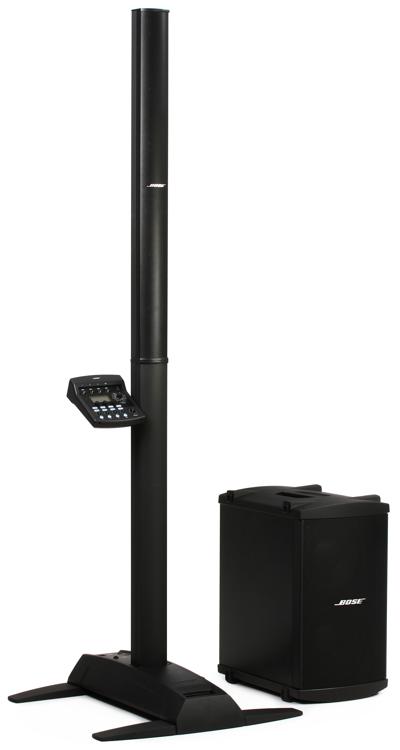
Bose has made serious inroads into the world of live sound reinforcement with their amazing L1 speakers, which feature a line-array arrangement of multiple small drivers. Using a line array allows Bose to carefully craft the dispersion characteristics of the audio coming from the “stick,” allowing up to 180-degree horizontal coverage. The L1 speakers are powered, so setting them up is a breeze. To expand the system, you can add a B1 or B2 subwoofer for extended low frequencies, and you can also add a ToneMatch 4-channel mixer to the rig to allow for complete control over your sound, with 100+ presets and onboard effects.
There are several models of L1, including both the L1 Model II, with 24 drivers and long-throw capability, and the L1 Compact, which is ideal for coffeehouses and small gigs because it has a built-in 2-channel mixer with one input for a microphone and another for a guitar or other instrument. The model we’re looking at here, the L1 Model 1S, has 12 drivers in its linear array and can cover audiences up to 300. The L1 Model 1S has a digital connection for a ToneMatch mixer system, and it also comes ready to connect to the B2 subwoofer – the system I examined had a B2 as well as carrying bags. The system is very easy to set up and connect. It provides very wide coverage that’s suitable for a decent-sized venue. If you need more coverage or want stereo, just add another L1 Model 1S and B2 subwoofer. Some bands also enjoy setting up an L1 system for each player/singer. In this case, the Bose system takes on the dual role of handling monitors and mains at the same time.
The Bose L1 Model 1S with B2 subwoofer fills a real need: it provides excellent full-range sound with incredible dispersion. And it does all this in a lightweight, compact form factor that is easy to load in and operate. Plus, with its thin line-array design, the L1 Model 1S is visually unobtrusive, so the audience will be looking at you instead of at your PA.