

Electric guitars and basses have many physical and functional similarities, such as pickups, frets, strings, wood, etc., and are tuned an octave apart but this is pretty much where the similarities end. If you’re a guitarist who wants to add bass guitar to your arsenal, remember that you’re learning a different instrument. The biggest differences between guitar and bass are in the way each functions in a track and how you conceptually approach each one.
Guitarists vs. Bassists
Guitarists think riffs and chords. Bassists think foundation and groove. The bass is the glue between the drums and the rest of the band: it’s similar to the drums rhythmically, but to guitars and keyboards harmonically, creating a bond between the two. Great bass parts can be simple or active, fundamental or intricate, a single note or a moving melodic figure. Ultimately the song should guide the bass direction.
To gain a better understanding of the function of the bass guitar in a track, listen to the songs that move you the most or are in the specific style you want to learn, and key in on the bass part. You probably learned guitar by imitating your heroes — the same applies for bass. Listen to the interplay between the bass and drums, especially the kick drum. Listen to how the bass part moves rhythmically and harmonically, how it works with the guitars and keyboards, and with the vocal or lead instrument. Figure out why it does what it does. Keeping it as simple as possible is a great starting point when creating a bass part.
It would be impossible to name all of the bassists that would be relevant to this article. Here are three bassists who, in my humble opinion, created bass parts that walk the balance between simple, melodic, fundamental, and busy, while always playing to the song and the GROOVE! It also helps that the songs stand the test of time and are fairly accessible and universal.
- Paul McCartney – Beatles and beyond
- John Paul Jones – Led Zeppelin
- James Jamerson – All of the early Motown records
What’s the Difference?
As a guitarist, when you’re ready to put your hands on a bass guitar, the first difference you’ll notice is in scale — the greater distance between frets, but also string size and spacing, how far you have to extend your arm to reach the first fret, and how the bass sits on you. I personally prefer a bass with a smaller neck shape, closer string spacing, and lower action so the transition to and from guitar isn’t as drastic. Fortunately, all it takes is a little time and practice to adjust.
Techniques
For picking-hand technique, it might be easier to start out using a pick. If I’m using a pick on bass, I find that palm-muting comes in to play, mostly to keep the notes from ringing into each other. I also prefer a pretty stiff pick, at least a 1.0mm, and I like the point of the pick pretty straight on the string unless I’m going for a “scrape-y attack” sound. If you are comfortable using your fingers, go for it. That’s my preference sonically, and it’s worth working up the technique. I use the pads of my first two fingers to attack the strings and as a mute, to create the note length I want, and to keep strings from ringing inadvertently. I rest my thumb on the body of the bass or on the pickup, depending on where my hand is in relation to the bridge. All of this is personal preference through trial and error — you’ll find the technique that works best for you.
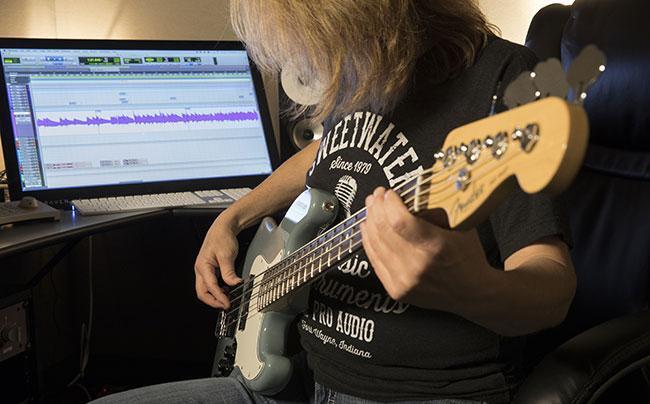
Whether you’re using a pick or your fingers, try moving your picking hand along the length of the string between the bridge and neck, as this makes a drastic difference in the tone. Experiment by playing steady quarter-notes on an open string and moving your picking hand slowly up the length of the string between the bridge and neck; it’s like adjusting an EQ or a tone knob!
All About That Tone
When it comes to getting an appropriate bass tone, just like with guitar, you need the instrument that will make the sound you want. A hollowbody with flatwound strings won’t get a biting, edgy rock tone very easily. Of course, it needs to be in good working order, intonated properly, etc. so you have a good starting platform.
When you’re ready to dial in a sound, here’s a workflow to consider:
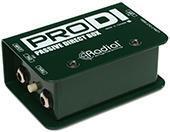
Are you looking for a clean tone or dirty? If it’s clean, is it totally pristine or does it have an amp-like edge? If it’s pristine, a high-quality direct box into a mixer or interface is the best place to start. In this case, I’d also add a compressor between the bass and the direct box. A good stompbox bass compressor will do the trick — the goal is to set it so that it keeps attack and sustain levels even. Many classic bass tracks are played and recorded with this simple signal chain.
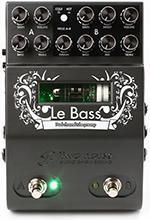
If the tone you seek is more effected and amp-like, there are many options. Most modelers and modeling plug-ins will have bass amp models. You could also mic an amp or use a stompbox amp simulator. If the options get too overwhelming, focus on copying an exact tone from a favorite recording or an isolated bass track. Listen to how the sound of the bass fits in the track as a whole, especially with the other low-end instruments. Does it have a lot of attack? If so, what register is the attack? Is it “clicky” and in the high end, or more of a honky, upper-mid? Is the low end wide and expansive or tight and focused? When you finally get the sound just right, notice what it sounds like compared to what you thought you were aiming for.
Other Considerations
Here are a few other things to consider when you’re choosing a bass sound.
Since the kick drum and bass are in the same sonic register and playing together, their sounds need to complement each other. Think of them as a unit.
With drop-tuned guitars, especially “B” and below, there’s a lot of sonic information below 100Hz, so it can get a little crowded down there. If you have a guitar sound that you’re in love with, figure out the sonic niches in the bass sound that will complement it the most and still gel with the kick drum. The goal is for each instrument to occupy its own sonic territory.
Crafting the Part
When it comes to creating a bass part, there are no rules, of course. However, there are standard starting points that will at least give you some ideas. I came up with five tools for constructing a bass part.
- Unison lines — playing unison with the guitar can be a powerful arrangement tool, but not necessarily something you want to rely on constantly. Think of it as a way to emphasize a riff or part.
- Walking lines — moving through the chord tones using passing scale and chromatic tones. Try to land chordal tones on strong beats for the most solid lines.
- 1–5 — pedaling between the root and the fifth of a chord. Create motion without creating or implying harmony, which is typical in classic country and roots styles.
- Pedal tones — holding a constant note while the chords change.
- Alternate chord tones — playing the third or fifth of a chord instead of the root note, for example. This can be used to either connect chords smoothly or create tension.
Don’t Be That Guy
I hope this gives you some food for thought and helps you get started playing bass. I have barely crested the peak of a gargantuan mountain, but you have to start somewhere! Guitarists are notorious for playing non-bass bass parts, so if you want to overcome the “guitarist picking up a bass” syndrome, you’ve taken a giant step forward. Remember to groove and keep making music.
If you need help or suggestions for any of your bass playing needs, give us a call at (800) 222-4700.