

If you play guitar, then I bet you recognize this story. A young boy finds music through his older brother’s record collection, falls in love with the guitar, and fondly remembers the influential moment when he first heard Jimi Hendrix play.
“When I heard that sound, I was like, I dunno what that is, but that’s what I’m going to do.”
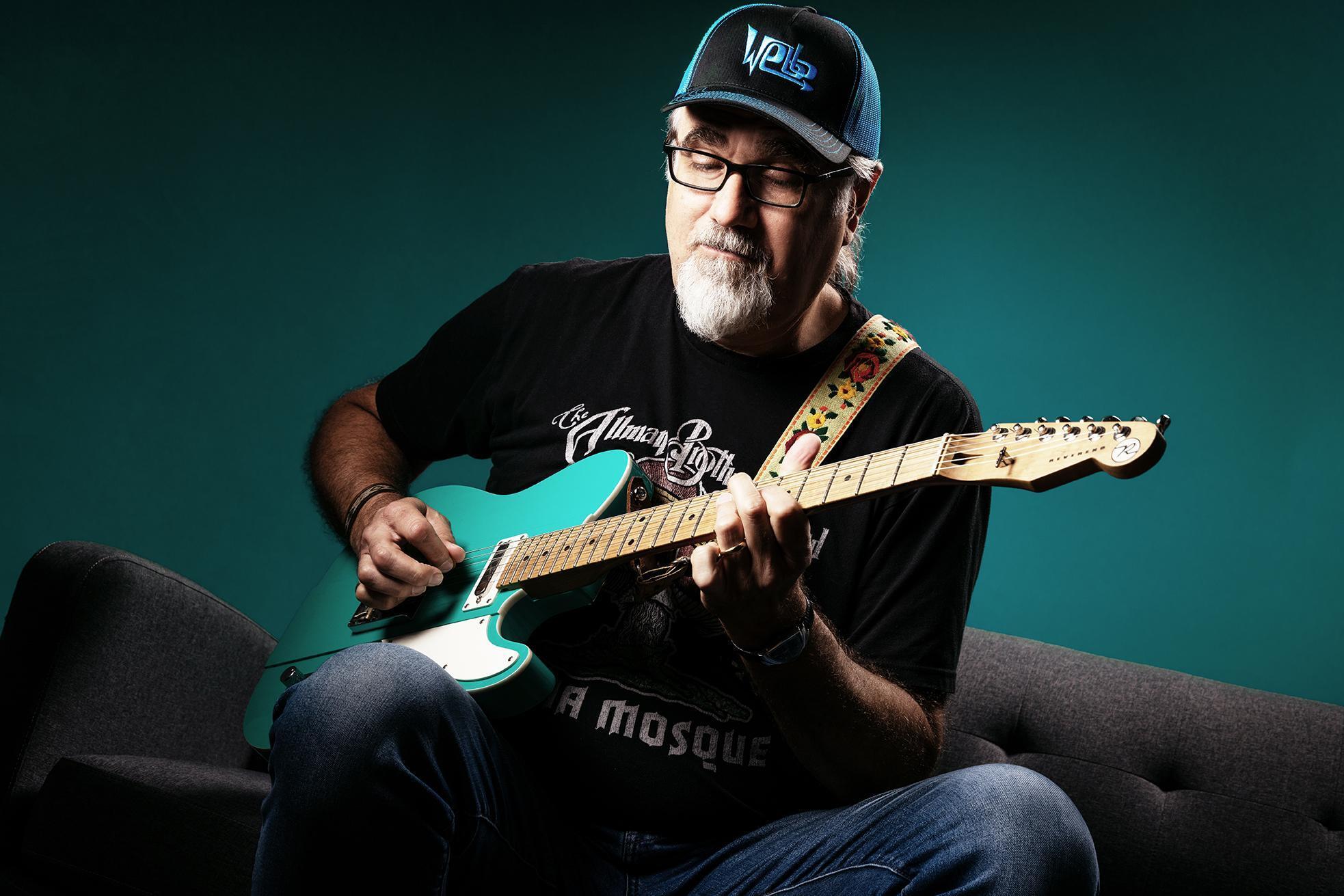
This is Greg Koch’s story. Greg’s a great guitarist, a teacher and clinician, an author, and a recording artist. Like so many musicians, he was inspired at an early age and knew that the guitar was his future. I chatted with Greg to discover how he’s achieved his enviable career and reputation. I asked him to share certain “aha” moments and magic bullets (gear that revolutionized his playing) he’s found along the way. I suspect you’ll find his story resonates with most guitarists and will inspire people taking up the guitar for the first time.
How Did You Get Started?
Fuston: What’s your first memory of wanting to play guitar?
Koch: Well, I always had a thing for guitar because I roomed with my older brother and heard his records. He was 14 years older, so it was a lot of Cream, a lot of Hendrix.
How old were you?
I did a report on Jimi Hendrix when I was in third grade. I was born in ’66, so I was not cognizant of Jimi while he was alive. As a matter of fact, when I first started getting into Hendrix, my sister said, “You know, he’s dead.” And I was like, “Well, that can’t be.” At that age, you just can’t fathom that. “No, I — what are you talking about?” I thought she was kidding me.
I was so into guitar as a kid that I made cardboard guitars. I had this really cool Hendrix book that I borrowed from a neighbor. That last year of Hendrix’s life, he always played that white Stratocaster, and he played the white and black Strat. So, I made a white cardboard Strat and a white and black Strat, and then I made whatever weird guitar Mark Farner used to play with Grand Funk Railroad because I loved their Live Albumfrom 1970 — still one of my all-time favorites.
So, I would have those guitars, held on with a little string, and I would pretend I was playing. And I would grab my sister’s sewing-machine pedal, which looked like a wah-wah pedal. Then I would pretend I was wah-ing to beat with the band and playing those cardboard guitars.
That’s wild.
I started getting into whatever my brother’s records were. He had Axis: Bold as Love. He had Band of Gypsys, and he had that first posthumous release, The Cry of Love, which I love. That was kind of my entrée into Hendrix, which was weird because most people would’ve heard the other stuff first. But I was into that. My brother would always tell me, you got to hear Electric Ladyland; that’s the greatest Hendrix record of all time. I was like seven or eight years old.
Then, one morning I’ll never forget. My brother put on “Still Raining, Still Dreaming,” and I woke up with that wah going on. I knew right then and there that that’s what I was going to do. I mean, when I heard that sound, I was like, I dunno what that is, but that’s what I’m going to do. And I remember just going to the bathroom and looking in the mirror, just going, “What did I just experience?” It was like a total lightning bolt.
Was that when you picked up an actual guitar, one not made of cardboard?
No, that was at my brother’s fiancée’s house. We were going to play basketball, and they had guitars. I saw those guitars, and I just sat there and plugged that thing in and strummed. And I remember I was trying to figure out that Pink Floyd song “Breathe” because I could kinda play it. So, right away, I was trying to figure out how to play it, and I could have played it all day long. It was like time was irrelevant.
What kind of guitar?
Silvertone. Right out of the Sears catalog. A no-name guitar right into a whatever, no-name little amp.
You were mesmerized.
Absolutely. Then the guy across the street, my buddy John Petroff, he had a Martin D-18 and a little Framus electric. He taught me some of my first chords, and I would go over there and play.
There was also a gal up the street who had this El Degas nylon-string guitar, and that’s the first guitar that I played all the time. And I learned that if I played the A chord and then lifted it up with open strings, I could kind of do a version of Clapton’s “Cocaine.” So, I just kind of started from there.
So, as a kid, you were just wandering the neighborhood, going to neighbors’ houses, playing their guitars? (Laughs.)
Pretty much. I mean, I always wanted to play, but it wasn’t until I was about 12 when I decided, I’m gonna play guitar. I had been playing cello because cello was offered in third grade, and I remember trying to figure out a Jimi Hendrix song on the cello, and it just was not happening. So, I quickly lost interest.
When I decided I wanted to play guitar, my dad was like, “Yeah, we’ve been down this road before. You get all excited, we rent the instruments, we get the books. You don’t practice.” So, he was not really into this whole guitar thing, but he made me a deal.
He had a client who was a guitar player, and my dad got me lessons with him. “But the moment he tells me that you’re unprepared for a lesson, this all ends.”
I was so into it I would memorize my lessons from the Mel Bay book. Now I’ve actually written the Hal Leonard guitar books.
I just took to it immediately. And after about five months, that teacher came back to my dad and said, “I can’t teach this kid any more.”
You surpassed your teacher?
Yeah. My mom was a good piano player, and she’d sit around the house playing. So, I think I got my musical abilities from my mom. My dad always liked music, but no one else in my family played.
Your First Real Guitar
What was your first guitar?
Well, after that El Degas guitar that I borrowed, I had a paper route, so I saved my dough. And back then, you always had to start on the acoustic even if you wanted to play electric. So, I got an Ovation student-brand acoustic called an Applause. It sounded great. I still have that guitar.
Then I very much wanted to electrify it. At first, I’d take the little cassette player that my sister had with a little microphone that you plugged into it, and I put that mic in the soundhole. If you turned up the gain on that thing, it would distort to beat the band.
Then I got this FRAP acoustic pickup that you would attach to the top of the guitar with beeswax. They gave you a little thing of beeswax so it would stick on the top. It was this little rectangular thing. You popped it on there, and then it had this little preamp, and I’d take a quarter-inch cord and plug that into our Tandberg cassette deck input. So, that was how I’d hear it through the stereo speakers.
Whatever you gotta do.
Finally, my first electric was a Lotus Les Paul and a Peavey Rage amplifier, a little practice amp.
Lotus Les Paul? I’ve never heard of that. Is that a real Les Paul?
Lotus Les Pauls were the Japanese Les Paul copies that you found all over the place back then. But the guitar wouldn’t stay in tune for love nor gold. Pretty soon after that, I was borrowing an SG from a buddy’s older brother, but I got a Fender Lead 1, which was late ’70s. Steve Morse was actually the poster child for these guitars. There was also a Fender Lead 2 that had two single-coil pickups, but the Fender Lead 1 had a single humbucker in the bridge that you could tap. There were a couple different toggle switches, and you could get some different sounds. And so, that was my guitar until my freshman year.
I really wanted the neck pickup of a Fender guitar — that’s what I wanted more than anything else. I just loved that Hendrix sound, that pristine sound. My guitar teacher at the time was selling a ’68 Telecaster. And even though I really wanted a Strat, the Tele was the guitar that was available to me, so that’s what I got. Ultimately, that would be the guitar I would connect with the longest, even though I’ve played Strats and continue to play Strats. But the Tele kind of became my thing, though not because all my favorite players were Tele players. It was just the guitar that was available to me and that I ergonomically connected to the most.
Strats & Teles
So, I’m a teenager, I’m just practicing nonstop, and I really connect with this Telecaster because, to me, the neck pickup was the best. The middle pickup was kind of like your rhythm sound that was a little snottier. And when you went for the jugular, you went to the bridge pickup. It’s like channel switching in the guitar. Everything was there. I had the whole dynamic range right there in my grubby, little mitts.
Another sister’s friend from high school, her boyfriend had a ’65 Strat. He wasn’t playing it, so he let me use it. And I didn’t know anything. This was before I had buddies that played guitar and knew how to set up a guitar, so the guitar wasn’t set up. But by the same token, the neck pickup, I preferred the neck pickup on the Strat because it was squishier. It was a softer sound. So, when I finally got my hands on a Strat, I was like, “Meh.” It wasn’t until later, when I forced myself to play a Strat to kind of learn its ins and outs and so on and so forth, that I finally acquiesced to its power. But, at first, I always preferred the Telecaster.
I’ve played Strats and Teles forever. Strat was pretty much my main performance guitar for a good 10 years. But I always had a Tele. Then, in 2005 or 2006, I just decided to make the Tele my main performance guitar because I got sick and tired of tuning issues with the Strats. And I just kind of went back to that original connection with the Tele ergonomically. It’s simple. It stays in tune. And I came up with the line, “In a post-apocalyptic world, there will be Telecasters and cockroaches, and the Telecasters will be in tune. I mean, they’re indestructible.”
Well, you’re known as a Tele guy, right?
The Tele became my main guitar. And then I did those Tele pickups with Fishman, the Fishman Fluence Gristle-Tone pickups, which I really like because they’re dead quiet and they have a button. You change the voice, they get a little bit fatter. They sound killer. I mean, they turn your Tele into Tele-zilla. I had those in a Custom Shop Tele, and I was buddies with the Reverend guys. We started talking about it at their parties at Summer NAMM in Nashville, and then in California.
I asked them, how can I play one of your parties? He’s like, “Well, you got to play a Reverend guitar.” I said, well, what if we put some of my pickups in one of those Pete Anderson Eastsider Tele things? He’s like, absolutely. So, we did that, and I was playing that guitar, and I thought, you know what? There’s a difference between this guitar and my Custom Shop guitar, but there’s not a $3,000 difference. And he was like, listen, if you ever think about doing a signature guitar, we’d love to talk to you about it.
Did you have a couple ideas?
I had some ideas, and one thing led to another. So, we came out with the Gristlemaster, which was my first Reverend signature guitar with my pickups in it. Then I had an idea to do some P-90 pickups with Fishman. So, then we did new Fishman P-90 pickups, and we did a set neck, more Gibson scale, with a Bigsby version of my Gristlemaster, the Reverend Gristle 90. That came out a couple years back, and then I got a hankering for having a really usable Strat again. So, now there’s a Gristlemaster Strat, the Gristle ST.
There are going to be new pickups that I did with Fishman, and then there’s going to be a new Reverend coming out. They’re all slightly larger because I’m a larger man. I remember when I was doing stuff with Fender, I recommended — I was like, why don’t you do a Mancaster, something a little bit larger?
So, these may not be guitars for third graders is what you’re telling me?
Well, you know what? They’re not so big as to be off-putting to the more diminutive individual, and they do fit in standard guitar cases. It’s not like they’re that big. It’s just like 2% or 3% larger. So, it seems visually more proportionate to the larger individual without being off-putting to the Lilliputian. [It should be noted that Greg stands six feet seven inches tall.]
What Will Be Your Magic Bullet?
Greg found his inspiration and connection to the Telecaster and now has a signature line of Reverend Greg Koch signature guitars and a whole line of signature Fishman Fluence pickups. Where will you find your inspiration and the guitar you’ll connect with? Reach out to your Sweetwater Sales Engineer at (800) 222-4700and let them help you find the right guitar for your music and playing style.
Sign up now to attend the Greg Koch Recording Workshop at Sweetwater Studios on May 30–31, 2025, hosted by Shawn Dealey.
Greg Koch Sites:
https://www.gregkoch.com/shop.html