My favorite way to compose is to score for film. There’s nothing quite like having a visual prompt to inspire you, and writing music becomes almost like transcribing a musical narration. You may think you need access to an orchestra and a conductor to achieve a viable score, but there is a low entry barrier to getting started. Let’s review the list of what you need to get started and get your work out there.
Computer
First, you’re going to need a computer. The faster the processor, the better. This way, you can avoid your machine lagging or freezing when it is trying to simultaneously play back many software instruments with digital processing. EastWest ComposerCloud Plus recommends a quad-core processor running at 2.7GHz or higher with a minimum of 16GB of RAM. Having a large amount of drive storage is also crucial. You will download VSTs for your orchestra, and those libraries take up a lot of space. Just the EastWest Hollywood Solo Cello Gold requires 7.6GB of space, and that is only one instrument. The EastWest Hollywood Orchestral Woodwinds GoldX is 35.9GB. Those are just a couple sections of an orchestra from one company’s software. If you want to collect a diverse software-instrument library, then I recommend a large external hard drive or a RAID.
Software Instruments
When it comes to software instruments, paying for a subscription makes sense. You will get a ton of diverse content for your money with a subscription to the EastWest ComposerCloud Plus. If you don’t want to clog up your hard drive, then you only have to download the instruments you need. If you want to download more, then you still have access to all that EastWest offers with your subscription.
DAW Software
To record, you will need a DAW. If you already have a DAW, then you need to verify that you have access to a video feature where you can see the motion-picture frames in time with your composition. The imported video should create a video track so you can align your audio to the exact frame you want (precision is vital when placing those jump scares at the perfect moment). Cubase is a popular DAW for film scoring, and one of the reasons for that is their “AudioWarp” tool. With this tool, you can stretch or shrink an audio clip without varying the pitch to get it to perfectly fill a particular cue (unless you drastically modify the length of the audio clip). In the new Cubase 12, you do not have to open an editing window to access this tool. You can perform audio warping right from the project window.
MIDI Controller
Now we need to choose a tool for composition. MIDI controllers allow you to send whatever melody you have in your head into the computer. Since it is just data that we are recording, we can change afterward which instrument we want to play that melody or how we want it expressed. I recommend getting an 88-key controller with pitch-bend and mod wheels so you can efficiently perform what you intend to record in one pass. The more expressive tools you have at your disposal, the better. Some MIDI controllers also have velocity-sensitive keys, which means that you can press them harder for emphasis, making the sound of your corresponding instrument react accordingly. Having velocity sensitivity will give you incredible expressive ability (but note that not all software instruments will read the changes in velocity, so this will only work for specific software instruments).
Synthesizers
If you want to get away from software libraries and instead create original sounds, then you will need something much more than a controller. Ultimate creative freedom exists in synthesizers and keyboard workstations! With these powerhouses, you can start recording sounds you create from the ground up. Synthesizers have always been popular in movies but are especially prevalent of late in TV, film, and music. The ’80s nostalgia has allowed synth composers to showcase their work. Not only can synthesizers re-create familiar atmospheres and effects, but they can also craft any new sound through experimentation with waveforms. You can learn about digital and analog audio by fiddling with synth oscillators. As a bonus, you may create your characteristic movie effects entirely from scratch.
Workstation Keyboards
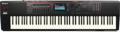
Keyboards called “workstations” are also a worthy investment. They are the “Swiss army knives” of music, offering synthesis, sampling, sequencing, and MIDI capabilities. Workstations cross the realm of digital to analog and contain everything in between. The Roland FANTOM-08 has a built-in interface so that you can hook it up to your computer to send those internal sounds!
Notation Software
Finally, you’ll need notation software. DAWs can notate MIDI compositions onto manuscript paper automatically, but their transcription is often riddled with errors. Bar lines will be in the wrong place, note lengths will be incorrect, and you’ll likely decide to rewrite the music professionally before you give it to the live orchestra for recording. Take what the DAW recommended and perform some good old-fashioned transcription. When you finish transcribing the entire piece, you can print off the full score for the conductor and then print the individual parts for each instrument using notation software. It is always a tedious task, but the orchestra will thank you for your proofreading. Finale is the software that I use and recommend. Sibelius is another notation software that offers a subscription plan if you wish to have the most updated version. Both offer a free version of their software to give users a taste of their workflow. Try them out and see which one works for you.
Now You’re Ready
Voila! You now know the basics of film composition. I offer these final bits of advice. Invest some time into the production aspect for your demo. The more time and detail you put into your work, the more realistic it will sound and the more directors will latch on to your talent. When you are hired, communication is essential. Take criticism and revisions with grace because you will be asked to revise your hard work. The most challenging part is matching the director’s vision for the film. If you see that, then the rest is music.