

Chad Loughrige
Capital University’s Convergent Media Center (CMC) in Columbus, Ohio, is connecting music and media students in ways never before possible. Leading the charge is professor Chad Loughrige — a professional drummer and audio engineer of over 20 years — and a network of state-of-the-art production suites and classrooms. Sweetwater sat down with Chad to hear more about his “interdisciplinary vision” for the CMC and learn what his groundbreaking Music Technology program is all about.
“Because of our growth over the last decade,” Chad says, “Capital saw the potential in pulling multiple media programs — Music Technology, Digital Media, Digital Art and Design, and Print Media — into a single facility. Thus, the CMC was born. Now an agency of sorts is being created among the students. Multiple disciplines have access to all stages of production and can build an understanding of how each area integrates into the completion of a project.”
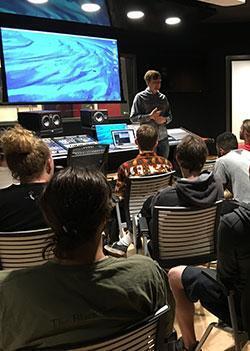
Capital’s Music Technology program owes its growth, in part, to its being available to all types of music producers: those with music education and those without. “Bachelor of Music students pursue a traditional music program with theory, composition, and piano arrangement alongside their music technology coursework. Then we have the Bachelor of Arts in Professional Studies, which caters to the closet musicians and software users who may not have had that band/orchestra background but are still passionate about creating music.”
Capital University has allowed Chad to customize the CMC for the latest studio technology, which is a major boon for the program. “We were ecstatic. I and about four others got to design the spaces based on our curriculum needs and based on how the various programs in this building would be able to merge together.” Chad knew right away that he wanted to connect the entire facility via Dante-equipped Focusrite RedNet audio interfaces. Unlike expensive audio cable, Audinate’s Dante protocol transmits multiple audio and video signals over a single CAT 6 cable.
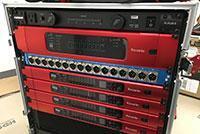
“The RedNets are so simple. With the click of a mouse, we can move any audio signal anywhere in the building. Our network pretty much runs through the whole facility: the recording studio, the production suites, the labs, our 100-person classroom, our TV studio, our radio station, the lobby, and certain office spaces. So we can provide audio support from one room to the next. It’s been really exciting to see how the students have taken to it and what its potential is.”
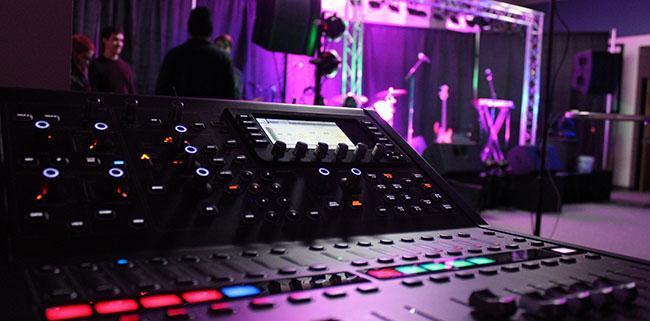
How Chad’s students are putting the network to use is absolutely cutting edge. “We held a rock concert this semester with three bands, a stage, and a full live sound system. We had the front-of-house going for the concert, but then Dante’d out of our Midas M32 mixer down to our production suites. I was mixing the session in Pro Tools while simultaneously sending a stereo output back up through the RedNet system to our radio station. So we were able to broadcast the concert live while live-multitracking it down to Pro Tools. And it worked flawlessly. I was blown away by how low the latency was.”
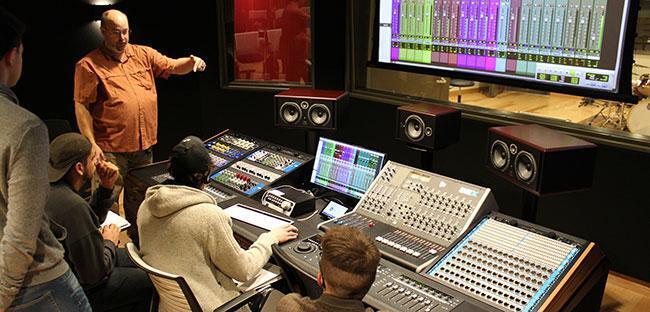
But networking isn’t the only thing distinguishing Capital’s music program from others in the nation. Surround mixing is also emphasized to prepare students for the ever-growing virtual reality and theater system markets. “I knew we made the right decision because of the resurgence of spatial audio — not only thanks to systems like Dolby Atmos, but also because of virtual/augmented reality and the need for ambisonics and binaural recordings.” Students currently learn on Focal 5.1 monitor systems, which Chad plans to expand in the near future.
Though embracing these technologies is crucial to the CMC’s future success, Chad won’t deny that his first love is making music in the studio, a love that he owes, in part, to Sweetwater. “I’m originally from Celina, Ohio — just an hour southwest of Sweetwater Studios. I did my first recording session there when I was 13 or 14. That’s probably one of those moments that led me to where I am today — teaching recording production at a university.”
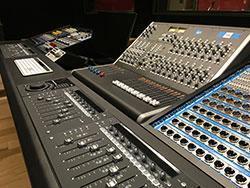
Chad’s passion for recording arts shows in the CMC’s state-of-the-art control room. At the heart of this 700-square-foot mix space is a 16-channel API The Box console and a smorgasbord of boutique outboard gear from Manley, UA, Daking, Vintech, Shadow Hills, SSL, Chandler, and more. Chad opted for this modular system over a traditional large-format mixing console to allow students to compare different preamps, compressors, and EQs for various applications. “Educationally speaking, the students are able to listen critically and critique all this equipment. They also learn interfacing — you know, ‘How do you hook it all up?’ With The Box having inserts on all 16 channels, you can then go a step further and say, ‘Okay, now let’s put Distressors on the kick and snare.'”
Chad also raves about the API’s summing potential, which he describes as “night and day” different than mixing in the box. “What it seems to do is bring out the nuances of the space in such a transparent way that you truly hear the sound of the room.”
Chad credits Sweetwater, and particularly his Sales Engineer, Dan VanAmerongen, with always hooking him up with the most in-demand audio tools. “Dan’s my go-to guy, without a doubt. I started working with Dan my first week teaching at Capital 10 years ago. He’s the only person I’ve worked with, and he comes through all the time on customer support, service, and the ability to get me equipment quickly. As an educational institution, when I need something, I typically need it right away. I can place a quick email or phone call to Dan and often receive the equipment the next day. It’s a potential source of stress in my life that I know I don’t have to worry about.”
Sweetwater congratulates Chad and Capital University on its bold step into this brave new world of interdisciplinary media education. If you’re interested in an education in audio or media production, then reach out to Chad for more information on their program and Capital’s one-of-a-kind CMC facility.