

There are just a handful of people I know who have been making music, playing instruments, and writing music-industry books and articles for as long as I can remember. Craig Anderton is one of that select group. Craig was a leader in this industry back when I was just getting started, and I’m honored now to call him a friend.
If anyone has stories about gear or technology that changed their life, then it’s Craig. As we chatted, it was clear there were many moments in his career that he considered revolutionary. I asked if he could pare down that list to just one and share that story. Since Craig is such an excellent communicator, I’ll let him take it from here and tell you about one of his favorites.
Craig Anderton: For me, a “magic bullet” is something that makes life better, easier, and ideally more fun. I’ve experienced several, such as the first time I sang through a DigiTech Vocalist (“Whoa! Vocal harmonies . . . live?!”), saw Melodyne pitch-correct polyphonic guitar, or used Studio One’s Harmonic Editing to parse a rhythm guitar part and generate an editable chord track from it — for both MIDI and audio. All extremely cool stuff, to be sure.
And then there’s the Line 6 Helix.
I consider multiband distortion the Holy Grail of distorted sound, starting with my Quadrafuzz hardware design back in the mid-’80s. This was later virtualized by Steinberg (Quadrafuzz v2 comes with Cubase) and MOTU (their MultiFuzz). It was also the inspiration for iZotope’s Trash.
Helix was the first multi-effects unit that let me create multiband processing easily, live and in the studio. Having multiband operation baked into the Helix architecture was huge. Inserting different time-based or modulation effects on different frequency bands was great, but distortion was where I went nuts. The high-frequency band could have a bright Vox emulation, the lower band a beefy Marshall, and the middle bands could be, well, anything. And panning these in stereo created monster stereo images.
But there was an initial concern: price. When it was introduced, Helix cost more than other multi-effects processors. I grilled one of the designers at the NAMM show, and he said the unit’s price was due to being overbuilt. They planned to keep updating it, so the first version used only a fraction of the hardware’s capabilities. The intention was to create a platform with a long life, not just another multi-effects pedal.
Uh, sure. I said a silent prayer for all those “This product will never be obsolete! You can update its firmware!” devices that have since become doorstops. But even in its initial form, Helix did what I wanted. I felt updates would just be a bonus.
How to Make Amp Sims Sound Better
Many amp sims offer great potential and the Helix offers more than most, but I’ve found I really need to finesse the settings in amp sims to get the best sound out of them, despite ongoing improvements in the state of the art over the last quarter century. I’ve designed and built many hardware processors because I simply wasn’t happy with commercially available devices.
This is another reason Helix became my magic bullet: It included the EQs, dynamics processors, and other modules needed to customize the sound. Presets could go from “Yeah, it’s an okay sound . . . y’know, for an amp sim,” to “Actually, that sounds better than a physical guitar amp.” Yes, it takes effort to assemble and tweak complex presets (fig. 1), but the tools let me do what I wanted, even in version 1.0.
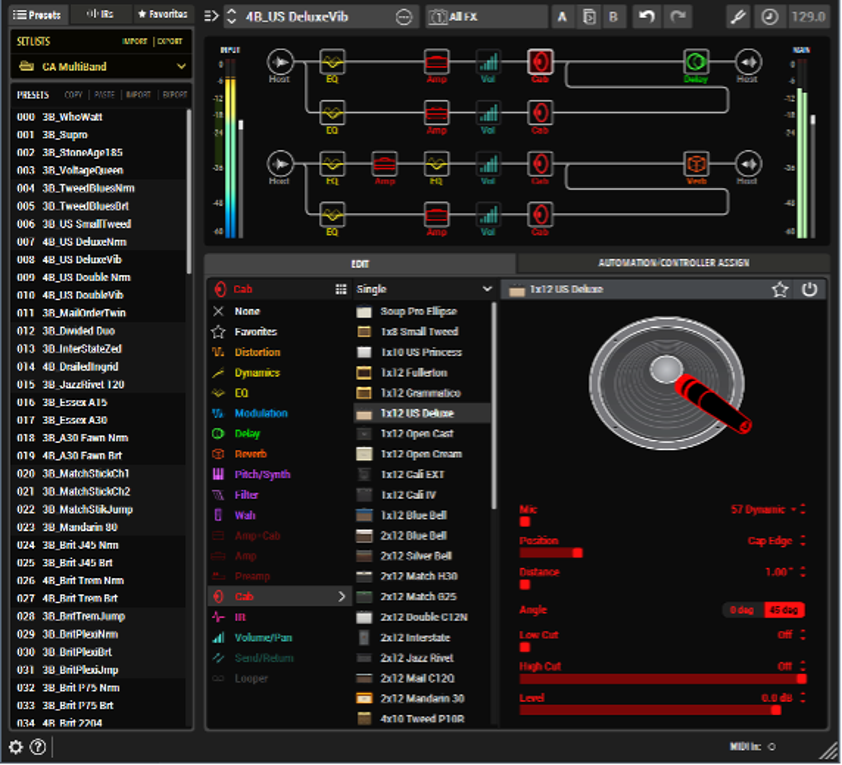
Hmm . . . They Weren’t Kidding
That was 2015. Since then, there have been 18 significant Helix updates (as well as updates for the companion HX Edit preset management/design software). In addition to the expected bug fixes, each update added new capabilities, workflow improvements, and usually new amps, cabinets, and processors. Then, in 2017, Helix was virtualized as the cross-platform Helix Native plug-in. I could create presets in the studio and exploit unlimited computer power if needed. Transferring presets between the floor unit and my computer was seamless.
Over time, Helix Native was updated in parallel with the hardware. It has now become one of my go-to plug-ins for vocals, drums, keyboards, and buses. Certain delay effects are magical on voice — and have no equivalent. For keyboards, the modulation effects are amazing. Amp distortion on kicks can be a thing of beauty with parallel cabs augmenting room sounds.
Many firmware changes have been ongoing, such as improved MIDI functionality, shortcuts for live performance, and so on. But one of the most significant updates was added six years after Helix’s introduction. In 2021, the audio engine was overhauled, and oversampling was added. This improved fidelity, particularly for high-gain amps, and put aliasing in the rearview mirror. Then, only a year later, the code for the cabinets underwent a major change. Instantly, the cabs sounded better and required less DSP. You can imagine what that meant for my multiband presets. Work-arounds to economize DSP were far less important, and the sound quality went up another notch.
2022 also saw the addition of dual IR blocks. I use IRs to create impulses of complex EQ-based cabs that have a different, more “analog” sound than typical digital cabinets. Being able to run these in parallel within one block was the frosting on the cake.
Additionally, I appreciated when Line 6 started to design more of their own virtual amps instead of just emulating existing amps. Several of Line 6’s original amps and processors have become my favorites. I always wished Line 6 would do more original amps. I finally got my wish.
To Infinity and Beyond
Okay, so I stole a line from Toy Story, but if the shoe fits . . . sure, products get firmware updates. But it’s unusual to see major updates to a unit’s core architecture years after its introduction. Even as the competition has heated up with IK Multimedia’s excellent ToneX ecosystem, the Neural DSP Quad Cortex, the Headrush Pedalboard, and others, Helix has more than held its own. It is the platform Line 6 promised.
Ultimately, what also makes a magic-bullet device is being able to develop a relationship with it. I now have nine years of Helix experience, yet I still haven’t explored every possible nook and cranny. I love stuff that has almost no learning curve when you get started, so you can do cool things immediately — but as you learn more, you can go deep into advanced functionality.
Maybe someday I’ll find something so compelling that I feel it’s gone beyond what Helix can do. That hasn’t happened yet. But it’s hard to imagine that anything would replace Helix for me. Supplement, yes — replace, no. Helix is so ingrained into my musical world, and I have so many customized presets that sound exactly the way I want, that the updates could stop tomorrow, and I’d be fine.
However, if someone wanted to bet that Helix has reached the end of the line for updates, then I wouldn’t take that bet. There have been a lot of surprises over the past nine years. I don’t think I’ve seen the last of them.
Take a Listen
Here are two samples of distinctive guitar sounds that I can achieve only with the Line 6 Helix.
Helix Multiband Crunch: The multiband processing gives clarity and a wide stereo image.
Helix Multiband Gain: By processing individual bands, even high-gain amps can sound more defined and focused because there’s less intermodulation distortion — just the “good” amp-based distortion.
Get Your Line 6 Helix from Sweetwater
Today, there are many variations on the Line 6 Helix, hitting every price point. The Helix is available as the original pedalboard or as the Helix LT, Helix Rack, or Helix Native. If you’re not sure which is right for you, then give your Sweetwater Sales Engineer a call at (800) 222-4700, and they’ll help you choose the Helix you need.
If you want to unlock the full potential of your Helix, then check out Craig Anderton’s eBook, The Big Book of Helix Tips & Tricks, that covers everything you need to know about Helix along with the newest Helix cabs, amps, and effects blocks. You’ll benefit from Craig’s years of experience and experimentation with the Helix and also get free updates as Helix continues to evolve.
Find more articles by Craig Anderton here.