When you’re shopping for your first synthesizer, should you get analog or digital? Even if you’re shopping for your 20th synth, it’s a fair question — analog and digital synthesizers each have their own strengths and weaknesses. And, while each type can offer powerful sound-creation potential, one may feed your creative impulses better than the other. Let’s take a look at analog and digital synths and hopefully help you decide which is better for your musical needs.
Analog vs. Digital Synthesizers Defined
To be clear, there are a lot of modern synthesizers that blur the lines between purely analog and completely digital designs. Digital oscillators can feature analog filters; analog synths can be digitally controlled to support user presets; and so on. To start, let’s define what we’re talking about when comparing analog and digital synths — the following definition is from Daniel Fisher’s article, “Analog vs. Digital Synthesizers“:
“In our industry, it’s common to label a synth ‘analog’ if the entirety of its audio path is purely analog. This means that the oscillators, mixer, filters, and amplifiers are truly analog. Quite often, the synth components in the control path (as opposed to the audio path), such as LFOs, envelopes, and MIDI, are digital; but we still consider that synth as analog because you don’t hear the digital components, only what they do to the analog audio components. We also consider a synth to be analog if it has digital effects that can be fully bypassed, leaving the signal not digitized. If some of the audio patch sections are digital (like a synth with digital oscillators but analog filters), then we call that synth a ‘hybrid.’ And, of course, if a synth has all digital components in its audio path, then it’s considered a digital synth.”
Analog Synths: Pros and Cons
Ask any experienced synthesist to describe the sonic character of analog synths, and words like “warm,” “punchy,” and “smooth” will often come up. That doesn’t mean digital synths can’t have these attributes, it just means that there’s a reason classic analog synths still hold up today. If you’re after that “analog” sound, then choosing an analog synth is an obvious choice. Analog synthesizers usually offer one knob per function, which means you can adjust practically any parameter just by turning a knob — no menu diving required. Regarding overall sound quality, analog synths excel when playing extremely high pitches or when modulating signals at audio rates, allowing for extreme sound-design maneuvers without creating unwanted sonic artifacts.
All that being said, analog synths simply can’t offer some of the modern-day conveniences that digital synths offer. Some analog synths don’t offer user presets for you to store your own custom sounds, instead requiring you to re-create that sound each time. Another consideration is polyphony — analog synths need dedicated circuitry for each synth voice, which means even a four-voice polyphonic analog synthesizer is going to cost more than a digital synth with similar functionality. It’s also worth noting that analog synths generally don’t offer as many modulation options as digital synths, again, due to the constraints of dedicated circuitry.
Analog synth pros
- Vibrant and “alive” sound quality
- Smooth, artifact-free sound even at high pitches and audio-rate modulation
- Dedicated controls give you one-knob-per-function sound-shaping capability with no menu diving
Analog synth cons
- Can get expensive if you need high polyphony (multiple notes sounding simultaneously)
- May not allow you to save presets for easy recall
- May not give you as many modulation sources and destinations as you want
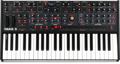
Some popular analog synths at Sweetwater include the Moog Matriarch, the IK Multimedia UNO Synth Pro, and the Sequential Take 5.
Digital Synths: Pros and Cons
Because digital synths don’t require discrete circuitry for every function, they generally offer much more flexibility than analog synths. This means digital synths often have all the polyphony you could ask for and generally have more sound-design potential than analog synths. Many digital synthesizers provide “virtual analog” operation — mimicking the signal flow and processing options that analog synths allow — while also giving you access to wavetables, deeper FM synthesis, sample-based synthesis, and more. And, because modulation routing is based on digital processing instead of dedicated circuits, you’ll likely find digital synths provide much more flexibility in terms of modulation sources and destinations. It’s also worth noting that pretty much any digital synthesizer will allow you to save your own custom presets for easy recall.
While modern digital synths can rival the sound quality of analog offerings, there are some instances in which analog has the edge. Due to the nature of digital audio, extremely high pitches played on a digital synth can produce aliasing — in contrast to the consistently smooth sound of analog synthesis. A similar sonic deficiency becomes evident with extreme modulation, such as using an LFO at audio rates (above 20Hz). Even the most advanced digital synthesizers usually don’t have the depth or nuance you’ll hear in an analog synth using the same modulation scheme.
Digital synth pros
- Higher polyphony count allows for more notes and longer release times
- More sound-design options including wavetable synthesis, FM synthesis, and sample-based synthesis
- More flexibility with modulation; more sources and destinations available
- Save your own custom presets for instant recall
Digital synth cons
- May create aliasing or other unwanted sonic artifacts at extreme pitches or audio-rate modulation
- May not offer knob-per-function convenience; some or many functions may require menu navigation
- Digital precision may have you looking for a way to add some “analog” character to your sounds
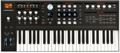
Some popular digital synths at Sweetwater include the Korg Opsix altered FM synth, the ASM Hydrasynth, and the Roland GAIA SH-01 virtual analog synthesizer.
In the Real World — Live Performance vs. Studio Recording
Most musical artists would agree that the sound is all that really matters — whether you use an analog or a digital synthesizer really doesn’t matter as long as you can create the sounds you need. But some of the differences between analog and digital synths that we’ve discussed could make a big difference for you, depending on how you’re using your synth. Let’s take a look at how your choice of synth could impact how you perform live onstage and how you create in your studio.
Live performance
- If your musical style is somewhat improvisational and on the fly, then you may require individual controls for each function so that you can shape sounds in real time. An analog synth will usually have the edge here.
- If you want to access specific sounds for each song in your set, then you need to have custom presets saved and ready to go. That would make a digital synth the smarter choice.
Studio recording
- Analog synths without presets can encourage spontaneity and creative exploration, but you may not be able to re-create that exact same sound in the future.
- Digital synths generally offer more sound-shaping/modulation options than analog synths, offering a wider sonic territory to explore.
- For extreme sound-design techniques involving high pitches and fast modulation rates, analog synths generally sound “smoother” and “hold together better” than digital synths.
Will an All-analog Synth Track Sound “Better” Than an All-digital Production?
If you can avoid the hype around the “warm analog sound” or the limitless sonic potential of digital, then you’re left with a basic question — does one sound inherently better than the other? British-born psychedelic artist Ott asked himself the same question and put it to the test with his Baby Robot EP. One track (“Baby Robot”) was created using only analog synths and effects processors, while the other track (“Mr. Balloon Hands”) was created using only digital synths, effects, and plug-ins. While each track has its own sonic signature, we’d be hard-pressed to say one sounds “better” than the other — and it’s clear Ott was able to realize his distinct sonic styling regardless of the tools he used.
Whatever It Takes to Make Your Music Come Alive
Hopefully, you now have a clearer picture of the benefits — and potential drawbacks — of analog and digital synthesizers. If synths play a large role in your music, then you’ll likely find that no one synthesizer will cover all of the sonic territory that you need. Both analog and digital synthesizers have their place in modern music production, and having a selection of analog, digital, and hybrid synths (as well as plug-ins) gives you a wider range of sounds to explore. For a sonic demonstration that compares analog and digital synthesizers, check out this video by Sweetwater’s synthesizer guru, Daniel Fisher.
If you’re still not sure whether your next synth should be analog or digital, then give your Sweetwater Sales Engineer a call at (800) 222-4700. We stay on top of the latest synthesizer developments, and we’re eager to help you find the right tool for your musical needs!