When choosing a guitar slide, there are several key considerations. Your choice will hinge on these factors:
- Materials
- Size
- Length
- Weight
- Slide Finger
The simple act of placing a slide across the strings of a guitar can be a transformation, taking the instrument to places that are nearly impossible otherwise. Everything changes: tone, pitch, articulation, sustain. The physical change demands a different musical vocabulary, simultaneously imposing limits and creating possibilities. In the right hands, it’s downright magical. Of course, many of us who play slide are just trying to not sound like a tortured house cat.
Where do you find a slide? Everywhere! Lowell George of Little Feat used the casing of a Craftsman spark plug socket, Duane Allman used a pill bottle, Ry Cooder has the necks cut off of sherry bottles, bluesman CeDell “Big G” Davis used a butter knife, Danny Gatton used a beer bottle — usually full — and made quite the mess. I’ve witnessed — and attempted — using mic stands, trem bars, Bic lighters, and whatever else is handy for a slide. Necessity may be the mother of invention, but thankfully all it takes is some knowledge and a little experimentation to find the perfect slide that was made for your specific purpose. Confused about slides? There are a lot of choices. Let me narrow them down and help you get a better grip on what slide you might prefer and why.
The first step in choosing a slide is figuring out what you want. Start with these questions:
- Acoustic or electric guitar?
- Do you have a guitar dedicated to play slide on, or do you want to play slide on any guitar?
- Low or high action?
- Light or heavy string gauge?
- Open or standard tuning?
Even if you don’t have answers to these questions, start by considering them. More than likely, you want to start playing slide because you’ve heard a player or performance that inspired or moved you. Figure out what that inspiration is, and start there; ya gotta start somewhere, right?
If there is someone specific you’d like to emulate, find out as much as you can about what they do, but don’t think you have to be locked into that. Modify the elements you need to fit your situation. For instance, a lot of my favorite slide players use an open tuning, and I usually play in standard.
Materials
Slides can be made from almost anything, but for our purposes, let’s stick to these three main categories:
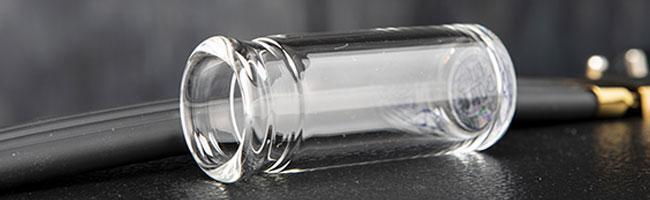
Glass
- Usually made from Pyrex, can also be tempered glass
- Smooth, warm tone
- Regular wall — lighter weight, thinner glass
- Heavy wall — thicker and heavier
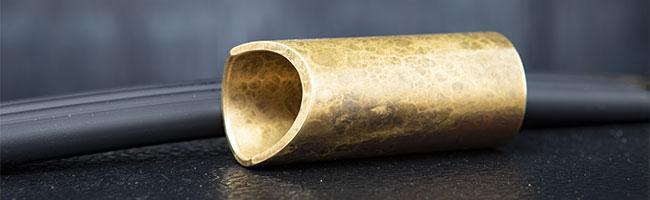
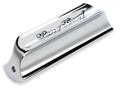
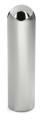
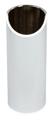
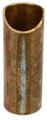
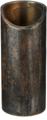
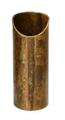
Brass/Nickel-plated Brass
- Heavy weight
- Maximum sustain
- Bright tone
- Adding chrome or nickel plating gives the brightest tone
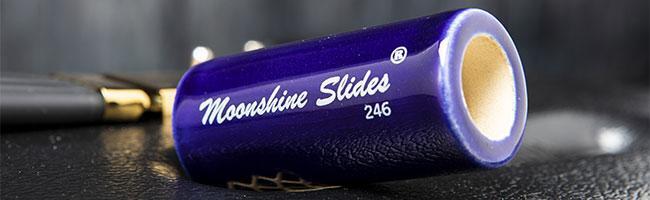
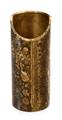
Ceramic/Porcelain
- Between glass and brass for weight and tone
- Glazed exterior — different glazes can create slightly brighter or darker tones
- Porous interior absorbs perspiration and keeps slide in place
Size, Length, Weight

Size
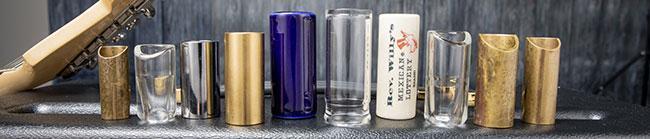
Slides typically are sized S, M, L, and XL, which refers to the inside diameter, specifically.
- Small — Ring size 4–7.5
- Medium — Ring size 8–10.5
- Large — Ring size 11–13.5
- Extra Large — Ring size 14–16
These are approximate — slides vary from model to model and are handmade. The basic process is to figure out which finger you want to use, get a ring size, figure out what material/type of slide you want, and get close. It doesn’t need to fit like a ring. A little space is a good thing: snug enough to stay in place and have control but loose enough to be comfortable.
Length
Shorter slides are useful if you want to wear a slide and switch back and forth between fretting and sliding. A shorter slide allows your finger to bend and tuck out of the way.
Longer slides can cover across the entire neck (all six strings) allowing more immediate note choices and possibilities.
Weight
Size and length both factor into the weight of a slide, but material and thickness have the greatest effect. There’s lots of crossover in this category between the three different materials.
Glass can be the lightest, but a large, long, heavy-wall slide is heavier than a short, small, thinner brass slide.
Ceramic/porcelain has more consistent weight from model to model, with size playing the biggest role in weight differences.
Make sure you have a slide that’s the appropriate weight for your guitar’s string height and gauge:
- Bigger strings, higher action = heavier slide
- Lighter strings, lower action = lighter slide
Choose a slide heavy enough to get the tone and sustain that you want, but not so heavy that the weight of it flattens the strings against the fretboard. The slide is supposed to glide over the frets. A too-heavy slide causes uncontrollable noises like string scraping and knocks from hitting frets and the board.
Slide Finger
Which finger you wear your slide on is strictly personal choice. Ring finger is probably the most common; it allows you to wear a bigger, heavier slide that puts more weight on the strings for a bigger tone and more sustain. It also allows for great control, because you have fingers on either side to help stabilize it. Control is the name of the game with slide; without control you have no tuning and without tuning you have…well, y’know.
The pinky finger would be the next most popular choice, because what you may lose in stability, you more than make up for in flexibility. On your pinky, even a full-length slide tucks neatly out of the way, allowing you three adjacent fingers to fret with. If the ability to freely switch between slide and fretted notes is important to you, consider the pinky finger. It will take a smaller slide size, and because of lesser stability, you’re likely to use a lighter-weight slide. The struggle may be in finding a slide heavy enough to get the tone you want yet light enough to control. That will require some experimentation. I can speak from my own experience, because I play with the slide on my pinky. I finally settled on a full-sized ceramic for tone, but my practical side wants a short, glass slide. I’ve found that I like the range of having all six strings available, and a short glass slide just isn’t quite heavy enough.
Middle-finger slide may be in third place, but all I have to say about that is, “it works for Bonnie Raitt.” ‘Nuff said.
Technique Tips
- The most helpful thing to remember is that the slide is replacing the frets on your guitar. The goal is to float above the frets and not to press down in between them.
- Use your frets as the guide to perfect intonation. Place the slide directly over the fret, and you should be good.
- Hold the slide steady and parallel with the neck so every note across the neck is in tune.
- Keep even pressure, especially when moving horizontally. Practice moving from note to note instantaneously, and try to make it sound like you’re not wearing a slide.
- Mute behind the slide with your free fingers to minimize and control extraneous noise. A certain amount of scrape and scratch is part of the slide sound, but make it happen intentionally.
- Be careful not to overuse the idiosyncrasies that come with slide: wide vibrato, scooping pitches, glissandos, scrapes and scratches, etc. Like any other effect, when well placed, they can be very effective, but a little goes a long way.
- I can’t overemphasize how important it is to listen constantly, especially to tuning. Your ear will tell you if the tone, feel, intonation, etc. is right for you.
Slide Care
It’s worth mentioning that it’s important to take care of your slide — they’re actually pretty fragile. Glass and ceramic can break or crack, brass can dent or pit, and they all can get scratched. The biggest problem with scratches is that they cause uneven spots on the surface that can catch or vibrate oddly against your strings. In fact, I make sure that ceramic slides with a logo on them have the logo facing away from the fretboard when I’m playing so I have a nice even surface.
If you need a way to store your slide to help keep it protected, a large plastic pill bottle will work. You can even put a piece of foam inside to make it extra secure. Another way is wrap it in a rag or guitar polish cloth and store it in the pocket of your guitar case.
I hope this armed you with some basic slide knowledge and helps you get to where you want to be with your slide playing. For more info on slides, check out our Guitar Slides page or call your Sweetwater Sales Engineer at (800) 222-4700.