

Guitar picks — they’re the unsung hero in the world of guitars, resting invisibly, as it were, in the shadows between the fingers of the players who use them. They don’t get a lot of ink or accolades, but other than maybe drumsticks, they’re the object most commonly thrown into the crowd at the end of a great concert. And while they might seem disposable, an afterthought really, the pick is a frequently discussed topic among players and an integral piece of gear that rounds out the total package of a player’s arsenal.
Note: This article is included in our “Electric Guitar for Beginners: The Ultimate Buying Guide,” a comprehensive, step-by-step guide to purchasing your first electric guitar. To learn more, click here.
Where It All Started
Picks were originally called plectrums – and still are in England — which meant any small flat “tool” used to strum a stringed instrument. In the early years of European stringed instruments that would eventually become the guitar, picks were made of stone, wood, or even the quill of a bird feather.
These natural materials were still used through the 1800s until a much superior, better-sounding source for picks was found: the Atlantic hawksbill sea turtle, commonly referred to as tortoiseshell, though it is really made from turtles not tortoises. For decades this prized material held on as the preferred pick for its flexibility, feel, and tone. Then in the early 1900s, celluloid was developed, and it became a popular secondary choice to tortoiseshell.
By 1973, the Convention of International Trade in Endangered Species of Wild Fauna and Flora (CITE) act was passed effectively making tortoiseshell picks illegal. Even to this day, it is illegal to buy or sell the leftover tortoiseshell picks from the pre-CITE’s period. A player can own a genuine tortoiseshell from the pre-CITEs period if that player can show proof that the pick was made before CITE became law and that the pick was obtained in an “ethical” manner. If that sounds complicated, it is. Most experts in the field recommend players steer clear of any offers to buy picks made from actual Atlantic hawksbill sea turtle.
A Shift to the Future
The good news for the Atlantic Sea Turtle is that celluloid picks caught on quickly. Players noticed that it most closely resembled the feel and tone of genuine tortoiseshell picks.
One of the earliest companies to manufacture celluloid picks was D’Andrea Manufacturing in the 1920s who would become a major vendor to America’s “Big Three” in guitars: Gibson, Fender, and Martin. With these iconic guitar companies on board, the celluloid pick became the pick of choice for a variety of both acoustic and electric players and it remains popular to this day.
It’s All About the Feel
Today, choosing a pick is a multifaceted endeavor for players of any stripe. Mandolin, ukulele, acoustic, or electric guitar players have an abundance of options when it comes to picks. The array of materials, shapes, and sizes alone can leave one feeling a bit overwhelmed.
There are dozens of companies who make picks from stone, bone, wood, glass, and even animal protein composites. But before anyone gets mired down by the plethora of pick options, seasoned players suggest focusing on what really matters: feel.
The feel of a pick involves a variety of factors. On the technical side are release, memory, and tone. Release is how fast a pick snaps back to its original shape after it has struck the strings of the instrument. Memory refers to how long a pick retains its shape over time and use. Finally, tone is the combination of release and memory since tone is most affected by a pick’s shape and how well it holds up to wear and tear.
Along with these three factors are four of the more visible and equally important aspects to a pick’s feel: shape, size, material, and thickness.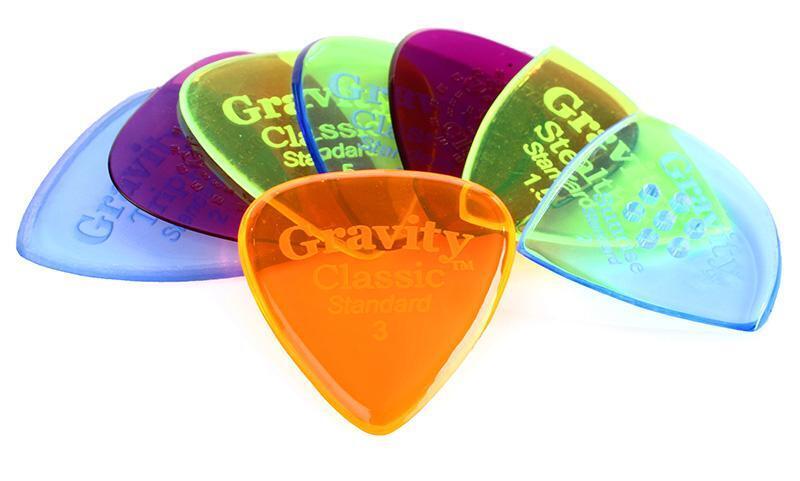
Variety Galore
Picks come in about any shape imaginable, but the dominant form for roughly the last hundred years is the “rounded” triangle — a triangle with all three sharp corners rounded or contoured for better feel when being held between the fingers.
While the rounded triangle is the most common, many players all over the world use picks of various shapes including square, circle, trapezoid, and even star-shaped picks. Some players like picks that are larger, some prefer smaller.
Preferences in shape and size often depend on the instrument being played. Many mandolin players, for instance, prefer smaller picks that are roughly the size of their finger ends and made from a very hard, industrial grade plastic called Meldin. Acoustic guitar players who mainly play rhythm often prefer picks that are larger and made from a softer, more pliable plastic like nylon. But these are only generalizations. Interview a thousand players of any instrument on pick preferences and you could well get a thousand different responses.
In terms of materials, there are players who prefer picks made from metal and some who will only use picks made from bone. There are even players who like the feel of glass picks. Brian May from Queen is even known to use a sixpence coin, while Billy Gibbons often uses a peso.
The preferences in materials are nearly endless because the tone that these various materials produce against the strings is vastly different. In general, picks made from harder materials produce a punchier, harsher tone while those made from softer materials emit a softer tone.
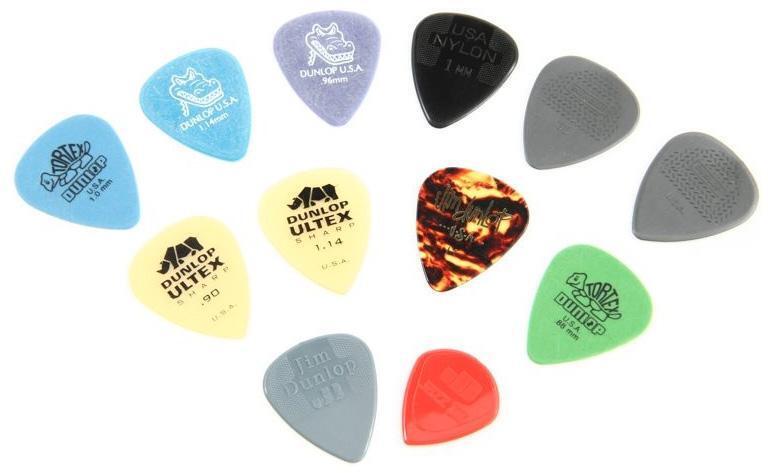
The other consideration is thickness. Pick thickness is measured in millimeters. Thin picks typically range anywhere from .40 to .60mm in thickness. Medium picks range in thickness from .60 to .80mm, while heavy picks range from .80 to 1.2mm. There are even extra heavy picks that come in at 1.2mm and higher. And believe it or not, there are custom pick makers who manufacture picks that are an inch thick.
Thin to extra heavy picks all have a different feel in the fingertips and a different response when striking the strings of an instrument. Again, in general, a thicker or heavier pick will have a heavier tone while a thinner pick has a softer tone.
Take Your Time; Take Some Chances
The only sure way to get the “feel” of a pick is to spend some time trying a variety of picks, to decide what material, shape, and size is right for you. Strum with a pick as you would when playing rhythm. Attack with a pick the way you would while playing lead. It is important to get the feel of a pick in both modes if you are a player who plays both rhythm and lead.
It is also important to make sure you are trying out picks on the gauge of strings that you normally use on your instrument since string gauge will also affect how a pick responds. You would not want, for instance, to try out a heavier pick on light gauged strings when you normally use heavy gauge strings. The feel and response results would not be accurate since a heavy pick will have a very different response against heavier strings than it would lighter strings.
Take time when it comes to choosing a pick. Also, don’t be afraid of variety. Many players here at Sweetwater have a large collection of picks of various size, shape, and thickness, each suited to the type of instrument they are playing. Some have specific picks for lead playing and as well as picks better suited for rhythm. Shop around and audition some of the brands we offer here at Sweetwater including Dunlop, Fender, Gravity, and Clayton just to name a few.
Veteran Players Admit Their Addictions
Sweetwater’s own Don Carr, a 30-year pro with credits as a live player as well as studio musician, describes himself as a “pick junkie” with an eclectic collection of picks in “all shapes, sizes, thicknesses, materials, edge-shapes.”
“I’ll try a different pick anytime just to see what happens,” said Don recently. “That being said,” he continued, “my go-to pick of choice is the Dunlop Ultex, either 1.0mm or .73mm. It seems to have the best overall tone and flexibility-vs-stiffness for a wide variety of applications. Hold it tight and it can be stiffer and more accurate, hold it loosely and it’s jangly and great for lots of rhythmic styles.”
Nick Bowcott, lead guitarist for ’80s metal band Grim Reaper, waxes a bit poetic when asked about his own take on picks. “They are the point of contact between the head and the heart and the first thing that has an effect on the tone of what ultimately comes out of your amp” Bowcott recounts with a grin, reminiscing about his own obsession with finding the right pick throughout his decades-long career that has taken him all over the world. “One thing I began to do early on is pay attention to the type of picks being used by the players I admired,” said Bowcott. “So I’ve seen picks of all sizes, shapes, and materials used by really great players and as a result I’ve tried my fair share of picks as well.”
More Than Meets the Eye
While they may not get the spotlight in the world of stringed instruments, a good pick that feels right in your fingertips while striking the strings of your instrument is more important than many realize.
The next time you are at a concert and the sweaty lead guitarist tosses a pick into the crowd, if you’re close by, grab it if you can. That pick has a history. That pick tells you a little something about the player who threw it and is a connection to a tradition that quite literally came from the ground, the air, and the sea.
If you need any help selecting the right pick for you, give your Sweetwater Sales Engineer a call at (800) 222-4700.