

If you ever need to sync a delay exactly to the tempo of a song, this is the chart for you! Keep it handy for those times when “close enough” won’t work: a rhythmic delay pattern that has to lock with a drum pattern, when you play with a sequenced track, a long delay with lots of repeats, or any time the delay has to be timed to a click track. As a studio tool, a BPM to Delay Time chart is invaluable. Think of it as one less calculation to make or one less app to call up. I always have one close by, especially in the studio. This particular chart’s design fixes the problems I’ve had with the other delay charts I’ve used, lo these many years.
How to Use This Chart
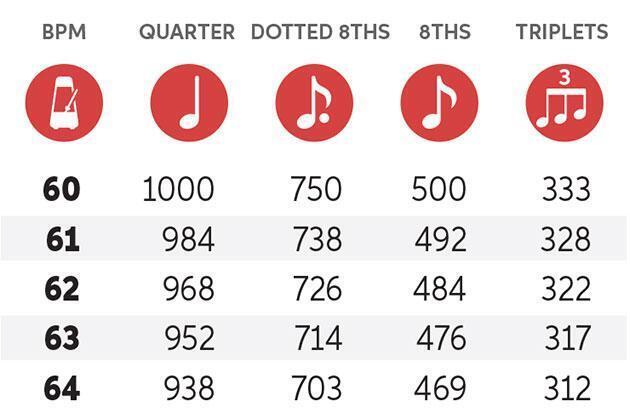
BPM — Beats per minute; represents the tempo of a song.
The first column (in bold) is the BPM of the song. The columns to the right represent different rhythmic subdivisions (Quarter note, Dotted 8ths, 8ths, and Triplets) and the associated delay times in milliseconds for that BPM. These subdivisions are the most commonly used, but some simple math can get you a long way.
Quarter — Quarter note; the typical beat or pulse of a song.
Dotted 8ths — Dotted-eighth note; the equivalent of three sixteenth notes, or 3/4ths of a beat. It creates a pattern that feels like 3-against-2, which seems as though it overlaps. Think of the guitar sound in the intro to Pink Floyd’s “Run Like Hell” and “Another Brick in the Wall, Part 2” or U2’s “Where the Streets Have No Name.”
8ths — Eighth note; half the value of a Quarter, so it splits the beat in half.
Triplets — Eighth-note triplet; there are three eighth-note Triplets across one beat, so it’s one-third of a beat.
Calculating Other Delay Times
To get a half-note delay, which is a delay that is two beats long, double the value of the Quarter-note delay that corresponds to your BPM.
Similarly, to get a quarter-note-triplet delay, which is three evenly spaced quarter notes across two beats, just double the Triplets delay value.
To get a sixteenth-note delay, which is four notes per beat, simply halve the 8ths delay time.
For a dotted-sixteenth delay, cut the Dotted 8ths value in half.
Click the link here to download this single-page, printable BPM to Delay Times Cheat Sheet. This is a tool that will help keep the creative process flowing and keep your mind on making music!