

An engaging light show is an essential part of a pro-level performance. It enhances the mood and adds emotional impact to your music. Whether you’re designing your own lighting rig or working with lighting professionals, it’s important that you understand a few basic terms. If you have a dedicated lighting technician, it helps to be able to speak their language so you can communicate effectively. Here are some basic lighting terms that you need to know.
 Atmospherics — Particulates released into the air to increase the visibility of your lighting effects. Common examples include haze, fog, and dry ice. Haze is nearly imperceptible — its only purpose is to reflect light. Fog provides a visible, smoke-like effect. Dry ice fog stays low on the floor — think monster movies or graveyard scenes.
Beam Angle — A measurement (in degrees) that indicates how the light is distributed from a lighting fixture. Light leaves a fixture in a conical shape, and the beam angle helps you determine how large the lighted area will be at a given distance.
Color Temperature — A measure of the color appearance of light (not the actual temperature of the light). It references a body that absorbs all incident electromagnetic radiation, generating light with the closest visual color match to the source, represented in degrees Kelvin.
Derby — A lighting effect that projects numerous fast-moving, razor-sharp, multicolor beams in a wide pattern.
D-Fi — A technology embedded into various Chauvet lighting products that provides wireless DMX capabilities. This allows you to control your lighting rig via DMX controller or your smart device without using cables.
DMX — An abbreviation for Digital Multiplexing, it is a serial data protocol that controls most lighting fixtures. Most LED fixtures utilize multiple DMX channels. DMX is to lighting what MIDI is to audio.
Effects — Lighting and atmospherics that are used to add mood, color, and visual impact to a stage presentation. These consist of basic lighting fixtures, lasers, fog machines, and more.
Ellipsoidal Reflector — A reflector that converges light into a single point, except for the space that’s occupied by the point source. This results in a beam that varies in width depending on the distance between the two points. Its shape resembles the end section of an ellipsoid. This is sometimes referred to as a Leko.
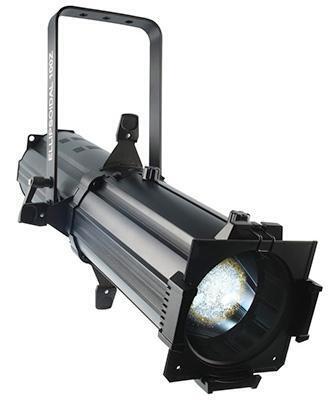 Ellipsoidal Spotlight — A spotlight that employs an ellipsoidal reflector and framing shutters, and occasionally an iris and pattern slot.
Facade — Similar to a scrim but can be placed right in front of the DJ, rather than behind, or around the room. Typically, a facade would be your “booth,” and the DJ would stand behind it.
Follow Spot — A manually operated, narrow beam-focusing fixture with a powerful light source, iris, shutters, and a color-changer. This light is used to follow a performer around the stage, surrounding them in a large pool of light.
Framing Shutters — Sometimes referred to as barn doors, these moveable panels block the light from a unit and are used to baffle off the area that is illuminated.
Fresnel Spotlight — A light boasting a single Fresnel lens. This type of fixture delivers a soft-edged beam and often includes a spherical reflector and an adjustable focus that cover the full gamut between spotlight and floodlight.
Gobo — A screen or plate that is placed in front of a spotlight to mask certain areas and project a shape. An acronym of GOes Before Optics.
Iris Diaphragm — An array of thin, moveable metal plates that forms a circular opening. This opening is adjustable, allowing you to alter the diameter of, or mechanically dim, your beam.
Lens — A transparent material, typically glass, that is shaped in order to bend light rays as they pass through it. Colored lenses are used as color media.
Lumen — A unit of measurement for the perceived power of light.
Lux — A unit of illuminance, representing one lumen per square meter.
Moving Head — A fixture with automated or mechanical abilities beyond those of a stationary fixture. Moving heads are controlled by either sound activation, a pre-programmed sequence, or DMX to create complex, engaging light shows.
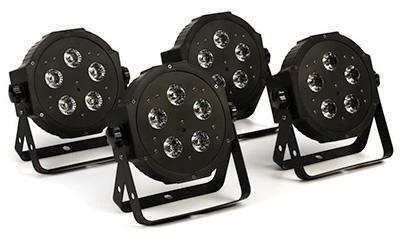 PAR — An abbreviation for parabolic reflector — used as a general wash light that fills an area larger than 6–8 feet in diameter and has a parabolic shape to its beam.
Pattern Slot — A narrow opening that accommodates a pattern holder or pattern rotator. A pattern holder loads a projected design into your fixture, while the pattern rotator spins the projected design.
Prism — An optical element used in moving-head lights to refract light. It is useful to make the beam fill more space or make a gobo effect look more interesting.
Scrim — A translucent material that allows some light to pass through. It diffuses light to add color and dynamics.
Spot — Short for spotlight — a light used to highlight a certain small area to focus visual attention. A spot is also a light where you can place gobo patterns, such as logos or effects.
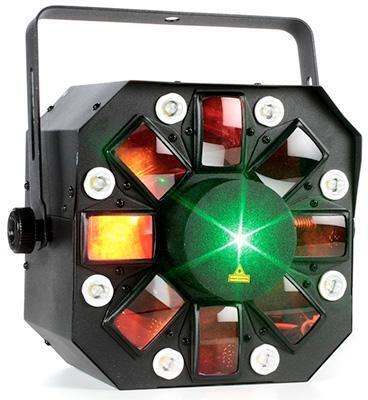 Strobe — An intense lighting effect that turns on and off rapidly. When used in a dark area, it produces a stroboscopic (flickering, slow-motion) effect.
Throw Distance — The effective distance between a lighting fixture and the area or item that you’re illuminating.
 Wash — A lighting fixture that covers a large area with light.
WiFly — A technology employed by various ADJ lighting products that provides wireless DMX capabilities. This gives you the ability to control your lighting rig via DMX controller or your smart device without using cables.
Color Models
RGB (Red, Green, Blue) — An additive color model in which red, green, and blue light is combined to reproduce a broad array of colors.
RGBA (Red, Green, Blue, Amber) — The combination of an RGB color model with an additional alpha channel. This extra channel indicates how opaque each pixel is, allowing you to combine one image over another using alpha compositing, with transparent areas and anti-aliasing of the edges of the opaque regions.
RGBAW+UV (Red, Green, Blue, Amber, White, Ultraviolet) — The combination of an RGBA color model with additional white and UV channels. These extra channels offer increased color mixing and a wider palette of colors than 4-color LED fixtures, such as hot pink, lime green, and electric blue.
If you have any questions about stage lighting, don’t hesitate to reach out to your Sweetwater Sales Engineer at (800) 222-4700.

