Do you possess an inherently curious and wandering soul, striving to finally answer the age-old question of whether the grass really is greener on the other side of the fence? If so, you’re probably wondering if a set of jet-black active pickups, pulsating with 9 volts of preamp-powered current will stifle your questing heart. Or maybe you’re afraid to admit that your eye sometimes wanders from your trusty EMGs to a shiny, sleek set of vintage-inspired humbuckers. Unfortunately, friends, this article poses a question that is left unanswered. What I will do is break down, to the molecular level, all of the important characteristics of passive and active pickups so that you can confidently answer this question for yourself: Passive or active pickups . . . which one is right for me?
Searching for the Sound
It’s very easy to cage passive and active pickups within the confines of a music genre. If it were that simple, then it would be easy to answer whether active or passive pickups are right for you.
If you play metal, then go with active pickups; and, if you play anything else, you should be playing passive pickups.
I personally don’t subscribe to the idea that any genre of music should determine your preferred guitar or pickup. Your pickups, just like your guitar and the rest of your gear, are just one bristle in the brush that you paint with. Let’s throw away all of society’s conventions about what pickup you should be using and dive deep into what really makes active and passive pickups unique.
In order to help you along this path of magnetic discovery, I’m going to weigh some of the basic pros and cons of active and passive pickups. By taking a close look at output levels, tonal characteristics, and the components, or guts, of each pickup, I’ll share my understanding of how active- and passive-pickup traits contribute to a pickup’s overall personality.
I’m also going to have a good, ol’ fashioned pickup shootout and pit a set of industry-standard humbuckers, classic Seth Lover PAFs, against a set of active pickups, the Zakk Wylde signature EMG 81/85. To evaluate the results, I’ll use a free frequency analyzer plug-in from Blue Cat Audio and compare the pickups’ respective waveforms in Pro Tools.

Seymour Duncan Seth Lover Humbucker
Learn More
EMG ZW Zakk Wylde Active Signature Humbucker
Learn More
Sustain, noise, frequency range, price, and compatibility are all things to consider when choosing between active or passive pickups. This article will guide you through questions you may have about the nuances of active and passive pickups and provide helpful insights if you’re shopping for a new instrument and are on the fence between brands or models.
How a Pickup Works
First let’s talk about how pickups work.
Pickups are constructed of a magnet and a conductive winding that generate a magnetic field underneath the guitar’s strings. When struck, the string’s oscillation disturbs the magnetic field, creating an electrical current. This signal can then be manipulated by many different means such as tone and volume controls, amplifiers, and stompboxes. Active and passive pickups both work this way but active pickups require an onboard battery-powered preamp.
Pickup Windings
The output strength of a passive or active pickup is related to the number of windings the pickup has. The greater the number of conductive-wire wraps around the bobbin of the pickup, the higher the resistance and the stronger the signal.
Signal Processing
In a guitar with passive pickups, the pickup signal is routed through a variety of components (pots, switches, capacitors) that allow you to modify the signal being sent to the output jack. From there, the signal can be sculpted by preamps, stompboxes, and amplifiers to help you create your tone.
Since active pickups have considerably fewer windings, they have a weaker output and require amplification to boost them to a usable strength. This is why there’s a preamp in the guitar and a battery to power it: to create a stronger, more compressed signal that will push your standard signal chain in a more aggressive and unique way.
Other Variables
There are also other factors that contribute to the tonality of the pickup, or whether mids, lows, or highs are scooped or boosted. Some examples would be the type of magnet, the baseplate thickness, and whether the pickup is potted or enclosed. For example, a passive humbucker is often dipped in wax to prevent microphonics, while an active pickup will be cased in epoxy.
The distance of your string to the pickup also plays a large role in how your pickup is going to behave. A good guitar setup always considers the distance of your string in relation to the pickup so that you have a balanced amount of energy transference and magnetic pull.
These are just a few things to digest when considering how your choice of pickups will interact with your rig.
Common Knowledge
Before we put on our lab coats and get down to some nerdy waveform analysis, let’s weed our way through some of the tribal knowledge within the music community regarding passive and active pickups.
Signal Strength and Noise Level
It’s no secret that active pickups produce a higher output than passive pickups. What I’m referring to is the signal leaving the jack of the guitar and traveling through your cable being hotter with active pickups compared to the output of passive pickups.
The boost, or muscle, behind the active pickup’s signal also allows it to travel longer distances in cables without signal loss. This is due to the impedance of each pickup’s respective signal. Passive pickups produce a higher impedance (lower current), and active electronics have a lower impedance (higher current). The lower impedance level of active pickups also allows you to raise them closer to the strings, accentuating a unique harmonic range not possible with passive pickups.
The stronger output level of active electronics can be really useful in the studio, as well. The higher output of active electronics gives you the ability to need less amplification (gain) compared to passive pickups. We’ll demonstrate this later in the article by comparing the two waveforms.
Active pickups are also quieter than passive pickups. Something that is often misunderstood is why active pickups are less “hot” than passive pickups. What I’m referring to is the amount of resistance measured from each pickup. The higher the resistance reading, the “hotter” or stronger the pickup signal generated is.
To use an extreme example, Black Winter passive pickups by Seymour Duncan are rated with a DC resistance of 16.6k ohms on the bridge pickup. (These are specifically engineered for boot stomping and head banging, by the way.) An active pickup like the Tosin Abasi Fishman Fluence, which is designed with the same intention, has a DC resistance rating of 2k ohms on the bridge pickup, nearly 14k ohms of resistance differential between them. However, the active circuitry in the Fluence system allows a lower electrical signal to be amplified and results in a cleaner and higher output.

Fishman Fluence Tosin Abasi
Learn More
Seymour Duncan Black Winter Humbucker
Learn More
While passive pickups have their disadvantages in the realm of noise and interference, there is no mistaking that single-coil pickups, albeit a bit noisy in the 60-cycle range, have found their way into the recordings of countless notable players. If you’re wanting to emulate one of your guitar heroes, then a passive pickup may be the way to go.
Components
In a passive system, your pickup leads can go to any number of customizable passive components. Some examples of what you can do with creative wiring are coil splitting, phase inversion, series/parallel wiring, or even a kill switch. With an active system, which relies on the preamp circuit, you may lose some of the freedom of customization that you have with passive pickups.
The truth of the matter is that some active pickups will not allow you to split coils or invert the phase of the pickup. Many of the active systems available come with a prewired kit that may also limit or even expand some of the functionality that may best suit your musical needs. You’ll want to be sure to have this conversation with your Sweetwater Sales Engineer when choosing your next pickup configuration so they can help you dial in all of the right tonal options.
A deal breaker for many guitarists is that an active system requires some type of power source (usually one or two 9-volt batteries, depending on the guitar). However, as long as the guitar is left unplugged when not being played, typical battery life can last from several months to a year, depending on the amount of playtime and the system.
In both systems (active and passive), the tone control acts as an attenuator, meaning that high frequencies are rolled off. Active pickups do generate a wider frequency range, which we will dissect with a frequency spectrum analyzer later in this article. It’s important to note that, because of the active system’s frequency range and impedance values, it’s necessary to use lower-value pots, typically in the 25k to 50k ohms range. A standard passive humbucker, for instance, will usually be paired with a 500k pot due to the limited frequency range generated from the pickup.
Hopefully this helps shine some light on the inner workings of passive and active pickups. If you’re looking for some inspiration to spec out some great mods available on your next guitar, then check out some of the far-out things you can wire up your guitar to do with a push-pull pot in our “7 Killer Mods with a Push-pull Pot” article.
Dynamics and Compression
Perhaps the most commonly perceived difference in passive or active pickups is how they handle dynamics and compression. Active pickups and electronics offer a lot of clarity compared to passives. This may come across as sterile and lifeless to some players, but there is, no doubt, an application for this in a wide range of musical styles.
If you’re looking for strong note definition with little variance in volume, then active electronics are a great way to achieve that. If your style requires a lot of dynamics and you’ll need to mix up your quiet passages with an epic rock-ballad chorus, then you may already be siding with passive pickups.
With all that in mind, there is a deluge of volume and compression pedals available that can circumvent any of the issues mentioned above. Be sure to keep those options in mind when making your decision on which pickup is right for you and what tools you’ll need in your signal chain.
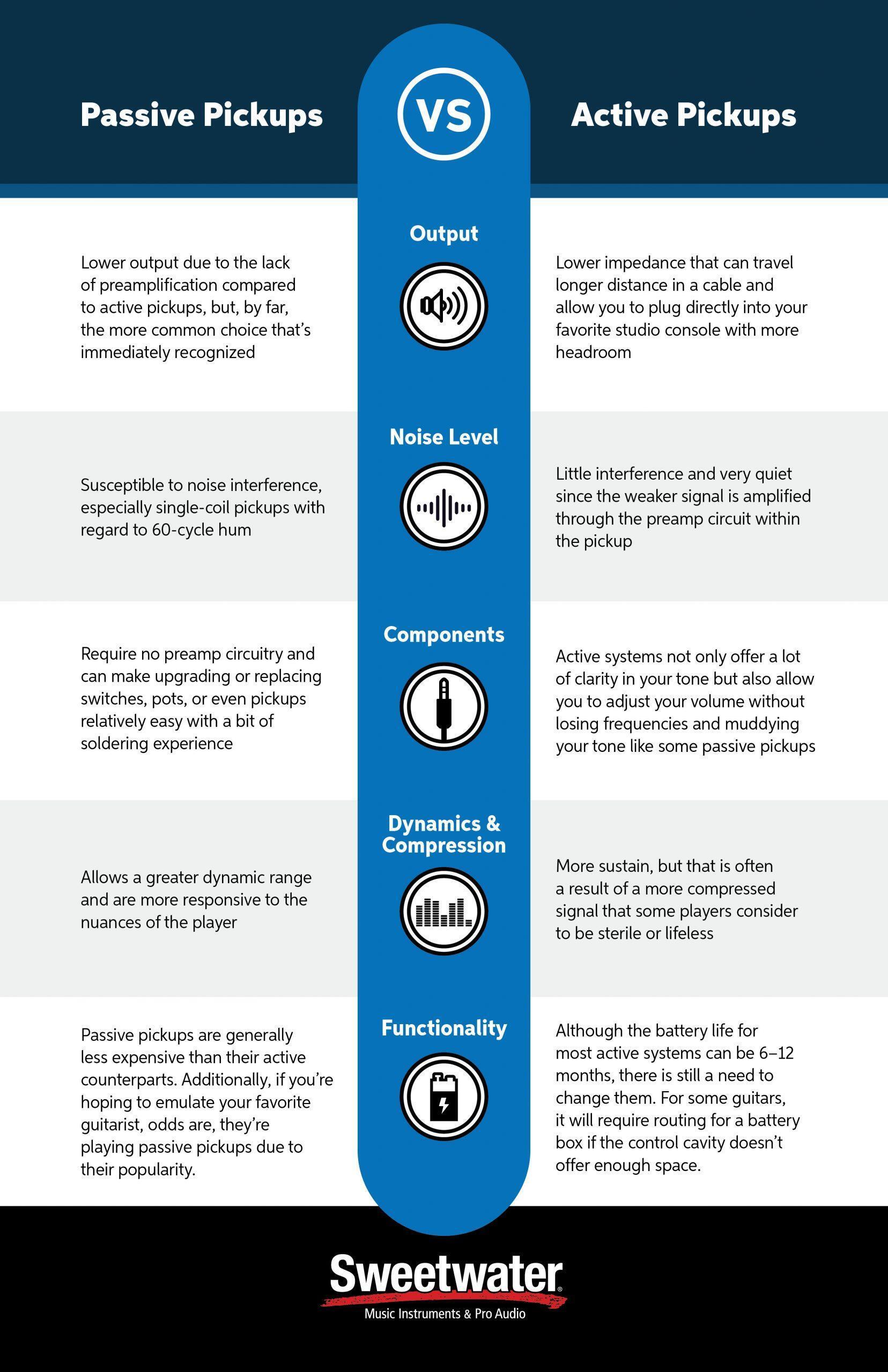
The chart below maps out the characteristics of each pickup so that you can better identify the right choice for you.
The Experiment
Did I really use this article as an excuse to throw some new pickups into a guitar and take them for a spin? A little, yes. But I also wanted to put all of the above analysis to the test and support it with some visual examples to help you understand the “why” of different active and passive pickup characteristics.
Before we get too deep into waveform dissection and frequency analysis, I want to say that these screenshots are offered only as a resource to help you visualize the differences between the pickups. When it comes to deciding which pickup is right for you, your eyes are not a substitute for your ears. When in doubt, I always suggest you rely on the opinion of the two friends on the side of your head (your ears) and not the two in front (your eyes).
The Guitar

In order to eliminate the variables of different tonewoods, body shapes, models, or manufacturers, I decided to use the same guitar for all of the waveform comparisons. This way, the only factor (apart from performance) affecting the analysis was the pickup and its proprietary components. I chose to use an Epiphone Les Paul Studio since a set of humbuckers and its two volume and tone pots would drop in easily with no additional pickup- or control-cavity routing.
For the installation of the pickups, I asked the luthiers from Sweetwater’s Guitar Workshop to put both pickups in the Les Paul.
Both pickup installations were relatively straightforward, apart from the routing for the battery box. Adding the battery box is well worth it in my opinion because it makes swapping out a dead 9-volt battery quick and painless.
If you have reservations about a guitar tech taking a router to your favorite axe, you shouldn’t stress too much. The control cavities of many guitars have enough room to fit a 9-volt, so you may not need a battery box at all. For me, though, I want to be in and out as quickly as possible when swapping a battery. With the battery box installed, there are no screwdrivers necessary to swap a battery and it can be done onstage in seconds.
The Pickups
The pickups we’re comparing are passive Seth Lover PAF humbuckers and the Zakk Wylde signature active pickups from EMG. These two pickups represent some of the most iconic sounds in the music world today. EMG 81/85s are some of the earliest visitors to the metal scene. I’m not sure what more I can say about Seth Lover’s PAFs other than they’re often imitated but cannot be duplicated. They’re both the real deal.
For this article I’m only considering the bridge and neck pickups individually. How pickups interact with each other when both are engaged is definitely worth considering, especially when weighing the tonal possibilities of series and parallel wiring. That discussion is better served in a different article where I can dive deep into pickup interactions.
The Tools
I kept this experiment simple so that you can do the same analysis with your own pickups. So, if you have a DAW and a guitar, get ready to follow along and put your own pickups under the microscope.
DAW
The DAW I’m using is Pro Tools | Ultimate, but any DAW will work just fine for everything we’ll be looking at. We’re going to use the waveforms to gain a better understanding of the differences between how passive and active pickups produce signal strength, compression, dynamics, and sustain.

I ran the guitar directly into a Focusrite Scarlett 2i2 USB audio interface. This is an ideal interface because it’s really compact and portable, and I only needed a single direct input for this recording. My goal was to compare an unaffected signal, so I made sure that the gain on the interface was set the same for both pickups. If you’re repeating this experiment on your own and comparing any two pickups, be sure that the gain knob is set the same for both.
Plug-in
In order to analyze the harmonic content of active and passive pickups, there is no better tool than a frequency spectrum analyzer. The one I’m using is absolutely free from our friends at Blue Cat Audio. If you don’t have a dedicated plug-in for this, then follow the link here to download this analyzer.
A frequency spectrum analyzer will display the abundance or lack of frequencies from any recording. This tool is useful for many more applications than just comparing active and passive pickups. Many of the engineers at Sweetwater rely on tools like this to help polish their mixes and better discern what their ears are telling them. If you’re looking to add something like this to your toolbox and to really up your mixing and mastering game, then I suggest you invest in Blue Cat Audio’s FreqAnalyst, a multitrack version of this free plug-in.
Analysis
Let me first tell you the specifics about the setup of the guitar. The neck relief was set at .006 inches with the bass-side action sitting around 5/64ths of an inch and the treble side around 4/64ths of an inch. The distance between the top of the pickup and the bottom of the strings were 8/64ths of an inch on the neck pickup and 9/64ths of an inch on the bridge pickup with the highest fret depressed. In my everyday playing, I would raise the active pickups a bit closer to the strings in order to capture more harmonic content, but I wanted to keep the string height as uniform as possible to make this a fair comparison.
One fun fact about these pickups is that, when measured with a VOM (multimeter), the Seth Lovers measure 7.3k ohms of resistance and 7.9k ohms of resistance on the neck and bridge pickups respectively. Checking the output of the preamp on the EMGs, they measure 203k ohms! Now, let’s look at some frequencies.
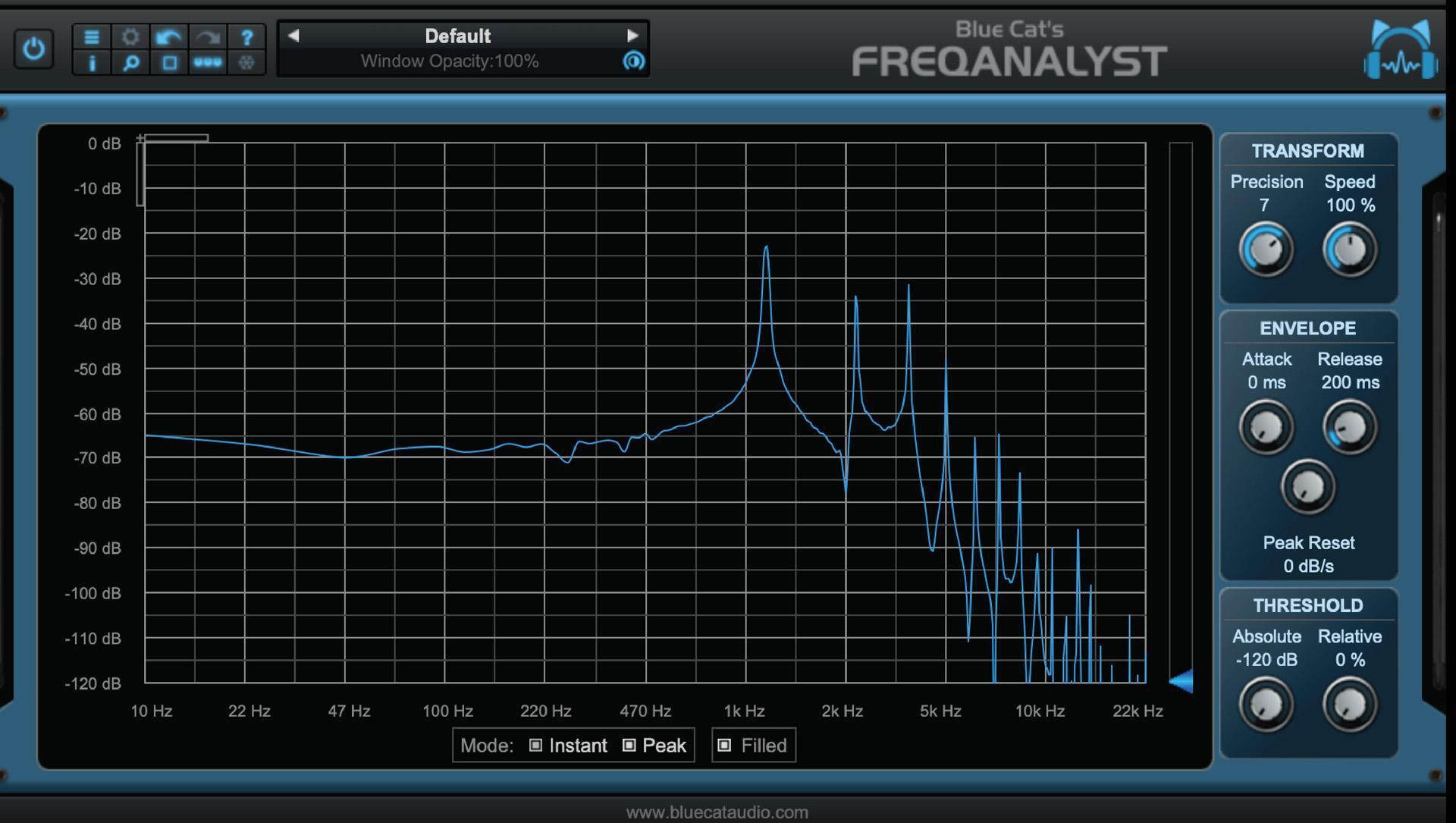
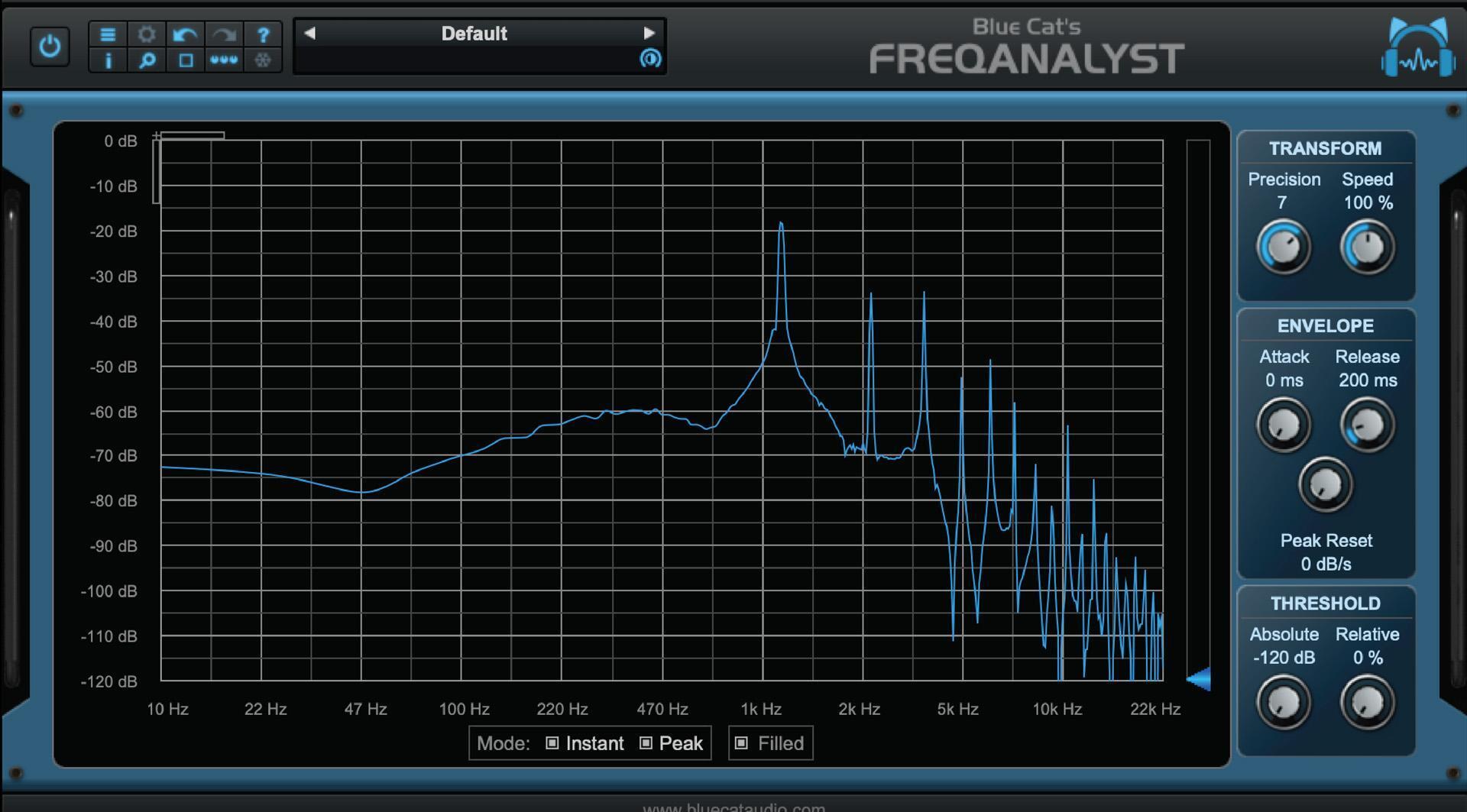
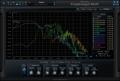
Take note (no pun intended) of the difference in the frequency content displayed in the images above. What you’re seeing is a snapshot of all of the frequencies when the highest note (D) on the guitar is played. As mentioned before, I could have squeezed even more harmonic content out of the pickups if I moved them a bit closer to the strings.
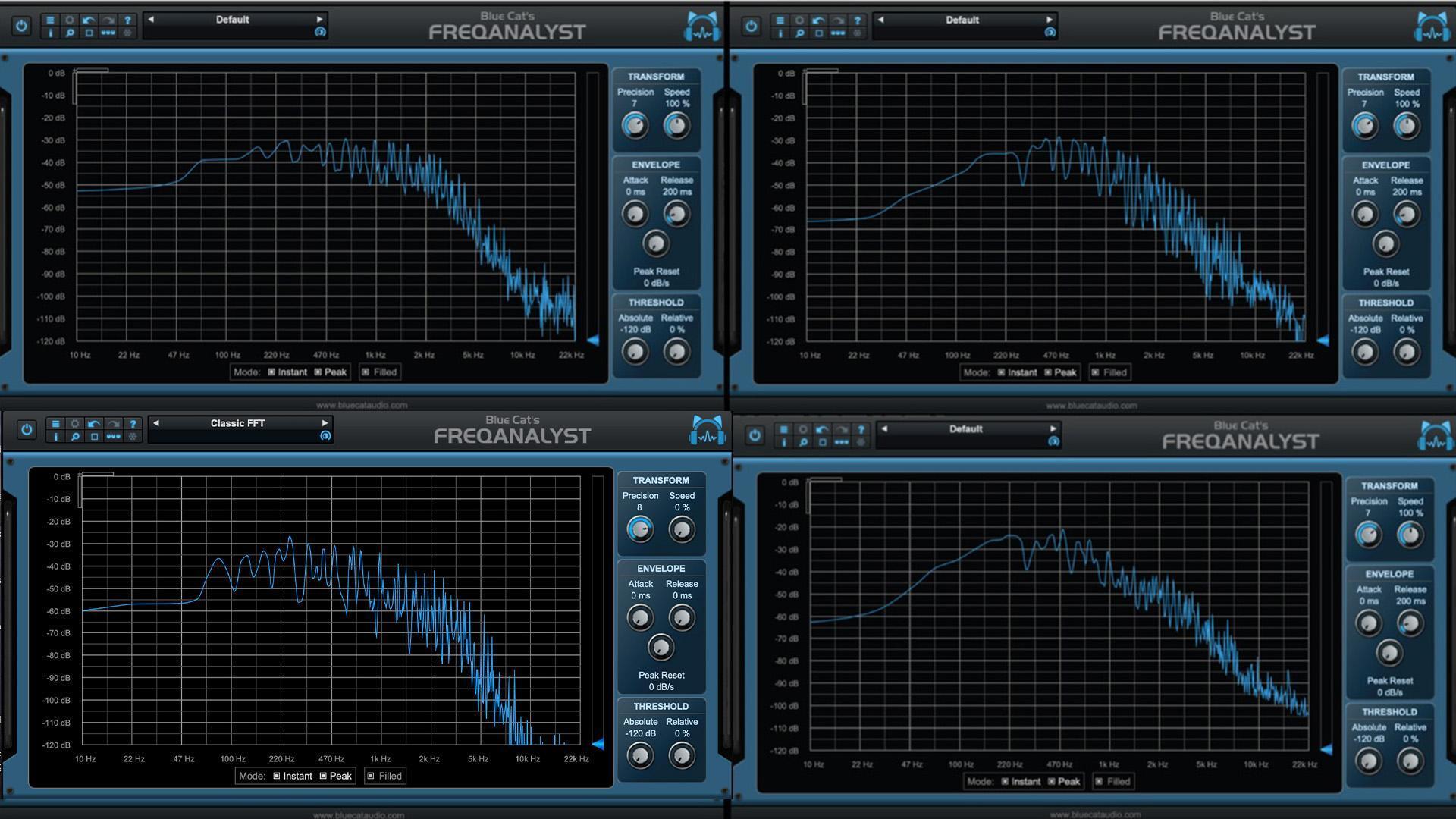
Passive Neck (bottom left), Active Neck (bottom right)
The screenshot above gives us insight into the amount of compression and dynamic distribution that is going on in our active pickups. Take a look at what the waveform does around the 2kHz area. The passive pickups on the left start to take a considerable dip, while the active pickups on the right slowly and evenly taper off into frequencies that we can’t hear as humans. Again, one is not necessarily better than the other, it’s just part of the characteristics of each pickup and will play into your own tastes and needs to create music.
There is a lot of harmonic content happening here. If you’re wondering what the source material is, this is an open E major chord strummed with a generous amount of pick attack.
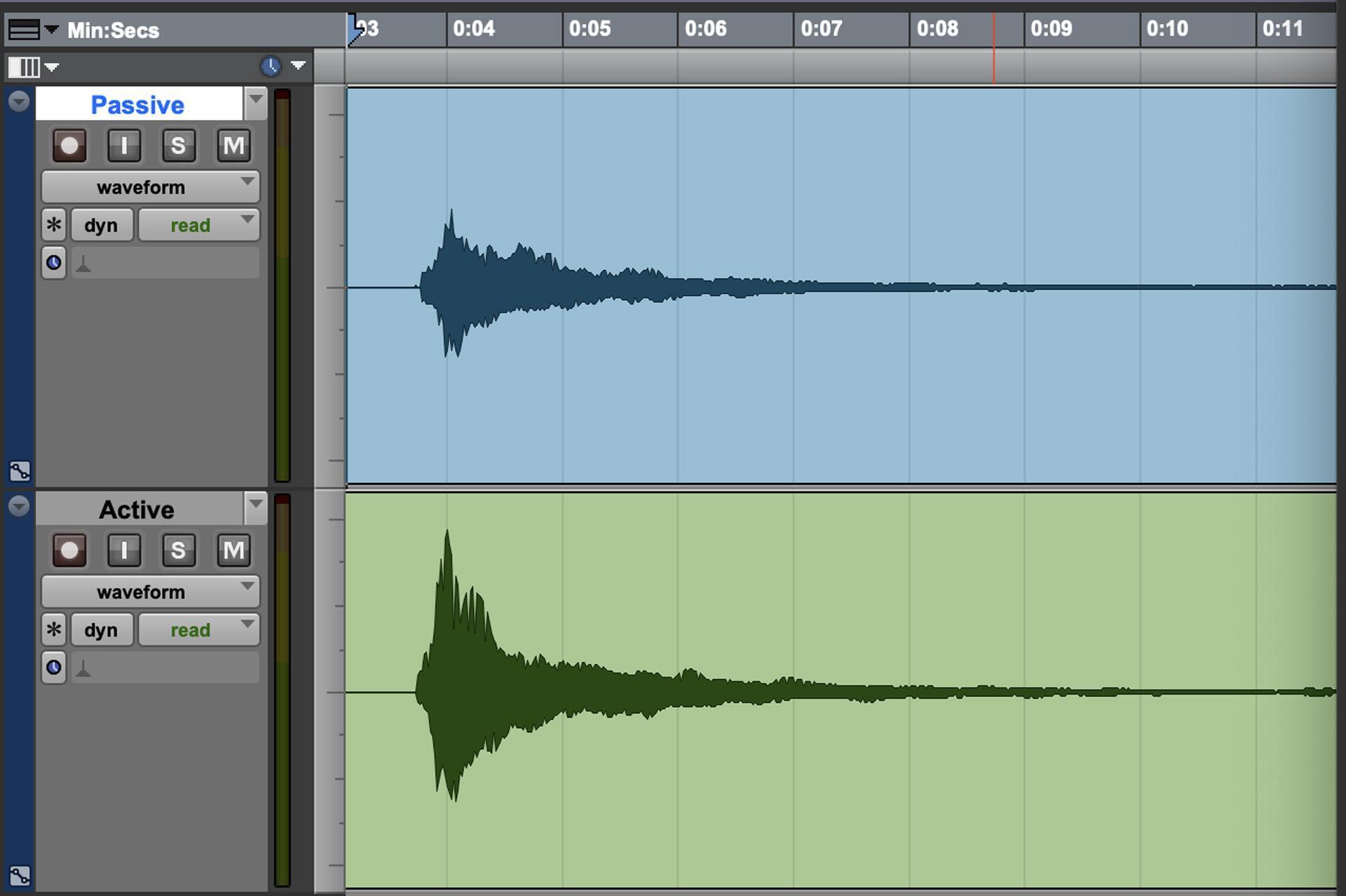
The waveforms you see above are pulled directly from the passive and active pickup tracks recorded directly into Pro Tools. This demonstrates how much hotter the active pickup is compared to the passive pickup. Keep in mind that the input gain was not changed for these recordings. There is certainly room for differences in string attack, but the image above is a fair representation of what I was hearing after numerous test runs.
When it comes to comparing sustain, the active pickup sustained about three seconds longer than the passive pickups on average.
Dive Deeper
So there’s my quasi-scientific analysis – one person’s fun way of analyzing pickups and gaining some insight into what’s happening under the pickup covers. Remember that these are only two pickup samples in a sea of different pickup options and configurations. I would encourage you to put some of the pickups below to the test, as well.

Active: Fishman Fluence Modern Active Humbucker
Learn More
Passive: Seymour Duncan Nazgul_Sentient
Learn More
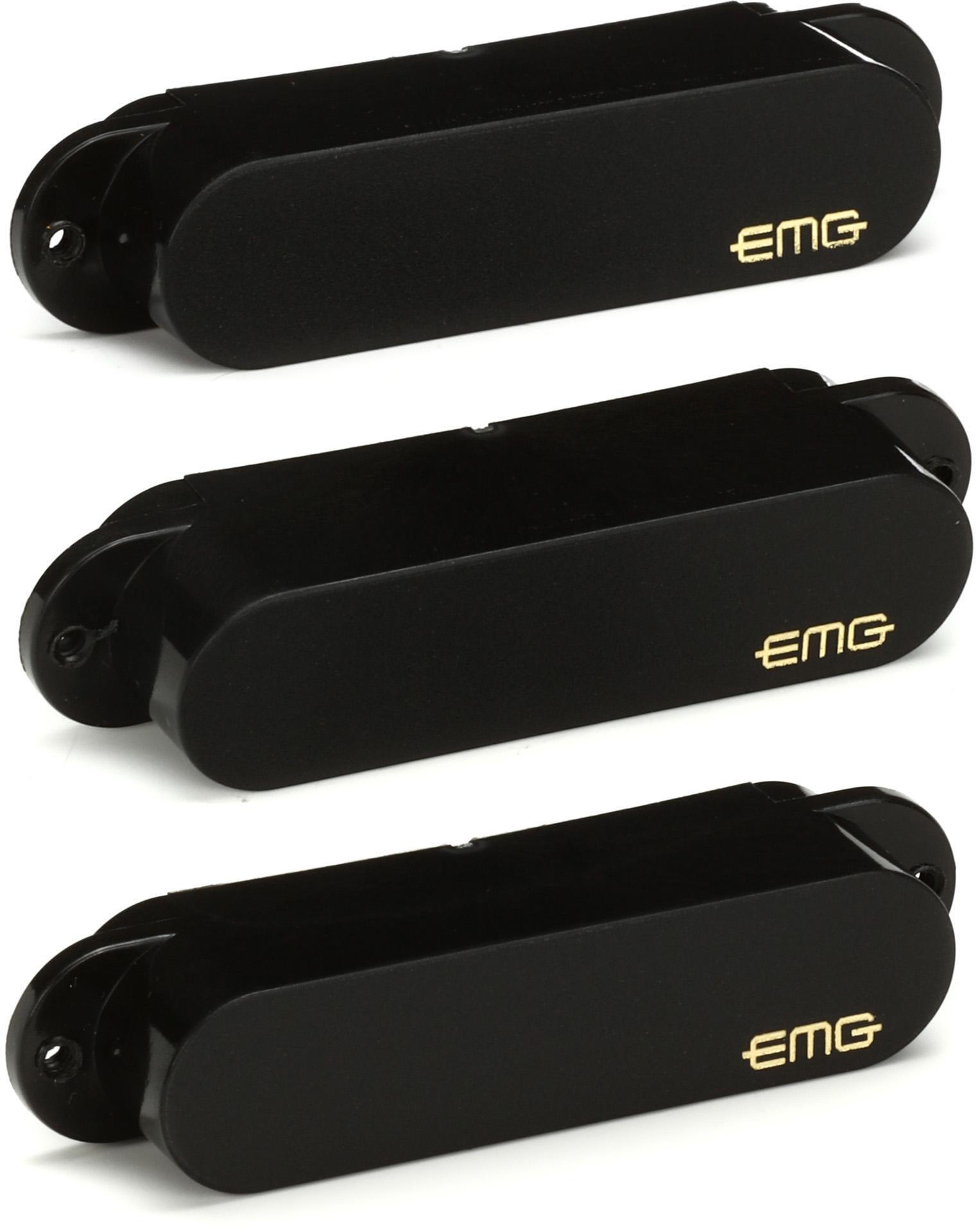
Active: EMG SA Active Alnico Strat Single Coil
Learn More
Passive: Fender Vintage Noiseless Stratocaster
Learn More

Active: EMG DG20 David Gilmour Signature
Learn More
Passive: Fender Hot Noiseless SSS Pre-wired Stratocaster Pickguard
Conclusion
I hope this article provides some insight to help pave the way on your personal journey to discover whether passive or active pickups are right for you. If you’re still unsure, then we’re here to help. Your Sweetwater Sales Engineer is available to discuss all of your musical needs and to offer some insight along the way. Or maybe there was some profound nugget of wisdom in this article that was the tipping point for you and you’re ready to take the plunge into active or passive circuitry but need a little help from an experienced guitar technician to do the installation. Sweetwater’s Guitar Workshop is here for you, as well. Our full-service workshop is equipped with the tools and skills to handle any modifications necessary to make your instrument work for you. Give us a call today at (800) 222-4700.