
Guitar Potentiometers
Get More at Sweetwater
Refine Your Search
Availability
Brand
- AxLabs (18)
- Emerson Custom (13)
- Mojotone (9)
- Fender (8)
- 920D Custom (6)
- DiMarzio (3)
- EMG (3)
- Gibson Accessories (3)
- PRS (3)
- EVH (2)
- Seymour Duncan (2)
- Allparts (1)
Price Range
Financing
What is this?Type of Deal
Series
Resistance
Related Searches


- 1
- 2
If you want to compare another product, please remove one of your earlier choices.
About Guitar and Bass Potentiometers
If you’ve ever picked up an electric guitar or bass, there’s a 99% chance you’ve used a guitar potentiometer. Guitar potentiometers are often hidden from view under the volume and tone knobs of an instrument. A potentiometer adjusts your guitar's volume or act as a tone control through variable resistance.
"The Name's Potentiometer — But You Can Call Me Pots"
In recent months, Sweetwater customers have asked their Sales Engineers about the inner workings of guitar and bass potentiometers. To put it simply, a potentiometer — also known as a pot — is a variable resistor. True to its name, a resistor is a passive component that resists the flow of electrical current. Resistors are used to reduce the flow of electrical current, which is incredibly important when it comes to the interactions between the pickups and the amp.
How Do Guitar Pots Work?
But how do guitar potentiometers work? It’s simpler than you think. The potentiometer has three terminals. The outside pair is connected to the resistive component. Meanwhile, the middle terminal connects to an internal wiper that contacts the resistive element. As you turn the knob of the potentiometer, the wiper travels along the resistive element, sending some of the signal to the output and some to the ground.
Run wide open, a guitar potentiometer sends 100% of the signal to the output. As you roll off the volume or tone control, the pot sends more and more signal to the ground until it eventually sends no signal to the output and 100% of the signal to the ground.
Which Pots Are Best for Which Pickups?
Now that we've established what guitar potentiometers are, how do we choose the right ones for the task at hand? The answer comes down to personal preference, since pickup selection and personal taste impact the best pots for your guitar or bass.
That said, if you're looking for guidelines, Sweetwater can help you narrow down your search. Guitar potentiometers come in a variety of resistance values, but 250K and 500K are the most common. Generally speaking, 500K guitar potentiometers are best for passive humbuckers and P-90s, as the higher resistance value creates a brighter tone that brings the midrange to life. The 250K pots are great for passive single-coil guitars since they help to mellow out any extremely high frequencies.
For most applications, the rule mentioned above will work. However, you shouldn’t be afraid to play with different guitar potentiometers. Is it possible to pair a single-coil Strat pickup with a 500K potentiometer? Absolutely! The sound will be ultra-bright and most likely cut through any mix. Do you need a dark-sounding humbucker? Run it through 300K or 250K pots for a smooth, jazzy bark.
Upgrading Your Guitar or Bass Pots? Start at Sweetwater
Are you champing at the bit to swap your guitar’s potentiometers? Sweetwater stocks guitar parts, accessories, and guitar potentiometers from the industry's most trusted brands, including Fender, Gibson, Mojotone, Seymour Duncan, and DiMarzio. We carry coil-splitting pots, concentric pots, split-shaft potentiometers, solid-shaft potentiometers, short shafts, long shafts, and more, all in a variety of values and materials. No matter what your instrument needs, it can be found here at Sweetwater.
For more information on guitar pots and electronics, see the following related articles:
- “5 Easy Mods That Will Hot Rod Your Tone” | inSync
- “7 Amazing Mods with a Push-pull Pot” | inSync
- “Potentiometer Values and Tone” | inSync
- “Finding Your Unique Guitar Tone” | inSync
- “Cleaning Pots and Switches” | inSync
- “How to Set Up a Guitar the Sweetwater Way” | inSync
What are the most popular brands for Guitar Potentiometers on Sweetwater.com?
What are the most popular Guitar Potentiometers on Sweetwater.com?
-

DiMarzio EP1201 500k Split-shaft Pot
4.5 out of 5 stars 19 reviews
$6.99 -

EVH Custom Potentiometer- 500k
4.5 out of 5 stars 2 reviews
$16.99 -
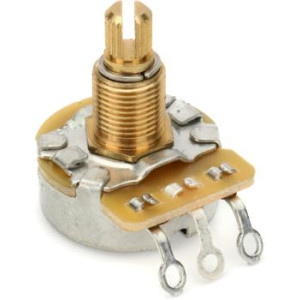
Gibson Accessories 500k ohm Audio Taper Potentiometer - Short Shaft
5 out of 5 stars 2 reviews
$14.99 -

920D Custom Bourns 500k Push-pull Potentiometer - 3/8-inch Short Split Shaft
4.5 out of 5 stars 2 reviews
$15.99 -

Emerson Custom Premier Pro Potentiometer - 500K, Short Split Shaft
3.5 out of 5 stars 2 reviews
$17.49
Why shop Guitar Potentiometers at Sweetwater.com?
With a massive selection of Guitar Potentiometers, free shipping, a free 2-year warranty, 24/7 access to award-winning support - and more - Sweetwater gives you more than any other retailer! If you have any questions about Guitar Potentiometers, make sure to give your personal Sales Engineer a call at (800) 222-4700.
