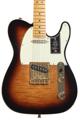
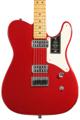
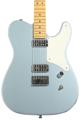
Seventy-five years ago, Fender introduced two legendary instruments that changed music forever: the Telecaster and the P Bass. Fender is marking this milestone with a 75th-anniversary lineup that celebrates the full history of these classics. From models that pay tribute to their origins to modern, feature-rich iterations, the diverse collection highlights the versatile appeal that makes a Telecaster or P Bass the top choice for so many players. To offer you a deeper, hands-on look, we let two of our writers spend quality time with each model. With decades of playing experience between them, they evaluate each instrument to share insights only players can offer while highlighting the special details Fender has included in this celebratory lineup.
The Instruments That Ignited a Revolution
By Cameron Day
From the moment I purchased my first Telecaster Standard at age 14, the Tele has reigned in my mind as the ideal electric guitar. It’s the guitar that I played in college while studying jazz, the guitar that I reach for first every day, and the guitar that first kicked off my fascination with Fender’s towering role in shaping the sound of modern music.
So, when Fender extended me the privilege to test out their 75th Anniversary Collection Telecasters and Precision Basses, you best believe that the first instrument I auditioned was the Fender 75th Anniversary Vintera Road Worn 1951 Telecaster. As a great fan of the scooped-sounding Teles of the early 1960s (my main guitar is an AVRI ’62 Tele), the biting, more midrange-forward twang of this Tele’s American-made Pure Vintage pickups made me think twice about where my tonal loyalties lie. Ditto for the chunky maple neck that captures the beloved “baseball bat” neck of Leo’s early creations. In short, it’s a pure, unadulterated rendition of arguably the most pivotal electric guitar in history and the instrument Fender fanatics such as myself champion when we claim that “Leo got it right the first time.”
While the Vintera Road Worn lived up to my exacting expectations of what a traditional Tele should be, I found the Fender 75th Anniversary American Vintage II 1951 Precision Bass offered a totally fresh playing experience — especially when compared to the split-coil P Basses I’ve recorded and performed with for years. This instrument takes you back to the very dawn of the electric bass, and it’s a far cry from the 1957 P Bass revision that most of us are familiar with today.
Setting aside the unabashedly rustic slab-style ash body, the 1951 P Bass felt surprisingly familiar in my hands as far as playability is concerned. However, plugging into this P Bass’s sole single-coil revealed a completely different voice than the round thump of a modern P Bass with a bright, punchy, and surprisingly aggressive bite. A set of old-school fiber saddles and stock flatwound strings temper that pickup’s crisp top end, but as a bassist that primarily plays with a pick, I can only imagine the growl this P Bass conjures when strung up with a set of roundwounds.
The last instrument that I had the pleasure of auditioning was the Fender 75th Anniversary American Professional Classic Cabronita Telecaster. It’s a guitar that I’m uniquely qualified to review, as my personal guitar collection contains not only several Telecasters but also a Gretsch G6122T-62GE Vintage Select Chet Atkins Country Gentleman that sports the very same 1950s-spec TV Jones Classic pickups as the Cabronita. Of course, the very first thing I did when taking the Cabronita home was to compare it directly to both my stock Tele and my Gretsch to figure out just where it sits on that spectrum.
I’m generally in the camp that regards pickups to be the most important sonic ingredient of a six-string, yet it was an enlightening experience to compare two guitars back-to-back whose specs were nearly all different besides the pickups. To my ears, the Cabronita clocked in far closer to the Tele side than the Gretsch, retaining the snap and twang of a typical Tele with a dash of warmer, more midrange-forward rockabilly attitude.
The Past Refined
By Jon Lennon
I played a Telecaster for the first time when I was in college. It shouldn’t have been anything special — a worn, poorly maintained instrument tossed around a college dorm — but, for me, it changed everything. The body felt large without being heavy, and its neck felt fast with an effortlessly low action and a slinky feel under my fingers. That broken-in Tele was easily the most comfortable guitar I’d ever played, and after negotiating with my roommate, it was mine for the cost of a gaming console.
That memory flooded back as I picked out notes on the Fender 75th Anniversary Player II Telecaster and stayed with me when I picked up the Fender 75th Anniversary Player II Precision Bass. The Player II strikes the perfect balance between the classic Tele design and its modern evolutions. That modern C neck just feels like home, and — trust me — the pictures can’t do that large flake finish justice. Tonally, the Thunderbolt pickups designed specifically for the 75th anniversary soften some of the harsher edges of the standard single-coil. I found the tone more predictable and forgiving, especially when I cranked the gain, responding to the nuances of my aggressive picking style and delivering that mid-forward Tele tone I love. While I’m not a bass player, I found the experience here to be equally enjoyable. It shares the same tonal sensibilities as its six-string cousin with an even, responsive quality that feels dialed in.
Distilling the Experience
While the Player II offers a balanced pivot point, the Fender 75th Anniversary American Professional Custom Telecaster and Fender 75th Anniversary American Professional PJ Bass refine the experience. They still play like classics, both featuring a Deep C neck profile and a maple fingerboard, with premium appointments such as a double-bound body, a burst-finished flame maple top, and gold hardware to elevate the design. However, the electronics truly set these guitars apart, highlighting the tonal versatility these models are known for.
On the Tele, the custom-tuned 75th Anniversary V-Mod II pickups brought a more traditional experience. As I played, they delivered the classic output and responsiveness I expected, but when I poured on gain and flipped on series mode, they fattened up into a warm growl. I plugged in the PJ Bass, and the same was immediately evident with the blended V-Mod II Jazz Bass and Split Single-coil pickups offering articulation without sacrificing that trademark thump.

A Fully Modern Take
I am not a player who sticks to just one style. I’ve played everything from jazz to metal on my Teles, so when I finally strapped on the Fender 75th Anniversary American Ultra II Telecaster, I couldn’t help but smile. It’s a guitar built for those who want the classic look but an undeniably modern feel. I love, love a compound radius, and that — combined with the tapered neck heel, ultra-rolled edges, and other ergonomic enhancements — immediately had me leaning on faster licks and more aggressive styles.
That instinct was only heightened when I cranked up the gain on the 75th Anniversary Fastlane bridge humbucker, which was aggressive and tight even at 11. However, as I dialed it back, the Ultra Noiseless neck pickup shone, and the S-1 switches added even more versatility, adapting to any and every stylistic variation I could throw at it. Decked out in an incredible metallic Liquid Gold finish, the Ultra II is truly a crown jewel of modern design.
A Collection for the Players
With the 75th Anniversary Collection, Fender has created snapshots that highlight the history of the Telecaster and P Bass. It’s a collection intentionally designed for the players who helped forge their legacy, celebrating the versatility, craftsmanship, and iconic tones that countless artists rely on. So, whether you’re a purist looking for the perfect historic re-creation, a collector who likes a guitar to look as good as it sounds, or a musician after a workhorse with every modern advancement, reach out to your personal Sweetwater Sales Engineer at (800) 222-4700 to score the Fender guitar or bass you’ve been dreaming of.