There are lots of notes you can play on guitar, and you know how many of them are fretted? Almost all of them! That’s why frets are so important. Not only do they divide the string chromatically into notes, but they also affect the feel and playability of the guitar.
Choosing the right frets for your playing preferences ensures enhanced playing comfort and scores of other benefits, ranging from supremely smooth and glassy bends to nearly indestructible fret-wire durability. But how do you choose when there are so many options?
Whether you’re sifting through the specs of brand-new instruments on Sweetwater.com or looking to have the Sweetwater Guitar Workshop deck out your old (or new!) instrument with fresh frets, an informed decision begins with information. This comprehensive guide will provide you with a firm foundation for everything from fret basics to fret sizes and the various alloys used to make frets.
Anatomy of a Fret
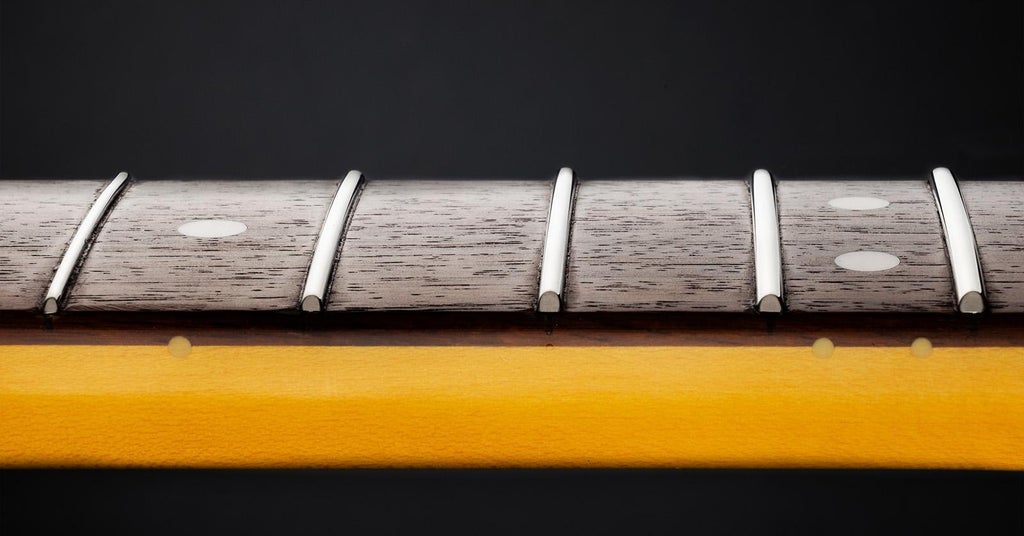
Before we dive in, let’s review the basics of frets and their construction. Frets are composed of a barbed tang that fits in the fret slot and a rounded “crown” that sits on the fingerboard. When we refer to frets, their width, and their height, we’re strictly referring to the fret’s crown. Here’s a handy diagram that illustrates a few common fret sizes.
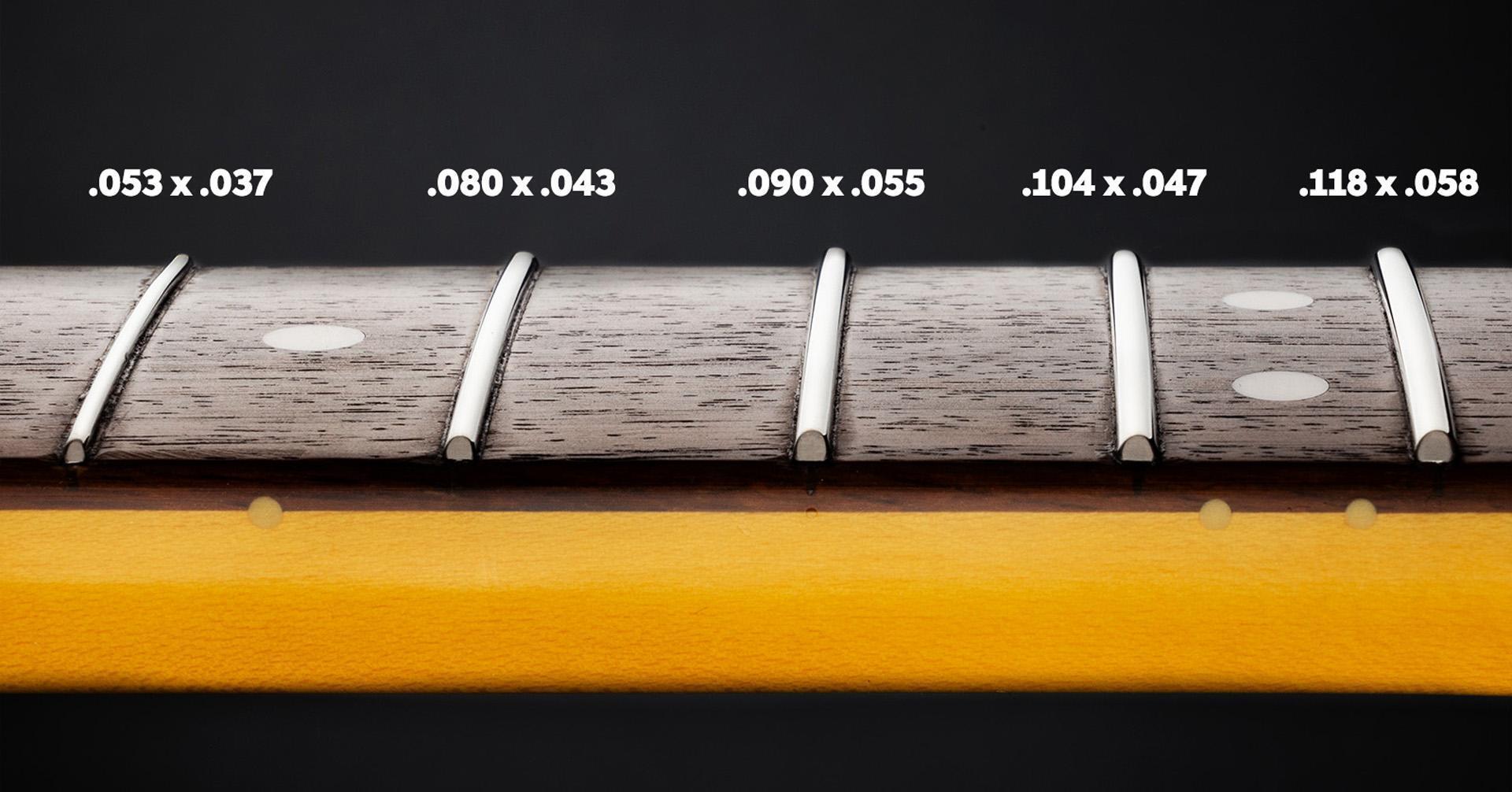
One more thing: As with many concepts in the world of guitars and basses, common wisdom concerning different frets and their benefits is largely subjective. Plenty of guitarists sing the praises of jumbo and medium-jumbo frets for their easy bending, but that doesn’t mean that you may not prefer smaller, vintage-inspired frets when showing off your well-practiced blues licks! Our guide is a rock-solid primer on the world of frets, but the best way to discover your preference is to get as many kinds of frets under your fingers as possible.
Fret Materials
Let’s start with the material of your frets. Truth be told, most fretted instruments will utilize nickel-silver frets. However, stainless steel is rapidly growing in popularity among guitarists, and plenty of guitars now even come equipped with glittering gold frets. To aid you in your six-string endeavors, we’ll take a closer look at these three fret materials.
Nickel Silver
Despite its name, nickel silver is comprised of nickel, copper, and a smattering of other non-silver metals. The name is a holdover from the days whenguitar makers did utilize silver in their fret composition, but as the metallurgists in the audience may point out, silver is a soft metal that wears far too quickly for constant contact with modern metal strings.
Nickel silver is so ubiquitous that, unless the manufacturer specifies otherwise, it’s safe to assume your guitar’s frets are made of it. It’s a perfectly durable and easy-to-work-with material, yet it does eventually wear over time. The rate at which it wears is entirely dependent on how often you play and how heavy-handed your playing style is. For example, a seldom-played guitar may go decades without needing fret leveling while road-worn six-strings that see hours of action every day may need leveling after just a few months.
Stainless Steel
For those wanting heavy-duty frets, stainless-steel frets are several times harder compared to standard nickel-silver frets. While they were once a rarity found only on boutique models or luthier-modified instruments, stainless-steel frets can be found on guitars of all styles and sizes nowadays.
So, why wouldn’t someone want these tough-as-nails frets on their instrument? To start with the subjective, many players find that stainless steel delivers a brighter timbre than nickel silver. Check out our article “Stainless Steel Frets – Do They Make a Difference?” to hear them in action and decide for yourself.
Additionally, stainless-steel frets can sport a smoother surface that certain players may find “slippery.” Once again, this is purely in the realm of preference, and players that regularly rip massive multistep bends may find they can’t live without stainless steel in their lives. Once properly polished, stainless-steel frets will also retain their sheen far longer than nickel-silver frets.
Finally, there’s no denying that stainless-steel frets raise the bottom line. The durability of stainless steel is a benefit to guitar players, but for the luthiers that install your frets, its toughness wears down and dulls their tools. The same goes for tools used in the factory to cut, file, and shape stainless-steel frets on brand-new instruments. Thus, stainless-steel frets are considered a premium option — with the increased price tag that entails.
Gold
Gold frets (such as Jescar EVO gold and other varieties) are less common than stainless-steel and nickel-silver frets since they’re the newest material on the scene. Just as nickel silver isn’t silver, gold frets don’t contain any gold; they simply have a far higher copper content that gives them their signature color.
What about durability? Gold frets are harder than nickel silver but not quite as hard as stainless steel. This gives them many of the same benefits as stainless-steel frets with the additional benefit that they’re easier for luthiers to work with. Sweetwater carries quite a few guitars that boast gold frets, and they are very fetching on instruments with matching gold hardware! And if you want gold frets on the guitar you already own, then our Guitar Workshop can install them for you.
A Matter of Height and Width
Now that we’ve knocked the factual bits out of the way, let’s take on a more personal topic: fret size. We’ll lay down the basics and commonly ascribed benefits for each fret size, but it’s key to remember that these bits of wisdom are by no means rules! Experiment and get your hands on as many types of frets as possible — that’s the best way to nail down which size best fits your style. Before covering the most common fret sizes, let’s talk about how a fret’s dimensions can shape your playing experience.
Fret Height
In general, taller frets are more conducive to bending. A very tall fret can result in an almost scalloped feel on the fingerboard, where your fingers sit high above and make no contact with the ’board itself. However, tall frets require a lighter touch — press down too hard on a tall fret, and you may bend it out of tune! Also, certain players will find that tall frets make for uncomfortable slides, sort of a like a speed bump in the road.
In comparison, smaller frets are more forgiving when it comes to finger pressure, feel more solid against the fingerboard, and present less of an obstacle when sliding up and down the neck. Thin, low frets were the norm for much of the guitar’s history; larger frets generally found increased favor the closer we got to the 21st century. For this reason, guitarists who favor a “vintage-feeling” instrument champion the feel of thin, low frets.
One indisputable advantage of taller frets is that they can be leveled and recrowned several times before a complete refret is required. In contrast, you may only get a light level or two at most out of a diminutive vintage fret!
Fret Width
Fret width follows the same general logic as fret height. Frets tended to get fatter through history, and the more of a bender or shredder you are, the more likely you’ll prefer a wide fret. The width of your fret is almost purely down to how it feels in your hand, and fat frets with gentle slopes can result in more of a seamless feel against your fingers as you traverse the neck. On the opposite end of the spectrum, thin frets can come across as more precise but may feel unwieldy to those who slide up and down the neck with a firm grip.
Fret Sizes
It would be a tall task to cover every fret size and style that Sweetwater has to offer, so we’ll provide a quick roundup of the most common fret varieties you’re likely to run into on most modern instruments.
Vintage and Vintage-tall Frets
Found on many historical reissues and vintage-inspired instruments, “vintage” frets are low, thin, and usually combined with a rounder radius. These frets are a fine choice for players who favor a low-profile feel and the tactile sensation of wood under their fingers. However, many players will find large bends more difficult to pull off. If you enjoy the precision of thin frets but prefer slightly easier bending, then vintage tall and other vintage-modified fret sizes retain a vintage shape with just a little more height to hold onto.
Narrow-tall Frets
These frets are strikingly similar to vintage-tall frets, only they’re just a bit taller and wider. Like vintage-tall frets, many vintage-inspired instruments utilize narrow-tall frets to provide enhanced playability without compromising entirely on a vintage feel.
Medium Frets
When in doubt, medium frets mark a superb middle ground that’s sure to please all but the most particular of guitarists. These frets can be found on all styles of instruments, offering both a comfortable feel in your hands and easy bending.
Medium-jumbo Frets
Clocking in with the same height as a medium fret, medium-jumbo frets boast a wider profile. These frets are immensely popular with players of all styles, and you can find them on models as varied as vintage-style reissues, modern shred guitars, metal-minded axes, and legions of six-strings that tout “modern performance.” What makes them so popular? These wide and reasonably tall frets are ideal for bending all over the neck, and they’re often combined with a flatter radius to further enhance bending performance.
Jumbo Frets
The largest of all the commonly available fret sizes, jumbo frets are sure to thrill guitarists who want the smoothest and easiest bends possible. Like medium-jumbo frets, jumbos are part and parcel in the world of metal, although it’s worth noting that plenty of legendary bluesmen, famously including the late, great Stevie Ray Vaughan, have had their instruments refretted with jumbos to better accommodate their bend-heavy styles. As you might expect, these frets are often paired with flatter, more modern radius necks. Finally, jumbo frets also come in a selection of supersize varieties for guitarists after the biggest frets possible, such as extra jumbo and super jumbo.
A Final Word on Frets
For such small strands of metal, frets can be a surprisingly complex and nuanced topic — a few thousandths of an inch can change a guitar-playing experience quite dramatically! While this starter guide to the world of frets has informed you about the basic shapes and materials used for frets, any musician will benefit by trying as many different frets as possible to find their favorite style.
Looking to optimize your bending technique with a jumbo-fret-equipped guitar or explore the hard-wearing virtues of stainless-steel frets? Make sure to give your Sweetwater Sales Engineer a call at (800) 222-4700 for expert, personalized advice on all manner of six-string minutia, ensuring that your current or next instrument perfectly lives up to your precise performance standards.