

A guitar capo is a device that is used to raise the pitch of the open strings of a guitar. It works by attaching to the neck and spanning across the fretboard, parallel with the frets.
If you attach a capo right above the nut at the first fret, then it effectively shortens the length of the strings and raises the pitch of the open strings. Each time you move the capo one fret higher up the neck (closer to the body), the pitch of the open string is raised by another half step. In this way, a capo is a movable nut.
For example, on a guitar in standard tuning with no capo, the notes of the open strings are:
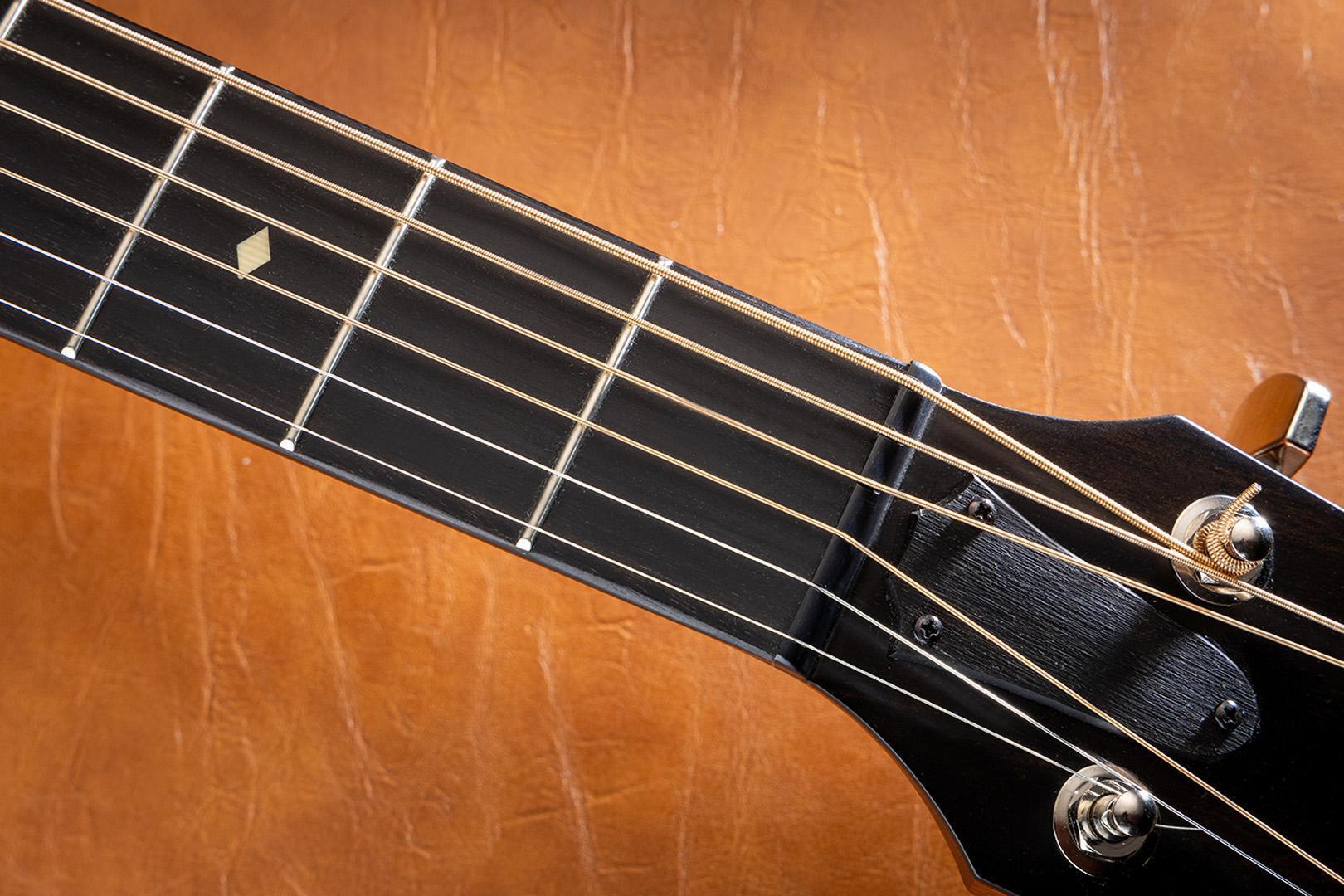
6th string: E
5th string: A
4th string: D
3rd string: G
2nd string: B
1st string: E
Attaching a capo at the first fret in the same tuning will raise all the pitches one half step. Now the notes of the “open” strings (first-fret capo) are:
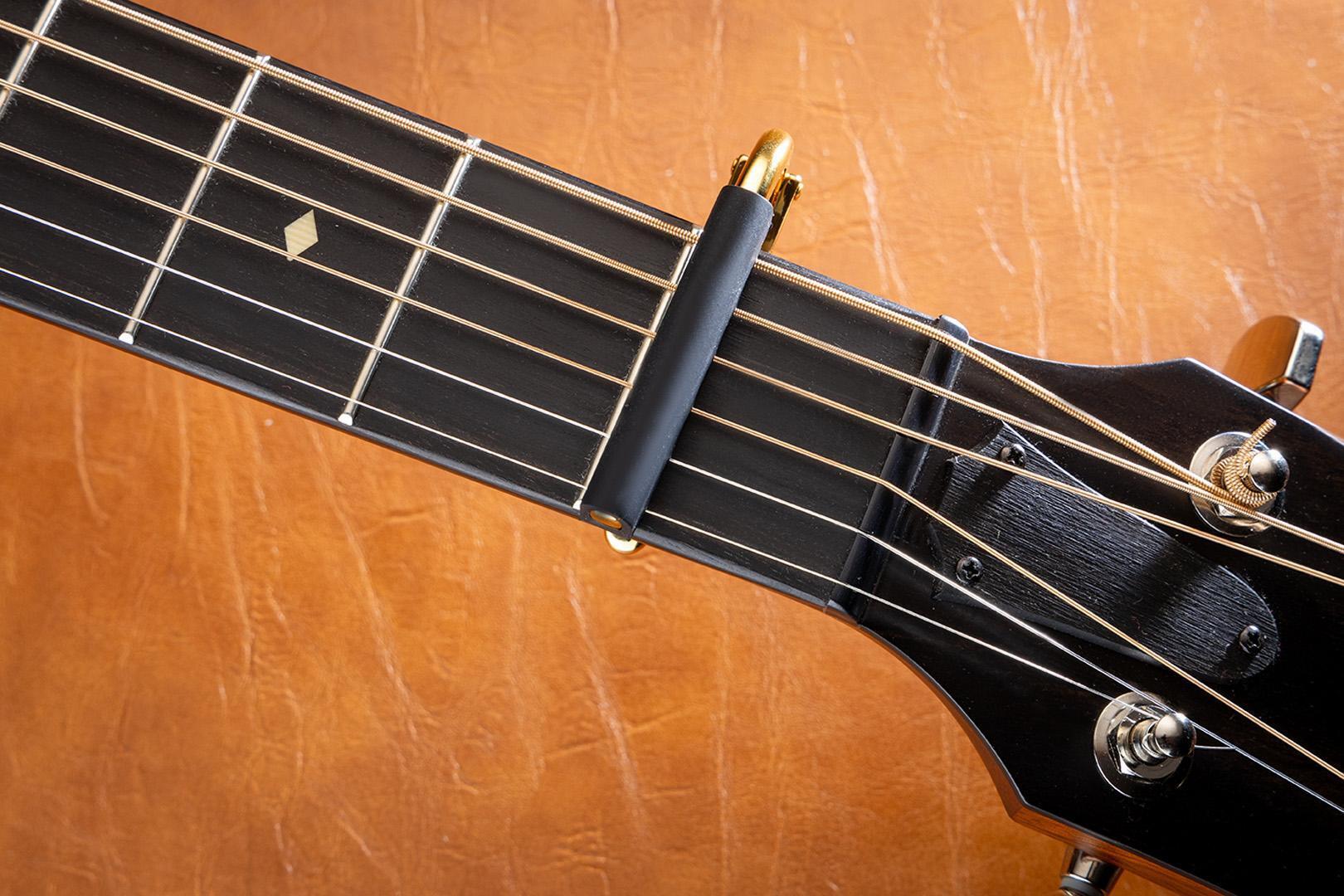
6th string: F
5th string: B-flat
4th string: E-flat
3rd string: A-flat
2nd string: C
1st string: F
Attaching a capo at the second fret will raise the pitch by another half step, and moving up each subsequent fret will raise the “open” pitch of the strings by a half step.
The capo has been in use on fretted, stringed instruments for centuries, with the first capo patent issued in 1850. “Capo” is derived from “capotasto,” the Italian word for “head of fretboard.” There are three basic styles of capo design: trigger, clamp, and yoke. Of course, there are exceptions to these basic designs, so those fall into our fourth category: specialty capos.
Capo Types
Trigger
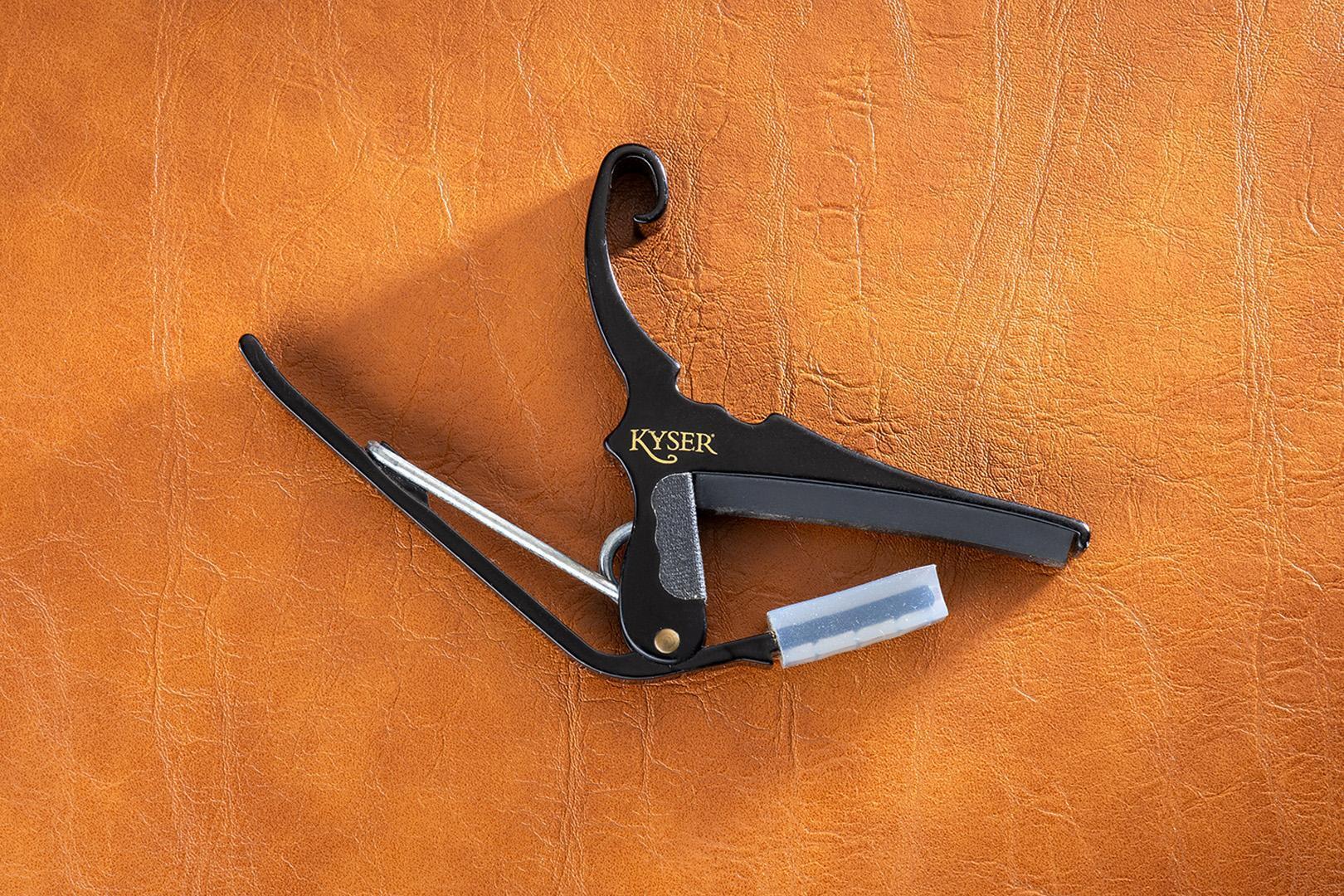
This is the most basic design and the simplest to use. Trigger capos are spring-loaded, gripping the neck and depressing the strings. They are attached via a “trigger” that you squeeze to open and then close to set the capo on the neck. Trigger capos are quick and efficient, so you can attach, remove, or move to another fret as quickly as you can grab the capo and move your hand. They’re also easy to access in performance. It’s not unusual to see a not-in-use trigger capo attached to the top of a guitar’s headstock, just a short reach away. The only potential downside to a trigger capo is the one-size-fits-all tension. The correct tension is one of the most important factors when using a capo. Too much tension and tuning can be a problem; not enough tension, and you have string buzz and/or dead open notes. Certain trigger capos offer adjustable tension, so you get the benefit of having the tension match your guitar’s action and string gauge along with their speed and ease of use.
Clamp
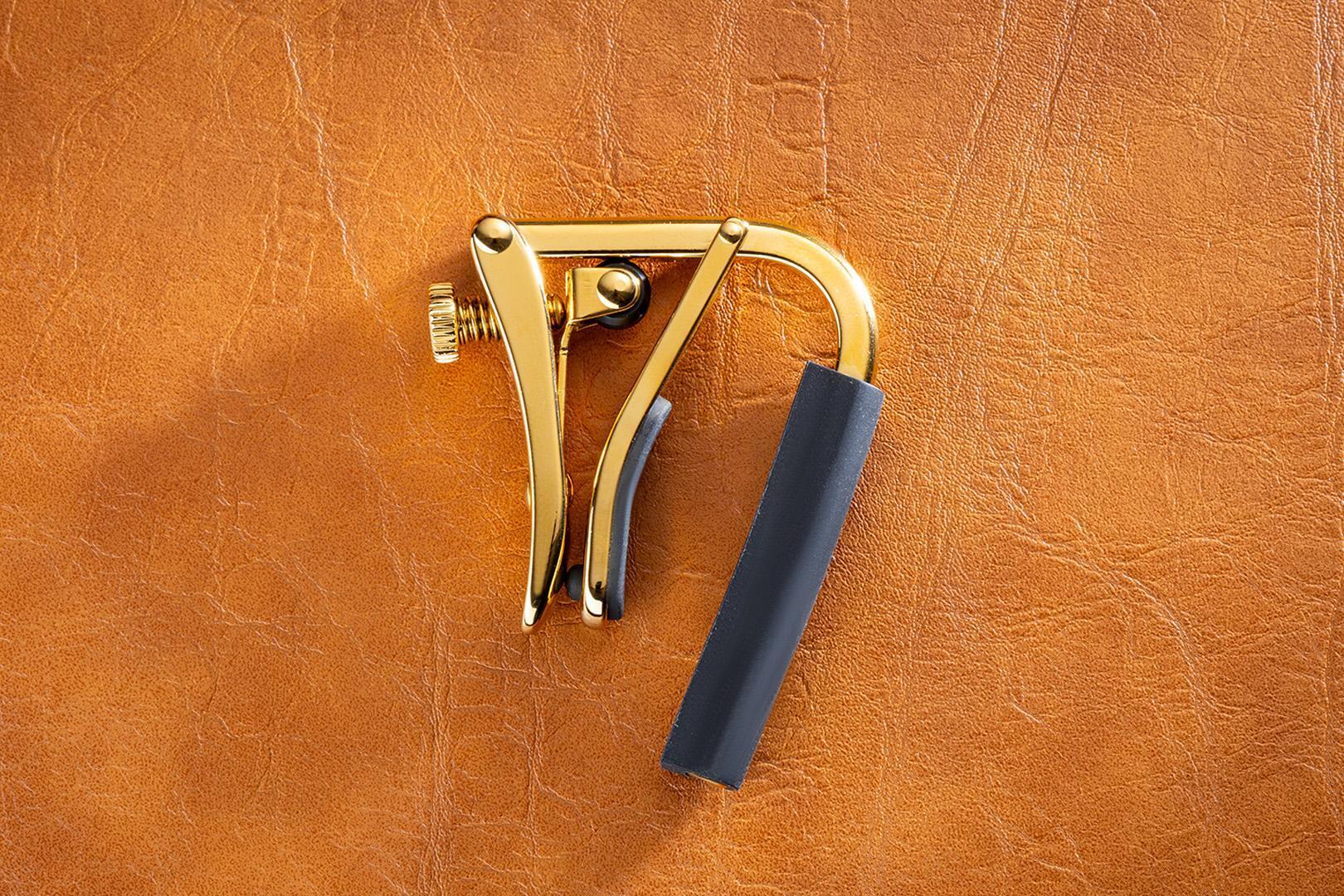
Clamp capos use two curved levers, a small adjustable spring, and a roller to push against the back of the neck and create pressure against the flat, rubber-coated surface that presses the strings against the fretboard. It’s an ingenious design that creates precise and accurate tension. It’s also quick to attach and release. The double-lever system releases the capo completely while the adjustable tension “remembers” your preset amount of tension. This makes attaching, removing, and reattaching a clamp capo quick and worry-free. The total release and adjustable tension also make it versatile — one clamp capo can fit on a wide variety of neck sizes, neck shapes, string gauges, action heights, etc. The versatility comes with a small downside, however. Setting the initial tension amount and finding the exact placement on your particular guitar’s neck takes trial and error. The total release of tension also means that you’ll need somewhere to keep the capo when not in use, which is not really an issue unless you’re in a performance and regularly taking the capo off the guitar.
Yoke
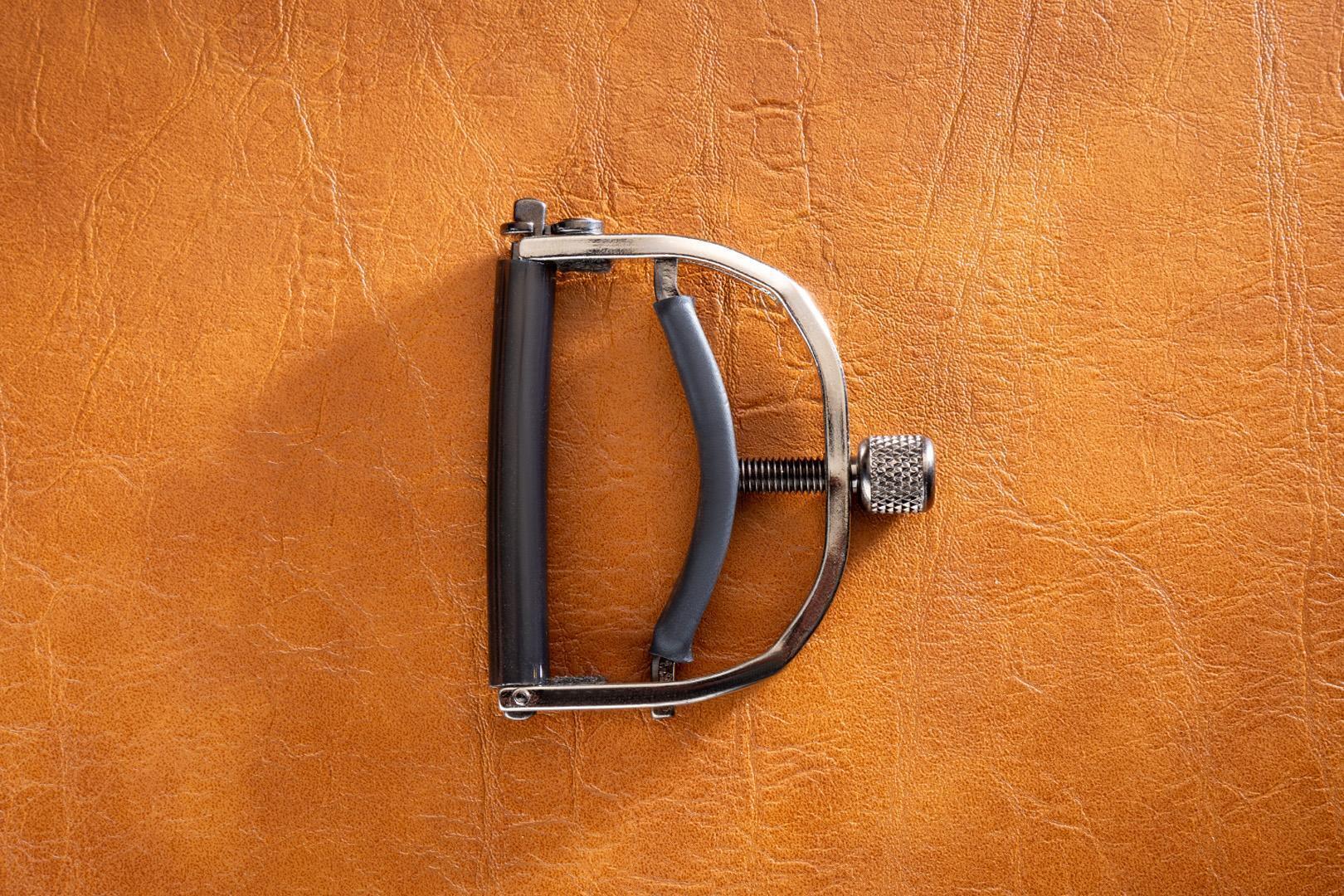
Sometimes referred to as “cradle” capos, yoke is one of the oldest capo designs. It wraps completely around the neck of the guitar and uses adjustable tension directly in the center of the back of the neck. This applies even pressure all along the fretboard side of the capo and is arguably the most accurate for tuning and tension. Modern yoke capos are sleek in design, and the tension screw is threaded so that a couple turns will tighten or release the capo enough to move it. This makes for a very quick and accurate change. When not in use, the capo stores discreetly on the headstock side of the nut, out of the way of your fretting hand and not putting extra tension on the strings between the nut and tuners. This means that you always have your capo right where you need it, ready for action.
The compromise with this style of capo is that it’s a bit more work to completely remove to swap it to another instrument compared to other designs. The wraparound design means that it is a bit more fitted to the instrument, so swapping between instruments with widely varying neck shapes may be a case for owning different yoke capos. Occasionally, a yoke capo in the not-in-use position can be slightly in the way of your fretting hand, but I’ve found that to be very rare.
Specialty
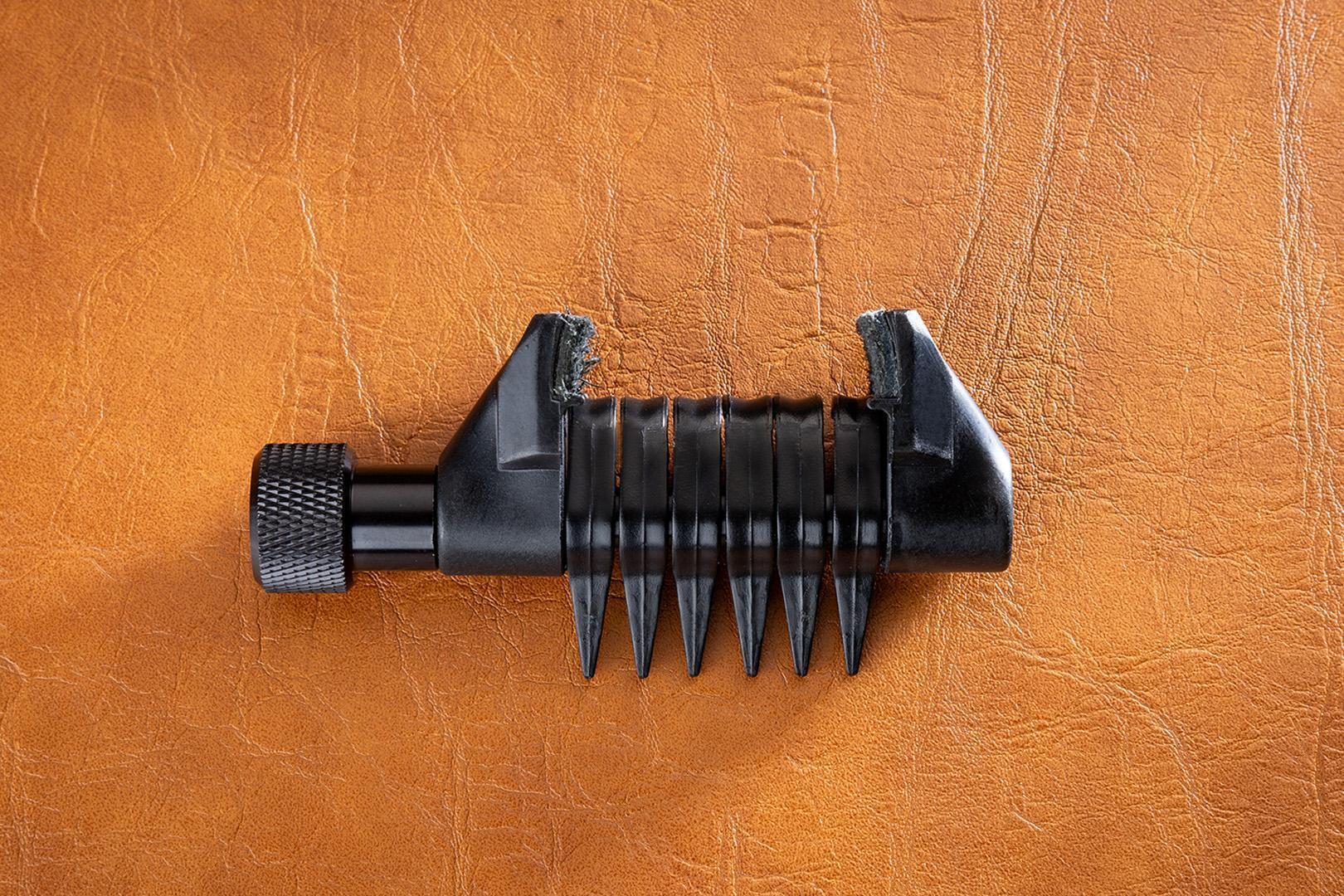
This category is a bit of a catchall because there are so many different designs, including trigger/clamp hybrids, clutch style, toggle action, quick-release yokes, and capos that use elastic bands to create pressure. The real specialty capos, however, are the partial capos, which only cover part of the neck and allow the other strings to remain open. This creates interesting alternate tunings. It’s also not uncommon to see two partial capos on a guitar in two different positions on the neck: one for the lower strings, one for the higher strings. A subset of partial capos are capos that cover the entire fretboard but only depress certain strings, allowing the others to remain open. More alternate-tuning fun!
I should also mention that any stringed instrument with frets can be capo’d. There are multiple types of capos designed to fit a wide variety of instruments such as banjo, ukulele, mandolin, etc.
Transposition Tool
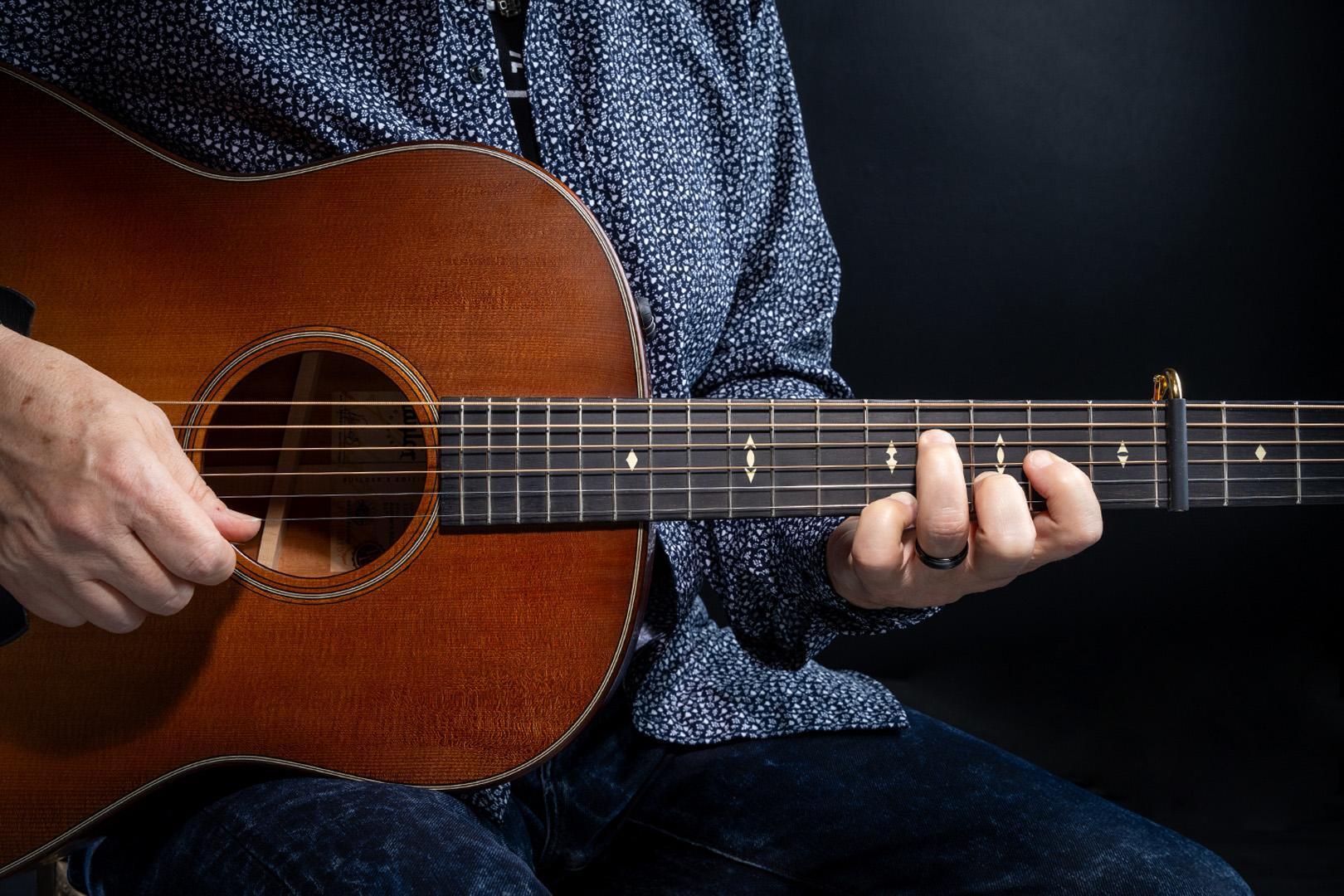
The capo is a great tool for instant transposition, especially to a higher key. For example, if you were accustomed to playing a song in the key of D using the familiar, open-position chord shapes for D, G, and A and someone you are playing with wants to perform the song one half step higher in the key of E-flat, then a capo on the first fret will allow you to use the same familiar chord shapes one fret higher on the neck. Even though the chords use the same shape and fingering one fret higher, the first-fret capo creates a new open-string pitch a half step higher. Now, your same three chords are in the key of E-flat.
This has led to the idea that using a capo is somehow cheating, as if it were a lazy way to play guitar, as opposed to learning multiple chord shapes and barre chords. The capo has even been referred to as a “cheater bar.” I say that any tool that gets you closer to your goal is helpful. With that thought, here is a sample of the musically creative uses for the capo.
Creative Uses
Let’s start with the sound of open strings versus fretted notes. Fretting a note with your finger changes the sound of the note overall. Open strings have a brighter, crisper sound that naturally sustains longer compared to a fretted note. This effect is compounded with chords; a barre chord sounds duller compared to a chord using open strings. A capo has the sound of open strings, so using a capo allows that open-string sound in keys that don’t normally accommodate open strings.
Another common capo use is for arrangement options. One of the most distinctive sounds on the guitar is that of open strings ringing against moving fretted notes. The capo gives you that option in any key, which is something that would be physically limiting with only fretted notes.
Because of the guitar’s tuning, chord shapes have their own unique qualities. The physical shapes of these chords and the fingers used also facilitate certain musical moves. Chord shapes that utilize open strings make transposing this concept difficult to impossible without a capo.
Stacking Recorded Guitars


The unique sounds of different chord shapes lead to a common trick for recording guitars. It involves playing the same chords in different places on the neck and using different chord shapes and a capo to mimic open strings. For example, let’s stack a C-major chord (C, E, G) using two different chord shapes, two different spots on the neck, and a capo. The first track uses a common C chord shape in open position. The second track uses a capo attached at the third fret and a common A chord shape. Because A is three half steps lower than C, using a capo at the third fret moves the pitches up three half steps from A to C. More importantly, the three notes in the C-major chord (C, E, G) are voiced differently in each chord shape, which provides a bigger sound than playing the same voicing twice.
Tips

- Place the capo at the end of the fret, next to the fret wire.
- Make sure that the capo is straight and parallel with the fret wire.
- For capos with adjustable tension, tighten them to the point where all the open notes ring evenly. Tightening beyond will push the pitch of the strings sharp.
- Use the right type of capo for each instrument, including nylon-string, acoustic, electric 6-string, or 12-string guitars. Neck shape, fretboard radius, and neck width can vary among instruments. You’ll have better results with the right size and shape of capo.
- When applying a capo, make sure the strings are not pulled up or down across the fretboard, this will ensure consistent tuning.
Sweetwater Has the Capo You Need
Interested in exploring what you can do with a guitar capo? Sweetwater has an amazing collection to choose from, so you’re sure to find what you need. Click the link below or call your Sweetwater Sales Engineer at (800) 222-4700 for more info.