
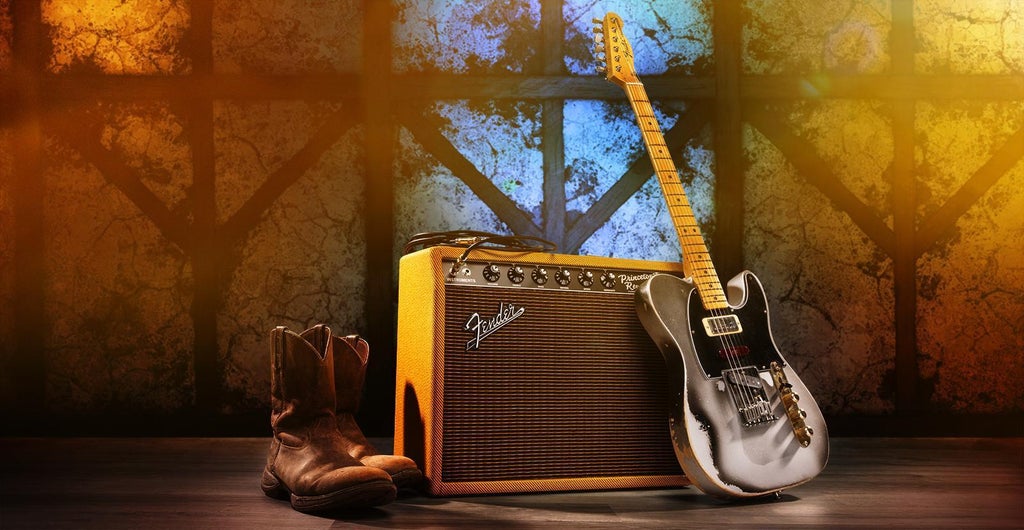
Hone Your Tone Using Artist Rigs As Starting Points
The relationship between country music and the electric guitar runs deep. Over the years, the genre has developed a distinctive tonal lexicon powered by a familiar collection of axes, amps, and pedals. That’s not to say, however, that there isn’t a tremendous amount of variety within the genre’s tropes. It’s often overlooked — at least by country outsiders — how adventurous and innovative country music guitarists have been and continue to be in terms of technique, tone, and technology.
If you’re an aspiring guitarist with a taste for country twang or a seasoned player looking to expand your repertoire, then cracking the country-guitar code may seem like a head-scratching proposition.
Don’t fret. This article will walk you through everything you need to know to get a great country guitar tone even if you’re brand-new to the genre. We’ll also unpack several verified country-artist guitar rigs, which you can use as starting points to develop your very own signature country sound.
But First: Great Country Guitar Tone Starts With . . .
Before we move on to our artist rigs, it’s important to understand the building blocks of a great country guitar tone. The key ingredients are:
- A twangy guitar — When country players speak of “twang,” they’re often referring to a particular sound: the quacky, nasal whine of a Fender Telecaster’s bridge pickup. It’s the sound that defined the genre. In fact, the Telecaster’s rise in popularity so closely follows the trajectory of country music that it’s difficult to separate the two.
Does this mean a Telecaster is required for modern country music? Absolutely not. As you’ll see in our artist profiles, several guitarists have found their sound using nontraditional instruments. That said, if you’re looking for the thing that will get you in the classic country ballpark, then a Telecaster (or T-style guitar) is a great place to start.
- A tube amplifier — Country guitar is steeped in the tube-kissed tones of stage combo amplifiers of the 1950s, ’60s, and ’70s. Standards of this era include the Fender Twin Reverb, Fender Deluxe Reverb, and Fender ’59 Bassman along with amps based on these circuits.
Country players favored these amps for their impeccable (for the time) clean tones, harmonic breakup characteristics, and onboard tube reverb and tremolo.
As with guitars, it’s not uncommon to find modern players bucking these trends, backlining stages instead with walls of Mesas or Marshalls. Just be aware that something like a Twin Reverb or a Bassman will often get you that Bristol/Austin sound much quicker.
- A handful of pedals — Country guitarists may not horde pedals like players of other genres, but the essentials are still present. Unless you’re dealing with an amp purist, it’s typical to spot at least an overdrive pedal, a compressor, a reverb, a delay, and a tremolo on a player’s board — tools rooted in country music’s golden age.
Now, with the basics out of the way, onto the artist profiles.
- Country Guitar Rig #1: Brad Paisley
- Brad Paisley Guitars
- Brad Paisley Amps
- Brad Paisley Pedals
- Country Guitar Rig #2: Brent Mason
- Brent Mason Guitars
- Brent Mason Amps
- Brent Mason Pedals
- Country Guitar Rig #3: Vince Gill
- Vince Gill Guitars
- Vince Gill Amps
- Vince Gill Pedals
- Country Guitar Rig #4: Albert Lee
- Albert Lee Guitars
- Albert Lee Amps
- Albert Lee Pedals
- Country Guitar Rig #5: Keith Urban
- Keith Urban Guitars
- Keith Urban Amps
- Keith Urban Pedals
- Country Guitar Rig #6: Chris Stapleton
- Chris Stapleton Guitars
- Chris Stapleton Amps
- Chris Stapleton Pedals
- Country Guitar Rig #7: Lindsay Ell
- Lindsay Ell Guitars
- Lindsay Ell Amps
- Lindsay Ell Pedals
- Country Guitar Rig #8: John Osborne
- John Osborne Guitars
- John Osborne Amps
- John Osborne Pedals
- Country Guitar Rig #9: Kurt Allison
- Kurt Allison Guitars
- Kurt Allison Amps
- Kurt Allison Pedals
Country Artist Guitar Profiles
Seeking inspiration for your next country guitar rig? Read on to find out what high-profile country players are maining onstage and in the studio.
Country Guitar Rig #1: Brad Paisley
Brad Paisley Guitars
Brad Paisley is one of the most influential country guitarists of his generation. His prized 1963 Silver Sparkle Tele — heavily featured on the 2011 release This Is Country Music — is the inspiration behind Brad’s signature Fender Road Worn Telecaster. Its ultralight body comes loaded with a set of top-tier country pickups: a custom-wound Paisley Spec bridge pickup and a Twisted Tele neck pickup. Together, these pickups are voiced to handle Paisley’s biting hybrid-picked leads and smooth country rhythm tones. A signature Road Worn Esquire with a hidden Secret Agent neck pickup is also available.
Brad Paisley Amps
When it comes to amps, Brad prefers AC30 styles, particularly those made by Trainwreck and Dr. Z. One of his self-described “desert island” amps is a Dr. Z Z Wreck Silver Set half stack. This 30-watter was specially designed for Brad by the legendary Ken Fischer (of Trainwreck Amps) and Mike Zaite (of Dr. Z).
The Z Wreck is country famous for its spongy, cathode-biased AC30 cleans and full-bodied crunch past the amp’s halfway point. This amp is responsible for many of Brad’s signature tones from the “Ticks” era (2007) through “Remind Me” (2011) and beyond.
Building a Paisley rig on a budget? The Z Wreck 112 and Z Wreck Jr. combo amps are also available.
Brad Paisley Pedals
Brad’s signature Wampler Paisley Drive Deluxe — or “PaisleyDog,” as Brad has named it — houses two staples of the country guitar world. Side A is based on the fabled Wampler Underdog overdrive produced by Brian Wampler in short supply (only 100 units) to help offset a friend’s medical expenses. It’s based on a 5-knob version of a Nashville secret weapon, modified here to help tame some low-end deficiencies of the original. Side B of the Paisley Drive Deluxe is Brad’s signature mid-bumped Paisley Drive circuit, which Brad uses to stack his Underdog in a live setting.
Other pedals used commonly on Brad’s board are a Way Huge Aqua Puss analog delay (heard everywhere on Brad’s records from 1999 onward), an MXR Classic 108 Fuzz, a Dunlop Echoplex Preamp, and the country classic: a TS808 Ibanez Tube Screamer.
Country Guitar Rig #2: Brent Mason
Brent Mason Guitars
Grammy-winning guitarist Brent Mason has been featured on more records than any other artist on this list. When he’s not slinging licks for the likes of Alan Jackson and Brooks & Dunn, he’s teaching one-on-one sessions to players worldwide via Skype.
The signature sound behind Mason’s thousand-plus session record? His ’67 Tele modified with a 5-way Nashville pickup configuration to get him virtually any country sound under the sun. Its trio of choice Seymour Duncan pickups includes a bridge-position Duncan Vintage Stack STK-T3b, a middle Duncan Hot Stack STK-2S Strat pickup (which is actually a humbucker in single-coil form), and a neck-position Duncan Vintage SM-1N mini Firebird humbucker. Each pickup feeds its own dedicated volume control so Brent can feather in the perfect sound for whatever style he’s working in.
Apart from its far-reaching tones, Brent’s signature Tele is most identified by its gray auto-primer finish and internal Glaser B/G Bender system — a key to Brent’s pedal-steel mimicry.
Brent Mason Amps
A pair of Black-panel classic Fenders — a ’65 Twin Reverb and a Super Reverb — alongside the occasional Deluxe Reverb are all you’ll find on Mason’s stage rider today. These supply the ideal front end for Brent’s considerable pedal collection, from which he derives the lion’s share of his expanded textures.
Brent Mason Pedals
Central to Mason’s tone is a BOSS GE-7 graphic equalizer. This is used to front-end other amps and pedals, occasionally taming problem frequencies but more often juicing desirable frequencies. Following the EQ is a trio of Wampler pedals — the Ego comp, Euphoria drive (“D” style), and Brent’s signature Hot Wired pedal — that give Mason his many shades of dirt. The Hot Wired combines a Plexi and a Screamer into a single housing for massive versatility.
A Fender Tre-Verb gives Brent his amp-style reverb and tremolo. Other minor players include an EHX Deluxe Memory Man 1100-TT with tap tempo for copping old-school slapback echoes to tempo-locked eighth-note repeats.
Country Guitar Rig #3: Vince Gill
Vince Gill Guitars
Country Music Hall of Famer Vince Gill has proved he’s as at home on a solo stage as he is backing up today’s hottest talent (Carrie Underwood, Kelly Clarkson). How does he do it? It starts with his trusty Blackguard ’53 Fender Telecaster, which has served Gill his entire career. This guitar is one of the sweetest-sounding Teles in country music history, thanks in part to its aged ’50s pickups and Vince’s propensity for rolling back the tone control. Gill is also fond of a late-’60s semi-hollow thinline Tele, which he plays in D standard tuning on songs like his and Paul Franklin’s cover of Merle Haggard’s “The Fightin’ Side of Me.”
Vince Gill Amps
When it comes to amps, Vince likes ’em loud and proud. He can be heard raising Cain onstage and in the studio through a cranked ’65 Deluxe Reverb Reissue. For Strat tones, he prefers a ’59 Tweed Bassman. Gill is also a longtime user of Rivera amps, his favorites being a pair of Rivera Hundred Duo Twelves, which are Paul’s take on the historic Twin Reverb.
Vince Gill Pedals
Vince has remained mum on his pedal choices but has been seen playing live into a BOSS CS-3 compressor, a Keeley-modded BOSS DD-3 digital delay, a BOSS TR-2 tremolo, and a Wampler Faux Spring Reverb. Powering it all is a single Voodoo Lab Pedal Power 2.
Country Guitar Rig #4: Albert Lee
Albert Lee Guitars
Hybrid-picking icon Albert Lee is known for three things: replacing James Burton in Emmylou Harris’s Hot Band, an encyclopedic knowledge of Tele-style guitars, and his breakneck right-hand technique. Gear-wise, Lee is best known today for his line of Ernie Ball Music Man signature guitars, known simply as the Albert Lee.
The EBMM Albert Lee is a retrofuturistic take on the classic Tele. Its angular offset body is loaded with three custom Seymour Duncan pickups, Strat-style 5-way switching, and an active buzz-eliminating Silent Circuit to neutralize 60-cycle hum. A DiMarzio-loaded, twin-humbucker Albert Lee HH is also available. Each model comes outfitted with a hardened-steel vintage tremolo system and a drift-resistant roasted maple neck for effortless playability.
Did You Know . . .?
Besides being a credit to his craft, Albert remains one of the top Telecaster authorities. He has helped pioneer the practices of pickup modding and B-Bender embellishments among country lead players.
Albert Lee Amps
Lee comes from the old school of guitar session work: his axe, his hands, and a high-headroom Fender are all he needs to get his sound. He has been seen using bone-stock Twin Reverbs live. In the studio, he may reach for a 100-watt tube Fender Tone Master half stack or a 1970 Music Man HD-130 full stack when the occasion demands.
Albert Lee Pedals
Lee is a true axe-to-amp player. He has stated in interviews that he “hate[s] pedals all over the floor,” but he has been occasionally seen in his solo career using an array of TC Electronic drive and ambient effects. These include the MojoMojo overdrive, Flashback delay, and Hall of Fame reverb.
Country Guitar Rig #5: Keith Urban
Keith Urban Guitars
It’s hard to imagine the sound of modern country guitar without the influence of Aussie axeman Keith Urban. Keith has owned many guitars over the years, exploding onto the scene as a Tele man in the ’90s and later making waves with his trio of late-’50s P-90 Les Paul Juniors — the “Gibson Tele,” as he describes it.
Today, however, Keith mainly sticks to a handful of Stratocasters. The two most frequented are “RC,” a late-’80s Clapton Strat modified with a left-handed Cabronita Tele neck (which Keith prefers for its unique string tension), and his main axe, a black ’64 Stratocaster reduced to a matte finish from years of high-octane playing. Keith likes a blend of Fender Fat ’50s, DiMarzio Area 67, and DiMarzio Injector pickups.
Keith has been spotted most recently in a NASCAR promo playing a one-off relic’d black PRS Silver Sky, which bears a striking resemblance to his beloved ’64.
Keith Urban Amps
Keith’s amps of choice today are a Dumble Overdrive Special (said to have belonged to Television’s Tom Verlaine) and a ’59 Fender Twin-Amp 5F8-A Tweed High Power. Unlike many country players, Keith is not afraid to explore the full range of his amp’s tone knobs — a choice that probably reflects his use of the Clapton Strat’s onboard mid-boost.
Keith Urban Pedals
No pedal is more responsible for Urban’s lead tone than the Mesa Flux-Drive. “It works really well with his hands,” says Keith’s tech, Chris Miller. “It works with every amp I put it in front of.”
Keith’s rhythm tones are influenced by an Xotic BB Preamp MB and a Wampler Ego compressor with the occasional Ibanez TS9 Tube Screamer or Klon Centaur thrown in for bite. Wet effects (reverbs, delays, modulation) are supplied by Axe-Fx digital modelers.
Country Guitar Rig #6: Chris Stapleton
Chris Stapleton Guitars
Few songwriters as accomplished as Chris Stapleton would continue to wave the outsider country banner so proudly. But that’s precisely how Chris built his career. From his cover song choices to his guitar gear, Chris is known for swimming against the current of the mainstream.
Though best known for his fleet of Fender ’62 Jazzmaster reissues, Stapleton has also been spotted rocking a blonde Tele on Austin City Limits and a Gibson ES-335 on songs like “Second One to Know.”
For softer songs like “Whiskey and You,” Chris reaches for a battered Gibson LG-2 loaded with an LR Baggs M1 Active soundhole pickup.
Chris Stapleton Amps
Chris graduated from a ’64 Vibro Champ and a Tweed Bassman in pursuit of his tone. He eventually fell for an old 1962 Brown-panel 6G2 Princeton — modified with a non-stock 12-inch speaker — he found on Craigslist. This amp, more than any other, came to define Chris’s sound. “You can turn it up and be really rock and roll . . . or you can turn it down and be really tender and sweet.” The Fender ’62 Princeton Chris Stapleton Edition brings the best qualities of Chris’s modified Princetons, including its hallmark vibrato, to an off-the-shelf model.
Chris Stapleton Pedals
Though Chris’s pedals skew to the practical side, they are no less integral to his sound. A pair of AmpRX BrownBoxes ensures his side-by-side Princetons receive proper voltage in any venue in the world. An EHX Hum Debugger helps neutralize pesky 60-cycle hum, and a Little Lehle loop switcher routes multiple guitars into the same amp. A Moog Moogerfooger MF-104 delay and a modern-issue EHX Nano Small Stone phase shifter can also be seen on several of his board builds.
Country Guitar Rig #7: Lindsay Ell
Lindsay Ell Guitars
Lindsay Ell’s playing may have more in common with Eddie Van Halen than Ed King. But this leading lady of pop country comes from the John Mayer/Chet Atkins school of guitar storytelling, where the silence between licks says just as much as the notes played.
Lindsay’s current #1 strummer is Herbert: a ’50s-spec Fender Mary Kaye Strat reissue built, relic’d, and gifted by touring mate Brad Paisley. When she’s not playing Herbert, Lindsay reaches for any number of hand-painted Fender American Professional Stratocasters.
Supporting appearances by a ruby-red Gretsch G6115T-LTD15 Red Betty can be seen live and in the “Waiting on You” video. This guitar is noteworthy for its feedback-fighting center block, Bigsby B7C tailpiece, and a mismatched set of Filter’Tron/P-90 pickups, which deliver heaps of bite and twang on demand.
Lindsay Ell Amps
Lindsay is a longtime Vox user. Her backline consists of an off-the-shelf AC30 (dual 12) or AC30S1 (single 12) paired in stereo with a custom pink Tolex’d Dr. Z Z Wreck half stack.
Lindsay Ell Pedals
Lindsay’s pedals used to be a constant carousel of dirt boxes, delays, and mod pedals. But, thanks to a bit of help from Rig Doctor and friend of Sweetwater Mason Marangella, Linsday has a tour-ready setup that requires zero fuss.
First in line is the Wampler Ego compressor, which Lindsay uses to tame dynamics and push her amps. She’s fond of front-ending her chain with a Klon KTR, a custom pink(!) Klon Centaur, or a J. Rockett Archer Ikon, which she often mid-boosts with an MXR 10-band EQ.
Additional tone shapers show up in the form of a Siren Effects Etana (Linsday’s signature tri-mode overdrive), a Vertex Effects Ultraphonix, and a smattering of vintage or boutique choruses, reverbs, delays, and envelope filters.
For lead breaks, Linsday’s wah of choice remains the Dunlop Cry Baby 535Q for its variable bandwidth and switchable boost circuit. Powering it all is the Strymon Zuma pedalboard power supply.
Country Guitar Rig #8: John Osborne
John Osborne Guitars
For more than half a decade into the Brothers Osborne’s career, a ’68 “Smuggler’s Tele” (named for its internal weight-relief cavities) was the only electric John Osborne would play onstage. That is until he came across a Darrin Matney USA Custom Bender Tele body on eBay and had the bright idea to transplant the neck of his treasured ’68 onto it. After swapping the pickups for a set of hot-wound Lollar single-coils (described as “very punchy” and “nearly P-90–sounding”), John realized he had found his desert-island axe.
When he’s not playing the Matney, John can be seen playing a refinished 1960 Gibson ES-335 Dot with a wide ’60s neck and a ’64 Gibson Firebird with “spanky — almost like a Tele” stock mini humbuckers.
John Osborne Amps
John’s love for Fender amps is evident in his live rigs. He’s no stranger to schlepping around his early-’70s Silverface Twin Reverb, ’58 Bassman, Hot Rod Deluxe, or numerous DRRI Deluxe Reverbs to get the sound he needs onstage.
Most recently, John has been seen side-loading a Fender 5E3 Tweed Deluxe and a Two-Rock Classic Reverb Signature half stack. For feeding a PA, John employs a Universal Audio OX reactive load box with onboard digital cab emulations. “It feels like an amp — but it’s consistent all the time.”
John Osborne Pedals
For time-based effects (delays, reverbs), John relies on a Line 6 M9 stompbox modeler and an Eventide H9 Harmonizer with a Barn3 auxiliary switch. An EHX Switchblade Plus lets John seamlessly alternate between guitar and mandolin in a live setting.
Dirt and preamp pedals include an Xotic AC Booster and a JFET-loaded Strymon Sunset Dual Overdrive. For compression, John rocks a studio-grade Origin Effects Cali76 Compact Deluxe: “It’s the sickest compressor I’ve ever played through in my life.”
John speaks very highly of his DigiTech Drop, which he has used live on television for songs like “Stay a Little Longer,” which require the sound of a guitar tuned down a half step.
Country Guitar Rig #9: Kurt Allison
Kurt Allison Guitars
When other guitarists are rocking Teles and Twins, Jason Aldean lead guitarist Kurt Allison is filling venues with his humbucker-equipped rock machines and high-gain amplifiers.
In a 2013 Rig Rundown, Kurt showed off his pride and joy: a PRS JA-15 jazz box loaded with what appear to be non-stock PRS humbuckers. This guitar is responsible for the throaty lead and crunch tones featured prominently on tracks like “Camouflage Hat.”
Next up on Kurt’s short list is a relic’d EVH Wolfgang Custom — a guitar that Kurt says was originally built for Eddie but was soon passed on to him. The Wolfgang’s pickups have been swapped for aftermarket Seymour Duncans to give Kurt more of a country bite.
In 2019, Kurt was featured playing a PRS Silver Sky on the live video for “We Back.” Kurt says this guitar gives him the versatility to cover the range of guitars used in the studio track.
Kurt Allison Amps
Kurt’s live amps range from Mesa/Boogie Lone Stars to EVH 5150 IIIs. Kurt prefers the 5150’s Green channel for punchy, Black-panel Fender tones and its Red channel for crunch and lead textures. He opts for 4×12 EVH 5150 cabinets loaded with stock 20-watt Celestion G12 EVH speakers because of how they break up when pushed.
Kurt Allison Pedals
Kurt’s drive pedals fall more in line with those of contemporary country artists: Klon Centaur, Ibanez TS808, and an Xotic AC Booster. His expanded palette comes in the form of a DigiTech Whammy DT pitch pedal, an Electro-Harmonix Micro POG octave generator, and an EHX Micro Q-Tron envelope filter.
Concerning ambient effects, Kurt’s TC Electronic Flashback X4 tap delay and Line 6 MM4 Modulation Modeler give him endless options with a condensed footprint.
Unique to Kurt’s board is a tempo-synced Roger Linn AdrenaLinn II, which he uses to re-create the arpeggiated tones and added embellishments heard on Aldean’s records.
Dialing In Your Country Rig? Dial Sweetwater First!
We hope this article has inspired you to experiment with your next country guitar rig. Just don’t forget about your #1 resource: your Sweetwater Sales Engineer at (800) 222-4700. Sweetwater wants to be a part of whatever tone you’re chasing, whether it’s classic country twang or modern stadium-country bombast. Don’t hesitate to call, text, or email if you stall out while building your rig or need help finding a particular sound.