

Unless you’ve been living under a rock, you’ve probably been hearing a lot about Dolby Atmos. Thanks to its adoption by major music-streaming services, and with support baked into popular smartphones and consumer playback devices, Dolby Atmos Music is here to stay. And, with Dolby Atmos mixes being churned out at an extremely rapid pace, many pro studios are upgrading their rigs to accommodate the format. Here at Sweetwater, we’re at the forefront of this exciting development. Not only are we training our Sales Engineers on the intricacies of Dolby Atmos technology, but we also have a brand-new, certified Dolby Atmos mix room right here on our campus. Sweetwater Studios producer/engineer Shawn Dealey gives us the inside scoop on this thrilling upgrade to our already state-of-the-art recording facility.
What Is Dolby Atmos and Dolby Atmos Music?
Before we discuss Sweetwater’s Dolby Atmos room, here’s a quick review of the format. Dolby Atmos is an immersive, object-based audio format that expands normal 5.1 and 7.1 surround systems and enables them to mimic a three-dimensional soundfield by including height information. Dolby Atmos Music, as its name suggests, is the music-centric implementation of the format. Dolby Atmos adapts to just about any configuration from multi-speaker setups to stereo systems to headphones. Thus, playback devices of all shapes and sizes — from home theaters and soundbars to game consoles, smartphones, and automobiles — can support the format. For a larger overview of Dolby Atmos and Dolby Atmos Music, check out our article, “What Is Dolby Atmos Music?”
Why Did Sweetwater Build a Dolby Atmos Room?
The idea to build a Dolby Atmos mix room here at Sweetwater Studios has been considered for a while, but we started the process in early 2021. This was largely due to a massive uptick in Dolby Atmos Music content as well as wide industry adoption.
“We started the discussion when Tidal announced support for Dolby Atmos Music and Apple Music launched Spatial Audio last spring,” Shawn explains. “Customers were starting to invest in systems without a clear understanding of how to set up a complex Dolby Atmos system.”
Shawn and the rest of the decision makers here at Sweetwater agreed that building a Dolby Atmos mix room was important not only to keep our studio current and relevant but also to bring our Sales Engineers up to date on the format.
“We wanted to put a room together for studio projects,” Shawn states. “We also wanted Sales Engineers to have a place to train on the technology, in a room designed and equipped for that.” Shawn continues, “We also needed a place to demo Atmos for customers who are interested in the technology and may never had heard what it’s like.”
Leveraging Our Strong Industry Partnerships
When it came time to design our Dolby Atmos mix room, Sweetwater took advantage of our strong industry partnerships. Dolby worked with us to help us configure our system to their required specifications, while PMC — the foremost speaker company in the Atmos world — was our choice of speakers. Not only has PMC been at the forefront of Dolby Atmos Music system designs, but their speakers are also able to achieve the loudness and headroom requirements for mixing music in the format.
“It’s been a great process working with PMC,” advises Shawn. “It’s a great solution for Atmos, and we’re also looking forward to working on the new 8-2 XBD speakers — they’re impressive sounding!”
A Peek at Our Dolby Atmos Rig
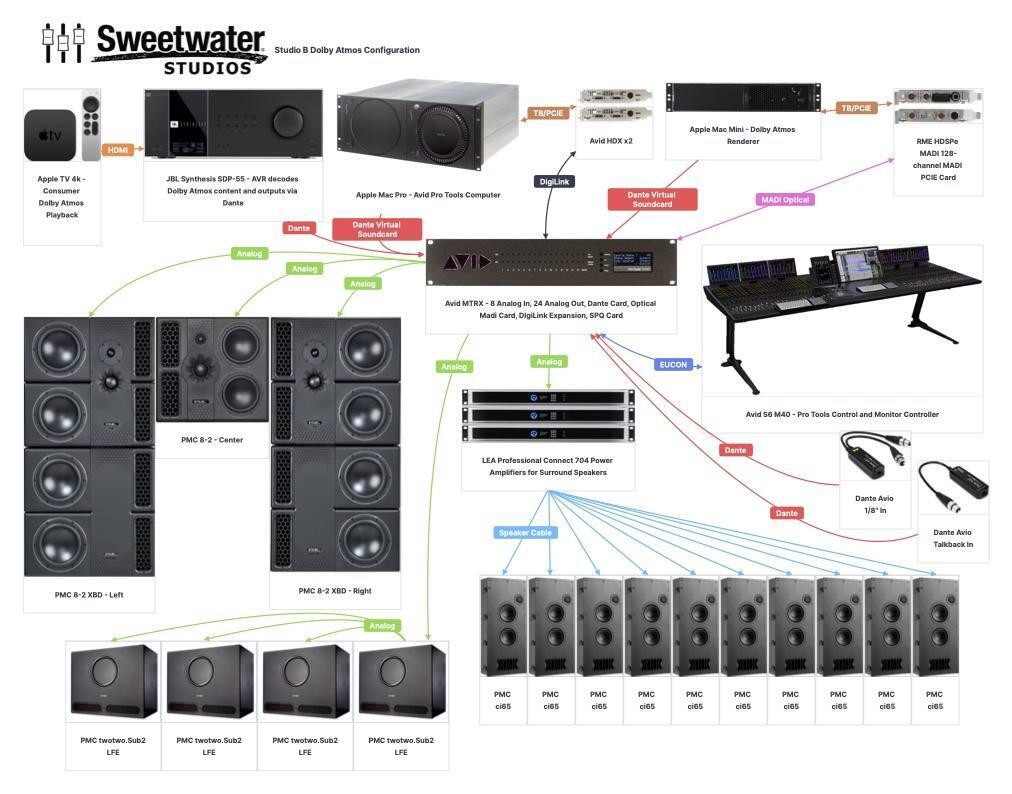
Sweetwater’s Dolby Atmos mix room is housed in Studio B. This 9.1.4 system (nine standard channels plus one LFE channel plus four overhead channels) is structured around PMC speakers. PMC 8-2 XBD speakers handle left/right duties with a PMC 8-2 in the center position.
Six PMC ci65 speakers act as surrounds with another four ci65s for height speakers. It should be noted that ci65s are passive — a must-have to keep ceiling-mounted speakers lightweight. The ci65s are powered by LEA Professional Connect 704 power amplifiers. Four PMC twotwo.Sub2 subwoofers supply low end to our system’s LFE channel.
Our Dolby Atmos system’s Avid MTRX interface includes eight analog inputs, 24 analog outputs, a Dante card, a MADI card, a DigiLink card, and an SPQ card. An Apple Mac Pro acts as our DAW computer, which is loaded with Pro Tools Ultimate and dual HDX cards. Our Dolby Atmos Renderer is installed on an Apple Mac mini, which is fed into an RME HDSPe MADI FX card.
For a control surface, we opted to deploy an Avid S6 M40. An Apple TV 4K and a JBL Synthesis SDP-55 are also included for media playback.
Shawn notes that building a Dolby Atmos rig isn’t quite as simple as installing software on your DAW computer and connecting a bunch of speakers to an interface — it’s way more complicated than that.
“We’re a Pro Tools studio, and you’re unable to utilize the horsepower from the HDX cards unless you’re using a separate rendering computer,” explains Shawn. “The setup we have includes an Avid MTRX with an extra DigiLink card, so we have 128 channels of connectivity to the one chassis and an optical MADI card to connect to the Dolby Atmos render computer. We then have 24 analog outputs and eight analog inputs in the chassis so we can have speaker outputs and still have the ability to record in here.”
The system also includes generous Dante connectivity, permitting extensive routing via Dante Virtual Soundcard, while the Avid S6 handles monitor control. Dolby Atmos systems also require speaker calibration and processing, which is handled by the SPQ card in the system’s Avid MTRX.
“It’s a very complex system, but it allows for ultimate connectivity and routing,” Shawn exclaims.
The Midwest’s Premier Atmos Room
Certified Dolby Atmos Music mix rooms are few and far between. That’s why Sweetwater intends to make this space available to outside engineers.
“We’re going to make the room available to engineers in the Midwest, or anywhere for that matter, that are looking for an Atmos mix room,” explains Shawn. “We’ll also be mixing music in Atmos, and we’re open to film and television post production, as well. So, give us a call . . .”
Shawn emphasizes that, because our space meets Dolby’s requirements for a Certified Dolby Atmos mix room, we can take on anything that comes our way. Sweetwater also plans to invite prominent engineers who have been working in the format to visit, use the room, and offer advanced training for our engineers, sales staff, and customers alike.
“This will be a busy room,” Shawn exclaims. “It will be an awesome space where people can share knowledge, create content, and educate on this developing format.”
Dolby Atmos Music Going Forward
Many new formats have come and gone since the advent of hi-fi audio (remember quad?). What makes Dolby Atmos Music different? For starters, Dolby Atmos doesn’t require expensive, specialized playback equipment. In fact, most modern smartphones have Atmos decoding built right into them, enabling consumers to enjoy high-quality Dolby Atmos–encoded audio with their existing earbuds. Some devices, such as later-generation iPhones, can even play back fully immersive content right from their built-in speakers.
What’s more, a large percentage of new major-label releases are being mixed in the format. Many hundreds of classic songs have also been remixed for the format, and they’ve received enthusiastic thumbs-ups from audiophiles and music aficionados. Finally, Tidal, Amazon Music, and Apple Music are all supporting — and even prioritizing — Dolby Atmos and other immersive audio content.
It’s clear that Dolby Atmos Music isn’t going away, and Sweetwater is primed and ready to guide you during this exciting musical journey. If you have questions about Dolby Atmos or would like to discuss how to implement it into your own studio, then give your Sweetwater Sales Engineer a call at (800) 222-4700.