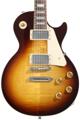
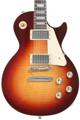
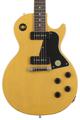
The Gibson Les Paul — that beastly bastion of fat, snarling tone; purveyor of searing shred and eternal sustain; object of desire for generations of guitarists. What makes the Les Paul so great? Ask an engineer, and they’ll probably tell you it’s the wood. Lots of wood — great, dense hunks of mahogany and maple. And humbuckers! Humbucking pickups that serve up a rich banquet of thick, blistering tone with a side of bone-rattling crunch when plugged into a dimed tube amp stack. Why would you want a Les Paul? With it, you can unleash a sonic blitzkrieg that’ll strip the paint off club walls (if that’s your thing). After years of playing other guitars, Al Di Meola, who wielded his ’71 Les Paul Custom with Return to Forever, went back to it because it is, as he tells it, an “aggressive monster.” It’s also the heaviest guitar in his arsenal. It’s all that wood. But the Les Paul wasn’t always a fire-breathing beast. The legendary solidbody electric guitar started life humbly enough as the brainchild of guitarist, inventor, and inveterate tinkerer Les Paul.
The Very Beginning
Les had been experimenting with guitar designs for years. In the early 1940s, in an attempt to eliminate the feedback that plagued the amplified acoustic jazz boxes of the day, Les handcrafted a solidbody prototype dubbed “The Log.” Often cited as the first solidbody guitar ever built, The Log got its moniker from the 4″ x 4″ pine block running through the middle of the body, to which were affixed pickups and a homemade vibrato tailpiece. Not surprisingly, The Log wasn’t particularly ergonomic or attractive, so Les enhanced it by slicing an Epiphone archtop body in half and adding the “wings” to the pine log for a more guitar-like look and feel. In the mid ’40s, Les approached Gibson with his prototype, but the company rejected his design, reportedly likening it to a “broomstick with pickups.”
Collaborative Evolution
The finalized design of the production Les Paul guitar we know and love ended up being a collaborative effort between Gibson president Ted McCarty, factory manager John Huis, and Les Paul himself. First entering the Gibson catalog in 1952, the guitar featured a single-cutaway solid mahogany body with a carved maple top, a mahogany neck with a rosewood fingerboard, and two of Gibson’s P-90 single-coil pickups (humbuckers were yet to be invented).
Design Revisions
The model went through some changes early on, including the addition of a Les Paul Custom model with gold-plated hardware (dubbed the “Black Beauty”) in 1953. In ’57, the Les Paul became available with humbuckers, newly designed by Gibson’s Seth Lover. At its introduction and for six years thereafter, the Les Paul was a bit like Ford’s Model T in that you could have any color you wanted, as long as it was gold. Sunburst finishes replaced the iconic gold top in 1958, placing more emphasis on the quality of the maple used for the guitar’s top.
Discontinuation
Today, the sunburst Les Paul of 1958–1960 is one of the most coveted, collectable electric guitars on the planet. It’s ironic indeed that, by 1961, Gibson decided to discontinue the original Les Paul. Their motivation was unclear. Weak sales? The urge to try something new? In any case, the first Gibson SGs were actually called Les Pauls, but Les himself wasn’t in favor of that for a variety of reasons. So, in a bold move, this instrument was renamed the SG, which stood for, uh, solid guitar. A few years later, Gibson started making the original Les Paul again, but the SG proved so popular that they kept making them.
The Resurrection
The Les Paul was resurrected in the late ’60s because guitarists like Eric Clapton and Mike Bloomfield discovered that, plugged into a cranked tube amp, the instrument delivers a powerful, girthy sound that barks with the big dogs, cutting through a thick rock track like a hot knife through butter. By the late ’60s, the Les Paul was the driving force behind countless bands — and it remains so to this day. From Duane Allman to Jeff Beck, it seemed every guitarist who was anyone was rockin’ a ‘Paul. Most professional guitarists, of course, own and play different guitar models for specific purposes. Allman used a ’61 SG exclusively for slide guitar. Beck and Clapton switched to Stratocasters in the ’70s and never went back. Jimmy Page started Led Zeppelin playing a Telecaster but switched to a Les Paul for live gigs. Who doesn’t crave the feeling of awesome power you get from a Les Paul and a wall of Marshalls? Today, it would be a shock to see Slash with any other guitar.
The Sound
We don’t mean to imply that the Les Paul doesn’t do subtle — it absolutely does. Consider that the instrument is heard cross-genre from rock and blues to jazz and fusion. Even Bob Marley played one. Sure, the wiry, spanky sound of a Strat may be a better choice for funk. Or for country, you might want the twang of a Tele. And if death metal is your deal, the Les Paul is not the best candidate for down tuning, given its shorter 24.75″ scale length. However, the Les Paul has its eternal charms. There’s really nothing else like it. If it’s a Les Paul you want, there is no substitute. Sweetwater’s Guitar Gallery is brimming with Les Pauls from Gibson and Epiphone: Standards, Customs, Specials, Juniors, and more; spanning all price ranges, decked out in every finish you can imagine, and outfitted with a selection of pickups from vintage-style P-90s to high-output humbuckers. To illustrate this wide, versatile tonal range, we’ve included several sound examples that will help you choose the right Les Paul to suit your needs and budget.
We’d also recommend checking out our Electric Guitar Buying Guide. Of course, our Sales Engineers are only too happy to provide expert advice. Many of them are professional gigging guitarists who play Les Pauls. Give us a call today at (800) 222-4700. You’ll soon be strumming the Les Paul (or another amazing guitar) of your dreams. Rock on!