Using distortion, overdrive, and boost pedals to push an already distorted amp “over the edge.” Welcome to the wonderful world of “front-ending” an amp…
It will probably come as no surprise that the biggest-selling segment in the guitar stompbox world is the signal-mashing family made up of distortion, overdrive, fuzz, and boost devices. What may well surprise some though is this truth: these pedals are not just used to make a clean amp sound dirty; they’re also often used to great effect with amplifiers that can achieve desirable distorted tones without any help.
Yes, believe it or not, even with the monstrously high-gain guitar amplifiers that exist today, many metal guitarists will often roll back the gain controls on their amps and then put their favorite OD, distortion, or boost pedals in front of them. This practice is often referred to as “front-ending” your amp — for a fairly obvious reason. Why do guitarists do this? Read on.
To get this ball rolling, let’s take a quick look at some gloriously distorted history.
The Early Days
Once upon a time in electric guitar history, there was no deliberate distortion available — no stompboxes and no high-gain amps. But that’s what a certain breed of axeman was searching for — dirt, desirable dirt. The first-ever stompbox designed specifically to generate distortion was the fuzz pedal, which was born in the mid-’60s. That said, in the ’50s, blues guitarists found that cranking their tube amps would add distorted overtones to their sound. Said distortion was mild compared to what many amps are purpose-built to do today, but it was a start.
Then, in 1958, the criminally overlooked Link Wray recorded a single called “Rumble” that featured a jarringly distorted guitar tone. How did Link create this groundbreaking 6-string sound back then? Well in addition to pushing a tube amp, he added to the sonic mayhem by poking holes in his speaker cones with a pencil, that’s how! The result? While “Rumble” was unceremoniously banned by US radio, it inspired future guitar giants like Pete Townshend of the Who to pick up the instrument.
Interestingly enough, Dave Davies, guitarist in the Kinks, adopted a similar technique to help conjure up the distortion heard on the band’s huge hit, “You Really Got Me.” He slashed his speaker cones with a razor blade to add extra dirt!
Yes sir, even though early tube amps offered by Magnatone, Fender, Vox, and Marshall would distort in a desirable way when cranked to the max, by today’s standards, the results were pretty mild — loud ‘n’ gritty but hardly high gain. Master-volume amps with all the gain you’d ever need were still a long way off back then.
As a result, rock’s early pioneers of distortion would not only turn such amps “up to 11,” but they’d also front-end them with pedals in order to attain the aggressive edge they were looking for. Legendary rock amps, such as the Vox AC30 and the Marshall JTM45, were around then, but their overdrive was relatively mild, dark, and a little muddy compared to modern high-gain amps. So various pedals and devices were used to add more boost and cut. Let’s quickly check out what overlords of overdrive such as Eric Clapton, Tony Iommi, Brian May, Ritchie Blackmore, Edward Van Halen, Jimmy Page, Eric Johnson, and Michael Schenker did to create their overdriven masterpieces.

Early “Front-enders”
Eric Clapton

John Mayall’s 1966 Blues Breakers album was Eric Clapton’s launchpad to 6-string stardom for two reasons — his phenomenal playing and his glorious tone. The latter was created by Clapton plugging a Gibson Les Paul into a Marshall 1962 combo with a Dallas Arbiter Rangemaster Treble Booster front-ending the latter to give it more drive and cut. What this now much sought-after effects box (I recently saw one on sale for $3,500!) did, in a nutshell, was this: in addition to boosting the highs (duh!), it also boosted the upper mids while cutting low lows. This magical combination definitely shaped and boosted tone in a highly desirable way.
Tony Iommi

Rightly referred to as the “Godfather of Heavy Metal” by many, Tony used a modified Rangemaster Treble Booster to front-end his already overdriven Laney amps in order to give them “a bit more oomph.” This effects box definitely played a significant role in the creation of some of his unique, groundbreaking early sounds. Unfortunately, in 1979, an amp rebuilder threw Tony’s beloved modded Rangemaster away because the dolt thought “it was crap.”
If you’re looking for that classic early Iommi guitar tone though, the Catalinbread Sabbra Cadabra overdrive pedal does a wonderful job of emulating it. Plus it has a control named “Vol 4” in reverence of Sabbath’s classic 1972 album!
And talking of the Dallas Rangemaster…
Brian May
This English fellow has one of the most revered tones in rock, and he credits his “voice” to advice given to him by the late, great Irish Blues–master, Rory Gallagher. A young Brian met Rory, asked him how he got his amazing sound, and all was revealed – a Vox AC30 with a Dallas Rangemaster Treble Booster. May immediately got his hands on “a battered old AC30” and a Rangemaster — combined with the guitarist’s homemade guitar and his hands, the rest is rock history.
If you’re a Brian May tone fan (and who isn’t), you can dive into his Treble Booster–enhanced sounds via the IK Multimedia AmpliTube Brian May Collection Software Suite.

Other British hard rockers who used the Rangemaster Treble Booster to great effect included Judas Priest and…
Ritchie Blackmore
The man in black responsible for such classic riffs as “Smoke on the Water” is also known to have front-ended his monstrous 200-watt Marshall Major stacks with a Rangemaster. Around 1970, Mr. Blackmore added in a rather unusual front-ending device — an Aiwa reel-to-reel tape recorder. Yes sir, Ritchie used the Aiwa as a preamp to boost his signal before it hit the amp, and it not only gave him more drive but also added more midrange. Mr. Blackmore often referred to his Aiwa tape deck as his “little friend”! And whilst on the subject of using tape machines as preamps…
Eddie Van Halen, Jimmy Page, and Eric Johnson
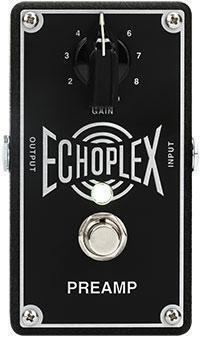
Wow, talk about a trifecta of tone! In addition to their deserved global “guitar hero” status and phenomenal playing, these three guys have one other thing in common – they’ve all used the Echoplex EP-3 tape echo as a preamp to front-end their amps. Due to its tuneful, signal-shaping magic as well as the boost it adds, the Dunlop EP101 Echoplex Preamp pedal re-creates the EP-3’s “secret sauce” right on your pedalboard.
Michael Schenker
Mr. Schenker is somewhat of an anomaly, hugely respected by his peers (many of whom he influenced) yet relatively unknown. His tasty, melodic soloing aside, Michael’s tone is instantly recognizable due to his trademark form of front-ending his Marshalls. He creates his unique sound by “cocking” a wah pedal open at the point he feels sounds the best – thus hitting his amp’s preamp with a signal that has a pronounced midrange bump, which sits beautifully in the mix.
At this point, it would be pertinent to mention another distortion-friendly advance in the guitar gear world that occurred before the advent of high-gain amps…
High-output Replacement Pickups
In the early ’70s, a pretty savvy fellow named Larry DiMarzio came up with a game-changing idea and also a game-changing product. The idea was offering aftermarket, replacement pickups; the game-changing product was a replacement humbucking pickup, which was aptly named the Super Distortion in view of its high output and muscular yet musical sound. One of its early users and advocates was KISS lead guitarist, Ace Frehley.

A big reason for both the Super Distortion’s design and popularity was the simple fact that there were no high-gain amps available at the time. Thus, the high-output Super Distortion gave players another front-ending option, other than a stompbox, to achieve the sounds they were looking for. Not surprisingly, of the impressive array of replacement pickups DiMarzio offers, the Super Distortion remains a best seller.
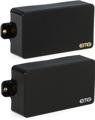
Other popular high-output pickups available today include the Seymour Duncan Distortion (born in 1980), the active EMG 81 (born in, wait for it, 1981) and, more recently, the Fishman Fluence Modern.
This concludes our brief front-ending history lesson, so let’s fast-forward to the high-gain amp world we live in today.
The Master-volume and High-gain Era

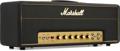
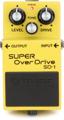
Master-volume designs that allowed guitarists to get more distortion out of their amps without having to turn them “up to 11” are no new thing. In fact, Marshall and Boogie were both making them by the mid-’70s. That said, even though master-volume amps, like the Marshall JCM800 2203, ruled the roost in the metal-heavy decade that was the ’80s, hard rockers were still looking for more gain than the amp could provide. So, high-output pickups and other forms of front-ending were necessary. Take guitar hero Zakk Wylde during many years of JCM800 abuse — Zakk not only called upon EMG ZW pickups for front-ending purposes but also used a BOSS SD-1 Super Overdrive and later on a Dunlop signature OD pedal. And, wait for it, his OD pedal was on all the time except for those relatively rare moments he played clean.
Kerry King and the late, great Jeff Hanneman of Slayer did the exact same thing to their walls of Marshall JCM800 stacks except with EMGs and a 10-band graphic EQ set to a “frown” (i.e., midrange bump). And to add to the front-end ante, Mr. King also has an EMG PA2 20dB gain booster built into his axe that he can switch in and out. His EMG 81, 85, and PA2 combination is available as the EMG Kerry King Set.
By the ’90s though, high-gain amps from the likes of Marshall, Mesa, Peavey, Diezel, and Bogner had become the norm. And since then, the gain that amps are capable of producing has continued to rise.

Consequently, with “none more distortion possible” available at the mere twist of your amp’s gain control(s), one might logically conclude that the art of front-ending would now be obsolete. But guess what, you’d be wrong. Many modern players using high-gain amps are actually backing the amp’s gain off a little, so they can add the sound and feel of their favorite front-ending tricks to their tone. Why? For the two words just mentioned – sound and feel. Hitting the amp’s input hard with any one or more of the aforementioned front-ending devices alters the amp’s behavior, and the resulting overdrive not only sounds but invariably feels different to the player. From Misha Mansoor of Periphery to the late, great Dimebag Darrell of Pantera, front-ending high-gain amps is good!
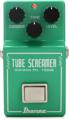
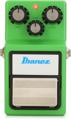
It should also be noted that sometimes it’s not just what the pedal or pickup adds that creates the “magic tonal sauce” — it’s what’s taken away. For example, the reason the iconic Ibanez TS808 and TS9 Tube Screamer pedals are used by so many modern metal players is because they create a desirable midrange bump while rolling off highs and lows, creating a fat, tight tone that sits nicely within the mix.

As already indicated in a couple of the photos accompanying this article, when front-ending an already driven amp, a noise gate is a great addition as, when set correctly, it will help eliminate unwanted noise and also feedback.
Conclusion
At the end of the day, tone is a very personal thing, so you should ultimately let your ears and your fingers decide what’s best for you. That said, even if you’re happy with your amp’s overdriven sound “as is,” try turning the gain control down a few notches and then hit it with a Tube Screamer or an OD pedal with its gain control low and its volume cranked (Jake E. Lee’s tonal trick with a BOSS OD-1). The resulting sound and feel might not only surprise you but also delight your ears and fingers!
If you have questions about boost, overdrive, or distortion pedals, give your Sweetwater Sales Engineer a call at (800) 222-4700. And if you want to check out hundreds of pedals in action, watch our video about Sweetwater creating the World’s Largest Pedalboard. Sweetwater is your source for pedals.