

Have you noticed that a Fender Stratocaster doesn’t sound like a Gibson ES-335? Or that a Gretsch White Falcon doesn’t sound like a Gibson ES-335? One of the major reasons is that each guitar has a distinct body type: the Strat is a solidbody guitar, the ES-335 is a semi-hollowbody guitar, and the Gretsch White Falcon is a fully hollowbody guitar. Each of these body types has a unique tone that contributes to the sound of the guitar.
Solidbody Electric Guitars
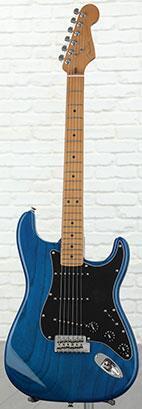
Solidbody electric guitars are the most common body type for electric guitars. Most popular Fender electric guitars, such as the Fender Stratocaster and Telecaster (and guitars based on these body styles), are solidbody guitars. This means the guitar body is solid wood, all the way through. Note that this doesn’t necessarily mean the body is one single piece of wood — the solidbody Gibson Firebird, for example, is a neck-through guitar with the body consisting of three pieces of solid wood: the center piece that continues from the neck and two wings that are attached to the center piece. But no matter how many pieces of wood comprise the body, the wood is solid, not hollowed out (except where the pickups and controls go).
Sonically, solidbody guitars tend to have the most sustain of the three body types, since the density of the wood contributes to the sustain. The denser wood also makes solidbody guitars more resistant to feedback from the pickups and results in a tighter, or more focused, low end. The increased sustain, better feedback rejection, and tighter low end are why solidbody guitars, especially “Superstrats” such as Schecter solidbody guitars, are favored by players of heavy styles of music. Solidbody guitar players range from mainstream guitarists like John Mayer and Annie Clark (St. Vincent) to metal gods like Tony Iommi and Synyster Gates (all of whom have their own signature solidbody guitars).
Semi-hollowbody Guitars
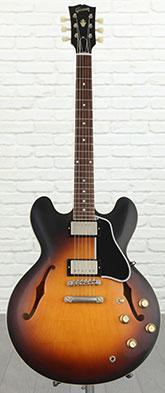
Semi-hollowbody guitars have the two bouts of the electric guitar hollowed out, often with F-holes or other types of soundholes to allow airflow, and a solid center block running through the center of the body. Perhaps the most famous example of this is the Gibson ES-335. Sometimes there is a sound channel that connects the two hollow sides, but not always. Semi-hollowbody guitars are distinct from chambered guitars, which are solidbody guitars that have had some of the wood removed from the solid body, often for weight relief (as is the case for many Gibson Les Paul models, which are otherwise solidbody guitars).
Semi-hollowbody guitars are tonally similar to solidbody guitars, but with a bit less sustain and a slightly less focused low end. Any guitar with large cavities in it will be more susceptible to feedback, but the center block in semi-hollow guitars does a pretty good job of taming the feedback compared to a hollowbody. If you strum a semi-hollowbody electric guitar acoustically, it will be distinct from a solidbody by its louder tone. These guitars tend to be favored by jazz, blues, and blues-rock players, who generally want the tightness and focus of a solidbody electric guitar but with a hint of that more round, acoustic tone of a hollow guitar. B.B. King and Dave Grohl are some examples of famous semi-hollow guitar players.
Hollowbody Guitars

A hollowbody guitar, as the name implies, is completely hollow inside. The earliest electric guitars were hollowbody guitars and were in many ways the closest to acoustic guitars. They usually have F-holes like semi-hollow guitars, but they lack the center block. Hollowbody guitars are exemplified by the Gretsch 6120 Chet Atkins and Gretsch White Falcon.
Hollowbody electric guitars have even more acoustic tone than semi-hollowbody guitars, which is evident by how loud and present they sound when you strum them unelectrified. They have the boomiest low end and the least sustain and are most susceptible to wild feedback. These guitars are often known as “jazz box” guitars because jazz players tend to love their warm, round tone and aren’t bothered by how uncontrollable they can get with high gain. However, this isn’t to say that hollowbody guitars can’t be used for heavy rock; Billy Duffy of the Cult, who has his own signature White Falcon, famously stuffed T-shirts into the hollow body of his guitar to control the feedback. But in general, hollowbody guitars tend to be preferred by those looking for warm, clean guitar sounds (like the Beatles, who famously used the Epiphone Casino).
There are many factors that go into the total sound of an electric guitar, but the body type is a fundamental one. Most importantly, you can’t swap body types as easily as you can swap pickups and strings, so be sure to do your research when deciding on which electric guitar body type has the sound you want. And if you have questions, don’t hesitate to call your Sweetwater Sales Engineer at (800) 222-4700 to discuss which electric guitar body type has the sound you’re looking for.