As guitarists, we spend a lot of effort amassing just the right gear, pedals being some of the most particular, and the final hurdle is getting them all to work together properly. Powering them is a big deal. If you only have one or two pedals, it’s easy enough to use batteries or individual power supplies. Heck, some pedals even have them included. If you have more than that — which includes most of us — you’ll appreciate a more cohesive system, especially if you use it a lot and it needs to be mobile.
One to Power Them All

A pedalboard power supply is a single source to power all your pedals. These power supplies are available in lots of different configurations to accommodate whatever your needs may be. Here are some steps to help you figure out exactly what your pedal power needs are:
1. How many pedals do you have?
This will determine the total number of connections you’ll need. The best advice is to power each pedal with an individual tap from the power supply.
 2. What kind of connector does each pedal have?
Every pedal has a way to connect power to it. Most pedals have a 2.1mm barrel connector. Some may have 3.5mm connectors, and a few, mostly older, only connect via 9-volt battery. In that case, an adapter is available.
3. What is the power connector’s polarity?
There is a positive and a negative connection on each connector. On a barrel connector, there is a center (tip) and a barrel (ring), and where the positive and negative connections are made determines the polarity of the connector. Center-negative is the most common. If you encounter a center-positive, be sure to use a reverse-polarity connector. This symbol is usually found on the pedal, near the power connection, and denotes center-negative.
 4. What voltage is each pedal?
Every pedal has a voltage rating; 9-volt is the most common, but 12-volt, 18-volt, and 24-volt are not uncommon. This is DC (direct current) voltage. A very few pedals operate on AC (alternating current). It is vitally important that you get this exactly right for each pedal, because this is the dangerous stuff. You can usually find the voltage printed on the pedal, near the power connection. If not, it’s in the owner’s manual.
5. How much amperage does each pedal draw?
 This is expressed in milliamps (mA) and can also be located on the pedal. The range can be from as low as 20mA to 1000mA, or 1A. The most important factor here is to not underpower a pedal with too few milliamps. For example, putting a 500mA pedal on a 100mA power tap would cause it to act erratically and probably shut down — it might even damage the pedal. Conversely, sending more milliamps than needed to a pedal is fine. Putting a pedal that draws 20mA on that same 100mA tap is no problem.
Daisy-chain vs. Isolated
If you daisy-chain the power to your pedals with a single, non-isolated source, you can run into two problems: 1) there is inevitably one pedal that has its own power needs, such as high mA or different voltage, and 2) if one pedal has even minor noise issues due to power, it gets amplified down the line exponentially by all the pedals you have. With an isolated power supply, each outlet is on its own power and ground, isolating each pedal, and they all offer multiple power options.
If you follow the steps above to determine your power requirements, you can pick the perfect power supply.
 T-Rex Fuel Tank Goliath
The Goliath has seven outlets: five switchable between 9-volt and 12-volt, one 18-volt, and one 12-volt at 450mA. It also offers 115-volt or 230-volt operation. T-Rex also offers the Chameleon, which has five outlets.
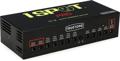
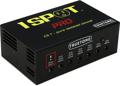
Truetone 1 Spot Pro CS12
Formerly Visual Sound, Truetone is capitalizing on the 1 Spot legacy with an isolated version. The CS12 has 12 outlets, including 18-volt, 12-volt, multiple-mA 9-volt, and an outlet that can be dialed from 9 volts down to 4 volts for that fuzz pedal that gets extra gritty with a battery on the verge of death. Cool. There is also a 7-outlet version, the 1 Spot Pro CS7.
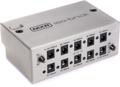
 MXR M238 Iso-Brick
The Iso-Brick is a 10-outlet brick with multiple mA options for 9 volts, two 18-volt outlets, and two outlets that are variable from 6 volts to 15 volts, perfect for vintage pedals.
Voodoo Lab Mondo
Mondo boasts 12 outlets with enough flexibility to cover almost any power requirement, including high-current digital pedals. In the event you have a true oddball power requirement, there’s a convenient AC outlet on the rear panel that will accommodate a wall wart. Voodoo Lab also offers the ISO-5, a more modest version with five outlets.
 Strymon Zuma
Zuma is a 9-output power supply that’s designed to handle your high-current needs. All the taps are 9-volt, capable of supplying 500mA, and two of them have an option for 12 volts or 18 volts.
Walrus Audio Phoenix
With 15 outputs, the Phoenix is sure to cover even the largest pedalboards. It also has the option of 12-volt operation for two of the outputs and one output at 18 volts.
All of these are excellent units that easily mount to most pedalboards. The trick is finding which one matches your particular setup. Whichever one you choose, your pedals will thank you for it.
For more information and a deeper dive into powering your pedals, check out our SweetCare team’s Guitar Pedal Power Demystified article.