

Have you ever found yourself looking at three subwoofers and an external amp, trying to remember the correct way to hook them up without burning up your amp? It can be a struggle to remember what happens to impedance when you wire speakers in series (impedance goes up) versus in parallel (impedance goes down), and even trying to figure out which wiring approach you are using can occasionally make your eyes cross.
Most musicians have a good sense that volume goes up as the power goes up, but it can easily get confusing when you are trying to keep in mind that power goes up as the impedance (a measurement of resistance in a circuit) goes down. Of course, that is only true in the safe operating range of an amplifier. Most amplifiers don’t like to operate below 4 ohms, and almost none of them work well below 2 ohms. They run hot and eventually burn up. This doesn’t leave you a lot of room for error.
Now, consider installing ceiling speakers in a large facility. The next time you are in a hotel ballroom or a school, look up and start counting speakers. Your head may start to hurt before you get too far. Can you figure out how the engineer designed the system to keep the impedance at a level that kept the amplifier from melting down?
What is Ohm’s Law?
Here is a secret: the design engineers didn’t have to do a lot of math because they took advantage of a different kind of audio system commonly referred to as 70-volt. Let’s discuss some background before we dive into the setup details.
Most amplifiers apply a fixed amount of gain (somewhere around 28dB to 32dB) to the incoming signal. The knob on the front is an attenuator that allows us to turn down the input level so we can adjust the overall output level. The input voltage to the amp compared to the amp’s output voltage represents the gain of the amp. An engineer will do the math on figuring these values using Ohm’s law.
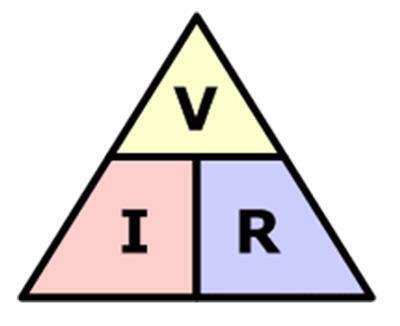
“V” is for voltage, “I” stands for current, and “R” is resistance. Their position in the triangle helps you remember the three equations, but the important one for us to look at is V = I × R. Voltage (V) equals current (I) times resistance (R). Changing the resistive load (number of speakers and the way they are wired) changes the voltage. If you could get the resistance to always be the same number, then these calculations would be so much easier!
How Does That Relate to 70-volt Speaker Systems?
The Ohms Law is exactly what a constant voltage (generally referred to as 70-volt or 70V) system is doing. By placing a transformer (a transducer that changes electricity to magnetism and then back again) on the output of the amp and then another one at each speaker, the circuit always sees the same resistance. This makes all the math involved in 70-volt systems very easy.
Most 70-volt speakers allow you to change how the transformer is tapped (“tapping” means selecting a different termination point along the transformer winding), so you can choose how many watts each speaker will draw. More wattage yields higher output level. Adding up the total watts of all the ceiling speakers indicates how many total watts of amplifier power is required to drive the entire system. If I have 30 speakers all tapped at 7-1/2 watts, then the system will require 225 watts of power: 30 × 7.5 = 225. These values could be different. If I had two speakers in a louder area, then I might tap them each at 15 watts to get more output level, and now, my system would require 240 watts of power: (28 × 7.5) + (2 × 15) = 240.
As with anything in audio, a little bit of headroom is always desirable, so I recommend about 20% more power than is mathematically required. In the example above, I would likely choose an amplifier like the QSC ISA300Ti 300-watt 2-channel 70-volt/100-volt power amplifier, which delivers 300 watts of power into a 70-volt/100-volt system.
The other significant benefit of a system like this is that because the signal runs between the transformers at a high voltage, the transformer at the amp steps the voltage up to a high level, and then the transformer at the speaker steps it back down to a lower usable level. Because of this, the current can be very low. This means I can install very long cable runs with relatively thin, inexpensive speaker cable. This is exactly how the power company delivers electricity to your house. The power company steps the voltage up to 480 volts on the cable and then steps it down to a usable 240 volts or 120 volts at your house with another transformer. If the power company didn’t do this, then it would require much thicker cable, and you would lose significant power over those long runs. 70-volt audio systems do the same thing on a smaller scale.
The Importance of Great Speaker Wires
This allows the use of a small-gauge cable like the Pro Co CM-16/2.K bulk install speaker wire, which will only lose 1dB in a 2,600-foot run! A 4-ohm speaker on that same cable would be down 3dB after only 185 feet and virtually inaudible by 1,000 feet. Also, because of the structure of the wiring, if one speaker dies, then the rest of the speakers will continue to function perfectly! I can also put a volume control on any individual speaker, and it will only change the volume of that single speaker.
Is There a Compromise?
In all honesty, there can be a compromise. Transformers have to be built into (or added to) every speaker, and like everything in audio, with transformers, you get what you pay for. Lower-cost transformers have less low-frequency response and distort more easily. This is typically not a critical issue because installers tend to use these kinds of speakers for background music with low-level output or paging systems for voice.
However, a speaker like the JBL Control 30 250-watt 10-inch indoor/outdoor speaker can get very loud and sound very good for an outdoor application in 70-volt mode. This allows you to place the amplifier a long distance away, so a 70-volt system is a great choice when inclement weather is an issue.
Sweetwater Can Deliver Your 70-volt Speaker System
If you have an application where you think a 70-volt system makes the most sense, then Sweetwater will gladly help you choose the right gear. Call your Sweetwater Sales Engineer at (800) 222-4700 today!