

Thankfully, this article has nothing to do with greasy fast food. Instead, it has to do with the relatively new and fast-growing amp-in-a-box guitar pedal category — namely, stompboxes that emulate the tone of specific amps. As I’m an unashamed metalhead, I’m going to zone in on the heavier, high-gain members of this fiendish family.
“What separates an alleged ‘amp-in-a-box’ from an overdrive or distortion pedal with some tone controls?” I hear you understandably ask. Well, in a nutshell, there are two essential prerequisites that have to both be satisfied for a pedal to be a part of the amp-in-a-box category — one or t’other is not good enough. These two criteria are:
- Convincingly capturing the right distortion/overdrive characteristic for the amp being “boxed.”
- Nailing the sound and behavior of said amp’s all-important tone network: a vital and unique sonic fingerprint of any and all great amps.
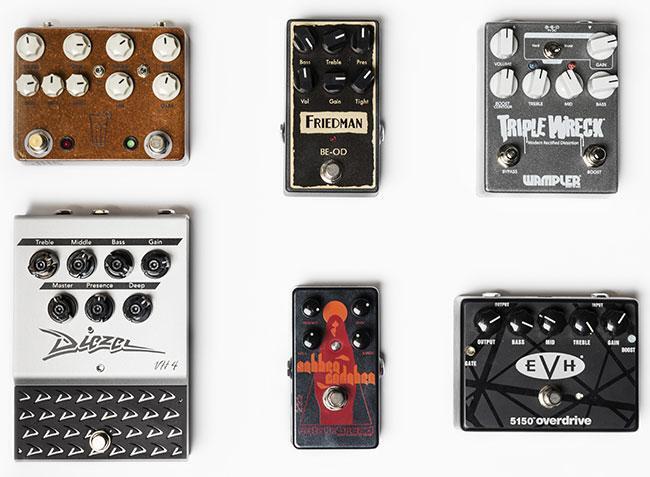
Here are six hard-hitting amp-in-a-box offerings that, to my ears, “do what they say on the tin” and are well worth checking out. This stated, please do NOT misinterpret my enthusiastic endorsement as me saying that, for example, a Friedman BE-OD or a Diezel VH4 are (way more affordable!) replacements for the actual BE-100 and VH4 amp heads, respectively! Always remember: we’re talking about tubes (preamp and power amp), transformers, brilliant designs, plus incredible feel and tone, in the aforementioned pair of highly revered, air-pummeling amps, folks. So, while the BE-OD and VH4 pedals both kick major butt and will impart a cool BE-100 and VH4 (the sacred Channel 3!) essence to any decent pedal-platform amp, please always remember this truth: there is a major difference between emulation and duplication.
Now in a perfect world, we’d all have a vast collection of killer amps in our possession. But sadly, few of us have the space, let alone the cash, to make this wonderful dream a reality! So, until you win the lottery, the six amp-in-a-box pedals about to be discussed are all wonderful options that will get you in the desired tonal ballpark without breaking the bank. For example: if you own a Marshall DSL40CR combo and would love to get a Mesa Rectifier tone for a tune or two, then plugging a Wampler Triple Wreck pedal into the clean channel of your Marshall will definitely prove close enough for rock ‘n’ roll.
Here are some particulars of my six amp-in-a-box pedal picks, in no specific order:
MXR EVH 5150 Overdrive Pedal
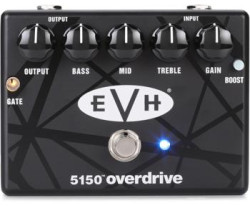
IMHO, the simple fact that this one has the royal approval of King Edward himself means that no further rationale/justification/endorsement is necessary, or relevant. After all, when it comes to righteous rock-guitar tone, Mr. Van Halen is a globally revered authority. That said, here’s the skinny on this black, stealth-striped beauty’s features:
Controls: Output, Bass, Mid, Treble, and Gain plus adjustable (noise) Gate and fixed Boost switch.
Power: 9 volts via battery or optional power supply (not included).
Bottom Line: The fixed Boost is a nice feature that adds flexibility, as you can back off the Gain control and use the Boost button to front-end the pedal, which gives the resulting overdrive a subtle but noticeably different feel (compression) and sound. The built-in, adjustable Gate mini control (which lights up yellow when the gate is active) is a definite bonus too — especially at high-gain settings. Add to that EVH’s sonic seal of approval, and it’s easy to see why the 5150 Overdrive is so popular.
Other Stuff: At 2018’s Winter NAMM, I was asked to guest on three songs by Fender Custom Shop guru John Cruz, as his band was opening for Gary Hoey. As it was literally a throw-and-go affair, I asked for a “decent clean” and then ran my EVH 5150 Overdrive and MXR Analog Chorus. All were blown away by the tone — despite my dodgy playing!
Catalinbread Sabbra Cadabra
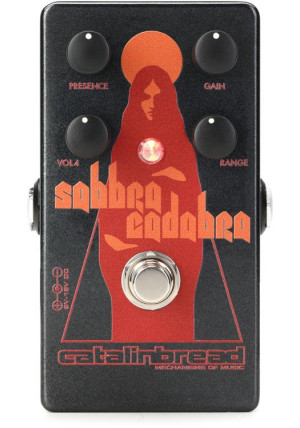
The manufacturers boldly claim that this compact, eye-catching, made-in-the-USA stompbox is “early Sabbath in a box.” I plugged in, played my favorite riffs from the Master of Reality album on a detuned SG sporting really light strings (an oft overlooked but essential factor in Tony Iommi’s tonal recipe, as his light strings have a very different sound and feel to heavier ones) and concurred!
To be more precise, the Sabbra Cadabra emulates the unique sound of Mr. Iommi’s early rig: namely, a modified Rangemaster Treble Booster pedal front-ending a Laney Supergroup amp (see TTT below). The Sabbra Cadabra has four controls to help further shape your sound.
Controls: Presence, Gain, Vol 4 (great name — none more apt!), and Range. The first three of these are pretty self-explanatory; the Range now does the following: to add further flexibility, it goes from treble boost only (anticlockwise) to a full-range boost (as you turn it clockwise).
Power: 9-volt to 18-volt power supply (not included) only — no battery option.
Tonal Note: To my (admittedly damaged) ears and fingers, while 18-volt power increases the headroom of the pedal, nine volts is the way to go, as it adds desirable “squash” to the sound.
Bottom Line: By using light strings and a 9-volt power supply, with a little tweaking, you can get pretty darned close to the tone Tony coaxed from his “rig of doom” that made the first four Sabbath albums. “Into the Void,” anyone?!
TTT (Tony Tonal Trivia): as revealed to Brad Tolinski in an amazing interview in the January 2018 issue of Guitar World.
- Because “there was no such thing as a preamp when we started Sabbath,” Tony’s inventive mind decided to “overload” the front of his amp with a Dallas Rangemaster that had been modified by a friend of his “to add even more gain.”
- What was the exact nature of the mod Tony’s friend did? Sadly, we’ll never know, as a guy the guitarist “hired to modify some Marshalls threw the thing away,” Iommi revealed. “Truth is, I’ve never been able to replicate that exact sound since.”
JHS Sweet Tea V3 2-in-1 Dual Overdrive Pedal
As its rather lengthy title reveals, this handbuilt bad boy is actually two JHS pedals in one: an Angry Charlie V3 and a Moonshine V2.
Just in case you aren’t aware, the Angry Charlie* is a rightfully renowned emulation of a hot-rodded Marshall, and — thanks to its convincing capture of a JCM800’s signature, tight, “punch in the chest” mid-range thump — this metal monster can Marshall-ize a good clean channel with a single, deft stomp.
Note: What’s in a name? And why is the Angry Charlie called that? Well, here’s my simple theory: the “JCM” in JCM800 are the initials of the late, great James Charles (Jim) Marshall – the man behind those legendary British Marshall amps. So “Charlie” comes from that, and “Angry” comes from the fact that the pedal’s tone emulates a hot-rodded, fire-breathing JCM800.
As for the Moonshine, well, that’s inspired by the highly desirable, mid-bump overdrive created by a very famous green OD pedal. And, as many know, a sizeable chunk (bad pun intended) of overdriven Marshall tones considered classic were created by pushing the front end of a Marshall stack with the aforementioned legendary green OD pedal.
So, for the reasons just mentioned, the Angry Charlie/Moonshine combination is a pretty powerful combo.
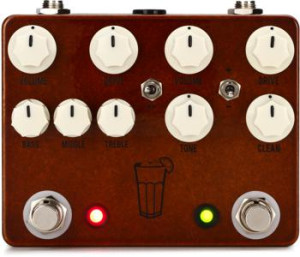
Controls: The Angry Charlie side (left) has Volume, Drive, Bass, Middle, and Treble — all self-explanatory, but it should be pointed out that, like a lot of amps-in-a-box, the tone controls are active (namely: they cut and boost), while the same controls on the amp they’re emulating are passive (cut only).
The Moonshine side (right) has Volume, Drive, Tone, and Clean. The Clean allows you to determine how much of your unaffected signal is blended in. There’s also a 2-position proof toggle switch that goes between high and low gain.
There’s also an order toggle switch between the two pedals that allows you to decide the order of the Angry Charlie and Moonshine in your signal path — more about that in a minute, as this is a super-cool feature.
Power: 9-volt power supply (not included) — no battery option.
Bottom Line: In addition to being able to echo the much lauded and sought-after tone of a Marshall JCM800 being front-ended with a Tube Screamer, the order toggle also allows you to place the Moonshine after the Angry Charlie. Why is this cool? Because this order allows you to use the Moonshine as a second master volume to make your solos louder — plus add a little more grit too. How? Because cranking the volume of the Moonshine (or any boost pedal for that matter) going into an already heavily overdriven pedal or amp will only serve to increase the distortion, NOT the volume, because there’s no headroom left to play with. But, by doing it after the overdrive, you can.
Consequently, the Sweet Tea is not only a 2-in-1 in terms of pedals, but also in terms of valid, usable options. Plus, as already mentioned, it nails that classic Marshall punch. Nice.
Diezel VH4 Distortion Pedal
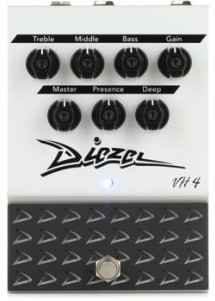
In the world of high-gain, all-tube amps, the German-made Diezel VH4 Distortion/Overdrive pedal is indeed a force to be reckoned with. This monstrous beast has been used by many metal heavyweights, including Metallica, Korn, and Tool. And, of its four channels, the third (a.k.a. “Mega”) channel is the one that made it an instant high-gain icon. So when Mr. Peter Diezel, the creator of the VH4, builds a pedal that emulates said channel, you know said stompbox will be a force to be reckoned with.
The majority of metal axemen gravitate towards the VH4’s third channel, not only because of its immense high-gain capability, but also because of its articulate musical tone and incredibly wide, low-end girth that you can quite literally feel as well as hear. To that end, the VH4 pedal’s Presence control allows you to dial in musical bite while the Deep knob delivers the VH4 amp’s trademark, low-end might, lurking around 80Hz–90Hz.
Controls: Gain, Treble, Middle, Bass, Master, Presence, and Deep
Power: 12-volt DC power supply with international adapters (supplied) — no battery option.
Bottom Line: The simple fact that this particular amp-in-a-box was designed and manufactured by the very same man who designed and manufactured the monster amp it emulates — the lauded Diezel VH4 — literally speaks volumes. Just like said amp’s third channel, it is musical and articulate with a brutal, tight, low-end girth.
Friedman BE-OD Overdrive Pedal
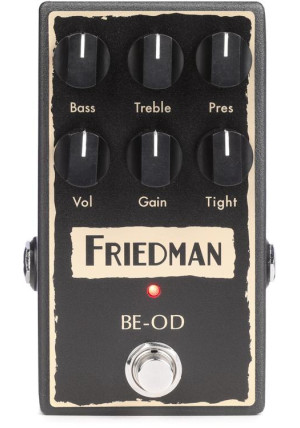
In recent times, one of the most respected newcomers to the world of high-gain, all-tube guitar amp design is Friedman amplification. Highly lauded, hard-rocking players such as Jerry Cantrell, Steve Stevens, and Bill Kelliher of Mastodon all have signature Friedman heads, and the company’s 2-channel, 100-watt, all-tube BE-100 head is deservedly hailed as a modern-day, high-gain classic with a decidedly “British” EL34-powered tone.
So, as is the case with the Diezel VH4 pedal, when the man behind Friedman, Dave Friedman himself, creates a compact amp-in-a-box device that puts the much sought-after tone of the BE-100 head on your pedalboard, you immediately take it seriously — very seriously.
Made in the good ol’ US of A, the roadworthy BE-OD also offers true bypass when not engaged. And armed with many of the same exact controls as the BE-100 head it emulates, the BE-OD does not disappoint.
Controls: Bass, Treble, Pres, Vol, Gain, and Tight
Power: 9-volt to 18-volt DC power supply (not included) — no battery option.
Bottom Line: Even with the Gain control “off” (i.e., fully counterclockwise), the BE-OD offers up a great fat, rock overdrive sound — low-gain it is not! Fret not, though. If you do want a lower-gain option, then there’s an internal trimpot you can adjust to do exactly that. IMHO, though, the pedal is perfect right out of the box. When you turn the Gain control higher, it just gets gnarlier and gnarlier — in a wonderful, musical, high-gain way! The Bass, Treble, and Presence controls give you more than enough flexibility to fine-tune the exact tone you’re looking for via the amp you’re driving. As for the Tight control — well, it does exactly what it suggests. When it is turned counterclockwise, the lows are kinda loose, wide, and “saggy.” Then, as you turn it up (clockwise), your bottom gets, wait for it … yep, tighter! Case closed.
Wampler Triple Wreck High-gain Distortion Pedal

This true-bypass pedal’s name makes no bones about the amp it’s inspired by, and as Brian Wampler is no slouch when it comes to making great-sounding amps-in-a-box, you know the desired tone will emanate from it. In addition to the modern rectified distortion it offers, the Triple Wreck also boasts a Boost switch that is controlled by one Boost Contour knob. What this added feature does is enable you to add some more flavor options to your sound — from merely boosting the gain (Boost Contour turned anticlockwise) to adding a gloriously flubby, fuzzy vibe to it (now clockwise) in varying degrees.
Controls: Volume, Gain, Treble, Mid, Bass, and Boost Contour (activated by footswitchable Boost), plus a Hard/Brutal 2-way toggle switch (read on).
Power: 9-volt to 18-volt* DC power supply (not included) or 9-volt battery.
*Important Tonal Note: according to the manual, the Triple Wreck is “intended to sound its best at 9V.”
Bottom Line: Just like the amp it emulates, the USA-built Triple Wreck is a high-gain monster with a distinctively deep and wide low-end thump. The Hard/Brutal voicing switch does exactly what it suggests — the Hard setting is warm and wide, Brutal is brighter, more in-your-face and much more, er, brutal! The footswitchable Boost Contour is a nice touch, as it enables you to go from a crushing, scooped rhythm crunch to a warmer, fatter lead tone (with said control set higher).
Conclusion
The pedals featured are a mere surface scratch on a fast-growing family of tonally viable amp-in-a-box pedals. As stated at the very onset, while none of them will ever replace the amps they’re inspired by, all six do their job incredibly well.
So check some of these bad boys out. They might well satisfy your hunger for new, inspiring, high-gain metal tones without breaking the bank!