

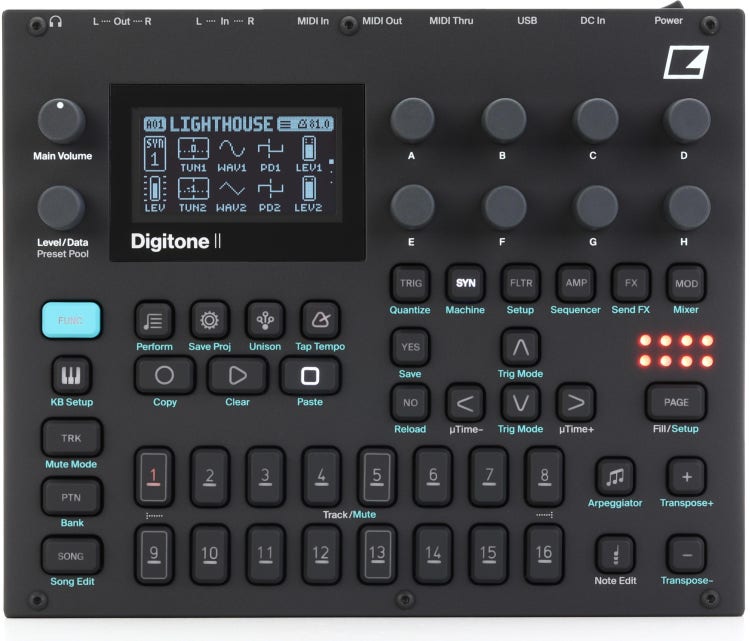



Digital Deliverance: 16 Tracks of Multimode, Polyphonic Power

Emerging from the Gothenburg garrison of synthesis scholarship, Elektron has forged a formidable follow-up to one of the company’s essential instruments. Sweetwater’s sonic adventurers can confirm the Digitone II is well worth the wait. Armed with 16 multimode tracks, this digital synthesizer delivers a deluge of dynamic delights, multiplying its aural arsenal to expand the scope of its predecessor, all the while retaining everything you love about the first-gen’s interfacing and form factor. Contrasted with its already powerful progenitor, Elektron engineered the Digitone II for even further forays into unexplored dimensions of prismatic potential, doubling its polyphony, quadrupling its track count, and overhauling its infrastructure to seamlessly move across synth and MIDI track designations. Its modulation capabilities, hexad of filter modes, frenzy of effects, and tetrad of Trig modes are supplemented by an explosive array of performance possibilities, including Song and Keyboard modes, as well as a titanic 128-step sequencer that’s teeming with details to discover, tweak, and customize. With ample interoperative integration abounding from its flexible connectivity suite complementing USB audio, Overbridge support, and high-fidelity A/D and D/A conversion, the Digitone II is a kaleidoscopic powerhouse that’s raring to go.
Related Videos: Digitone II 16-track Polyphonic Digital Synthesizer
Immensely expanded, striking synthesis
Elektron designed the Digitone II to summit stratospheric heights of compositional and performance possibilities, reaching significantly further than its predecessor to expand its potential, both internally and externally. Its 16-track architecture not only doubles the capacity of the first-gen Digitone, but its polyphony as well. This yields 16 voices of multitimbral polyphony that you can deploy using the Digitone II’s four synthesis machines: Wavetone, Warmer, FM Tone, and FM Drum. Every synth machine delivers an array of melodic sonics and percussive panache, augmented by a slew of FM algorithms to sculpt and shape your timbres and tones, from subtle soundscapes to searing, otherworldly madness. But Elektron didn’t merely expand voicing and track count; the company overhauled the entire architecture to eliminate the barriers between track designations, meaning any — or all — of its 16 tracks can be synth or MIDI tracks.


Menageries of MIDI
From zero to sixteen, the amount of MIDI you want the Digitone II to utilize is entirely yours to decide, and Elektron’s augmented the instrument’s performance palette to support more runway than the already-impressive quadrupling of total possible MIDI tracks. The Digitone II’s expanded polyphony includes up to 16 notes for every step of your sequence, while each of its 16 tracks can accommodate two simultaneous, totally assignable LFOs, in addition to 16 customizable MIDI CC controls. What’s more, the Digitone II’s MIDI connectivity comprises designed, 5-pin In, Out, and Thru ports, with its output fully DIN Sync-compatible, bringing a litany of physical or virtual instruments, effects, tools, and tones into your Digi-driven constellation.
Multitudes of modulation
Across the Digitone II’s myriad sonic-contouring tools, Elektron pulled no punches in undergirding its modulation capabilities. Each MIDI and audio track supports up to two or three simultaneous LFOs, respectively. Meanwhile, a suite of pitch bend, velocity, key track, mod wheel, breath control, and aftertouch parameters can be assigned to any number of modulation configurations. Plus, the 36-scale Keyboard Mode and composition-focused Song Mode expand these possibilities even further, allowing you to tailor your tones to your preferred performance interface.
Primed for performance: step sequencing, micro timing, and more
Whether it’s running the show or a shade in your palette, from all-night studio sessions to long-haul live shows, the Digitone II is ready to rip, thanks to its staggering 128-step sequencing suite. Offering 128 steps for each pattern and track is already an immense sonic sandbox, but the Digitone II uses this to take its expanded architecture to its limits. Detailed and dynamic possibilities abound within each track, as the length of patterns, value of time-scale multipliers, note editing, and arppegiation can all be individually edited, attenuated, activated, and controlled at the per-track level. Furthermore, the Digitone II offers both polyphonic sequencing and Euclidean sequence generation, adding to the customizable trigger conditions, trigger chance values, parameter locks, and micro-timing capabilities. Plus, the Digitone II’s quartet of Trigger modes take live and studio performance possibilities to greater heights: Tracks, Velocity, Retrigger, and Preset Pool — the last two of which work exclusively with your audio tracks.


Ferocious FX and filtering
Every voice of the Digitone II features a dedicated deluge of texturization, with digital base-width filters, bit-reduction, sample-rate reduction, and overdrive all eligible for individuated, per-voice application and adjustment. What’s more, the overdrive and stereo compression can be activated on the master channel, granting greater room for complex layering or sound design. A trio of Send Effects is also available, including Elektron’s lauded Saturator Delay, Supervoid Reverb, and Panoramic Chorus. When it comes to sound shaping, the Digitone II is endowed with six swappable filter machines, all of which offer distinct, dynamic approaches to your output: Multimode, Lowpass 4, Equalizer, Comb-, Comb+, and a bimodal Legacy lowpass/highpass combination.
Comprehensive connectivity and formidable fidelity
Elektron’s modular magic is found, in no small part, with a masterful balance of standalone prowess and interoperative use of instruments. No matter where you source or send your sounds, the Digitone II preserves their fidelity in exacting detail, thanks to the inclusion of 48kHz/24-bit D/A and A/D converters. Five 1/4-inch audio jacks provide not only a stereo I/O and dedicated headphone output. Still, they can be interwoven into a smorgasbord of re-sampling delight, while the Class Compliant high-speed USB Type-B 2.0 connector supports audio over USB. This latter point, in conjunction with the previously mentioned MIDI connectivity, all but erodes the divisions between virtual and physical sounds, instruments, and control. What’s more, the Digitone II is fully compatible with Elektron’s Overbridge software suite, and the company included a USB cable to let you dive straight into the musical madness of this voltaic, virtual vehicle. Just don’t forget to grab the power supply and exclusive artwork from the box!

Elektron Digitone II Features:
- Long-awaited successor to the original Digitone overhauls and expands the foundational capabilities of its digital synthesis and MIDI potential
- Quadrupled track capacity supplies 16 tracks of freely assignable MIDI or synth possibilities
- Doubled polyphony means 16 voices, including 16-note polyphony with each step in your sequence
- 4 synthesis machines — Wavetone, Swarmer, FM Tone, and FM Drum — are augmented by multiple FM algorithms for exploratory timbral sculpting and punchy percussion
- 6 distinctive filter modes are supplemented by digital, per-voice base-width filter, overdrive, bit-reduction, and sample-rate reduction, for expansive, dynamic sonic contouring
- Modulation includes multiple, simultaneous LFOs assignable to each synth or MIDI track, as well as pitch-bend, velocity, key-tracking, mod-wheel, breath control, and aftertouch
- Keyboard mode features 36 scales, accommodating numerous input, performance, and control configurations
- Song Mode allows you to focus solely on composition, streamlining your workflow and differentiating your live-performance approaches
- Robust 128-step sequencer features arpeggiation, polyphonic sequencing, micro timing, Euclidean sequence generation, customizable trigger behavior, and parameter locks
- Comprehensive connectivity suite of 1/4-in. stereo I/O and headphone jack, high-speed USB 2.0 port, and 5-pin MIDI In/Out/Thru for seamless interoperative integration
- Class-compliant USB port supports USB audio for expanded sonic potential
- Versatile MIDI and DIN Sync-rated output means limitless multimode control of compatible virtual and physical instruments, tools, effects, and more
- High-quality 48kHz/24-bit D/A and A/D converters ensure audio is preserved with pristine fidelity, regardless of where it’s sourced or sent
- Overbridge support opens exciting doors for dynamic and customizable virtual possibilities

