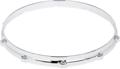
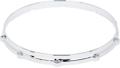
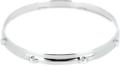
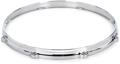
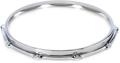
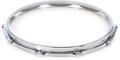
Drum hoops have undergone significant changes in the past hundred years. Following the rope-and-claw designs of wartime field drums and the “stick chopper” metal hoops of the mid-20th century, the industry eventually settled on Leedy/Ludwig alum Cecil Strupe’s sophisticated triple-flanged hoop design — called as such for its two screw-supporting bottom flanges and stick-saving, rounded outer top flange — as the standard.
Strupe and Ludwig’s triple-flanged hoop was a technological marvel. In fact, drummers the world over still cherish this timeless design on vintage and modern drums alike. But that’s not to say it’s always the best option for every drum or every application.
Quoting William F. Ludwig II from The Making of a Drum Company: The Autobiography of William F. Ludwig II:
One of the most significant inventions from Mr. Strupe’s great mind was the triple-flanged metal hoop. I had been complaining to Cecil about chewed-up drum sticks due to double-flanged hoops. Using pliers, he produced a third flange by bending outwards the top of the hoop, presenting the sticks with a rounded edge and minimizing cutting of the shoulder of the stick. We immediately tooled up for full scale production . . . “
This article will look at the much-discussed die-cast hoop and why it is — or is not — the right upgrade for your toms and snares.
- The History of Die-cast Hoops
- Cast Hoops: How Do They Sound?
- The Pros & Cons of Cast Hoops
- Full Set or Mix & Match?
- S Hoops: “S” Marks the Spot
The History of Die-cast Hoops
Flanged hoops have been traditionally made from strips of flat stock steel, brass, or aluminum. The strips were welded at the ends and placed onto a machine press that bent the flanges and holes into place. Many drum manufacturers have employed hoops made in this fashion because they are dependable and inexpensive.
But somewhere along the way — some attribute this to Gretsch in the 1940s — drum makers sought to make stronger hoops in an attempt to eliminate the need for reinforcing rings inside wood shells. Thus, the die-cast hoop was born.
In cast hoops, liquid metal (usually zinc, steel, aluminum, or brass) is poured into a molded cavity and left to cool and harden. This process yields a hoop that can be thicker, stronger, more consistent, and virtually free from weak points.
But drummers soon discovered another benefit of die-cast hoops, and that was the sound they produced. These heavy-duty hoops have a way of focusing a drum’s tone and enhancing its definition, which has made them a standard-issue upgrade on many modern snares and toms — especially those billed for rock and metal.
Cast Hoops: How Do They Sound?
The tonal differences that exist between flanged and cast hoops are plainly heard on their own. Tapping a steel triple-flanged hoop with a stick reveals a lengthy and harmonically rich tone — a bit like a train whistle. With a set of these on a snare or tom, they’re going to contribute to a thick overtone spread and long note sustain. This can be advantageous or problematic depending on the application; for instance, low-tuned snares equipped with flanged hoops will almost always require some level of muffling, especially in a studio setting. On the other hand, tapping on a die-cast hoop tends to exhibit a much shorter sustain and a louder, purer, bell-like resonance. Tacking one or more of these onto a shell is likely to focus the tone and give you a much dryer sound overall. Not only that, but due to the increased weight of cast hoops on snare drums, you’ll tend to get a chunkier rimshot and a punchier, more consistent cross stick.
The Pros & Cons of Cast Hoops
Like any hoop, die-cast hoops come with their own share of pros and cons.
Pros of Cast Hoops
- Sound: “Dry,” “focused,” “aggressive,” “cutting,” and “modern” are just some of the words that players use to describe the sound of die-cast hoops. This style is great for enhancing stage and studio drums that need a defined, high-output sound.
- Output: The added mass of cast hoops tends to increase a shell’s total output, which is perfect for stage kits.
- Rimshots: One of the cast hoop’s greatest claims to fame is the dry, devastating rimshot it can impart on snare drums’ batter sides.
- Cross sticks: Achieving a consistently chunky and cutting cross stick tends to be much easier with cast hoops than with flanged.
- Tuning and durability: Because they tend to be more heavy-duty, die-cast hoops not only hold their tune better but also stand up to the heaviest hitters on the planet.
Cons of Cast Hoops
- Added mass: Apart from making the drum heavier to haul around, swapping out flanged hoops for cast ones can choke the upper tuning reaches of a snare or tom.
- Inflexibility: Semi-rigid flanged hoops tend to be more forgiving on warped shells and damaged bearing edges. Cast hoops do not flex at all, so extra care and consideration must be given to head-to-head tuning and shell conditions.
- More expensive: A set of quality cast hoops can set you back nearly twice as much as a set of triple-flanged hoops.
Full Set or Mix & Match?
Ramping up to die-cast hoops doesn’t mean you always need a matching set. Players like Stewart Copeland prefer a die-cast hoop on top paired with a triple-flanged snare-side hoop. For some drums, this can be a winning combination; the bottom head is allowed to resonate more freely, which is especially useful on snares, and the top head is given that aggressive, midrange, die-cast cut. Whether a matching or hybrid hoop set is right for your shells is often a matter of trial and error, so don’t be afraid to experiment.
Drum gear guru Bob Gatzen is quoted from his 2010 interview with Drum Business (as reprinted in Modern Drummer in 2015) as saying: “Again, let’s remind ourselves that sound is subjective. My motto is: If it sounds good to you, then it’s a good sound.”
S Hoops: “S” Marks the Spot
Unsure about making the transition to die-cast hoops? A number of players have found their ideal snare and tom tone using S Hoop hoops. These steel hoops bridge the gap between traditional flanged and cast options, exhibiting a more focused sound and more stable tuning than triple-flanged hoops while not being as heavy or domineering as die-cast. S Hoop’s secret is a large, inward-facing top flange (more akin to a classic Slingerland than the more familiar Strupe/Ludwig design) of nearly half an inch. This gives S Hoop hoops greater mass, rigidity, and dryness, but their carry weight is still far more manageable, with less risk of choking out the drum. Investing in a set of S Hoops hoops is also less of a price commitment, which makes them a good option for drum restorers and players on a budget.
Sweetwater Has the Drum Hoops You Need!
If you’re considering getting new hoops for your snares and toms, then give your Sweetwater Sales Engineer a call at (800) 222-4700. Sweetwater can provide you with the hoops you need.