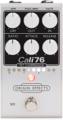
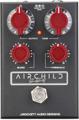
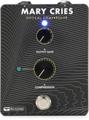
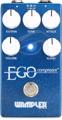
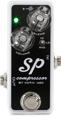
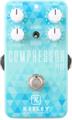
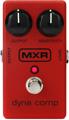
Championed by country pickers, funk-inflected rhythm players, and sustain-seeking soloists, compression is an obligatory part of a guitarist’s tonal toolbox. However, for such a ubiquitous effect, its subtleties are frequently misunderstood. Just what exactly is your compressor pedal doing when you stomp it into action?
In the simplest possible terms, compression makes the loud parts of your guitar signal quieter, effectively making the quiet parts of your guitar signal louder. For a plucked instrument, such as a guitar, the initial strike of the strings with your pick or fingers results in a large volume peak, which then decays as the strings lose volume.
A compressor reduces the amplitude (volume) of those peaks, which makes the soft parts seem louder. It reduces the dynamic range between the loudest sounds and the quietest sounds, thus “compressing” the signal from both the top and the bottom.
That’s all well and good, but what does a guitar compressor pedal sound like? The words you’ll most often hear are “squished,” “squashed,” “snap,” “pop,” and so on. If you’re after a more audible education, then make sure to check out our video with Sweetwater’s Don Carr, How to Use a Compressor Pedal – Getting the Most out of Your Compressor Pedal, for a plethora of in-depth sound samples.
When Should You Use a Compressor Pedal?
Although compressor pedals are regularly used by guitarists of all stripes and styles, there are several choice sonic applications where you’re all but guaranteed to find them.
Country Music and Chicken Pickin’
If there’s a poster-child genre for compressed guitar tone, then it’s country music. The sound of a clean, squashed six-string is all but a prerequisite for certain styles of country playing such as chicken pickin’, and you’re not likely to find a guitarist in Nashville without a treasure trove of compressor pedals. Moreover, compression is a must-have for players who utilize hybrid fingerpicking, where the initial attack of the pick is often quite a bit louder than a string struck by your finger.
Sustaining a Solo
Compression’s ability to sustain a guitar’s sound makes it a go-to for soloists who favor a smooth, clean, and singing legato flavor. It’s an especially useful tool for anyone playing leads with a clean tone, where you have none of the beneficial sustain and compression introduced by dirt pedals or an amp’s natural breakup.
Clean Arpeggios, Funky Rhythms, and ’80s Extravagance
Guitar compressor pedals have the wonderful ability to “glue” a group of notes together for a more cohesive feel. High levels of compression are often used by guitarists to inject clean arpeggios and funk-flavored rhythms with degree of punch, snap, and pop that they’d otherwise sorely miss. Plus, if you have a penchant for the chorus-drenched six-string sounds of the 1980s, then a compressor pedal is a nonnegotiable part of the formula.
A Convenient Clean Boost
Finally, a compressor can also make an excellent and character-packed clean boost — simply turn down the compression and use the volume control to crank up your signal!
Types of Compressor Pedals and Famous Compressor Units
Compression comes in various forms, each type resulting in a slightly different sound. This is an incredibly deep topic, so treat this as a primer on the different flavors of compression at your disposal.
Optical
Often referred to as “opto” compressors, optical compressors use a light bulb/LED and a photocell. Opto compression is revered for its soft, natural character and smooth attack. The LA-2A family, helmed by the mighty Universal Audio Teletronix LA-2A, is arguably the most famous group of optical compressors in music history; there are several pedal-size incarnations available for guitarists with a penchant for studio-grade sound.
Tube
Although many classic compressor units use tubes within their circuits, tube compressors are different in that they actively use their tubes to compress the signal. The legendary Fairchild 660 tube compressor is the most famous studio example. A few modern guitar compressor pedals pack the harmonic-rich warmth and slow, round attack of tube compression into a pedalboard-ready box.
FET
Field-effect transistor (FET) compressors utilize electrical components called transistors to compress your tone with ultra-fast attack and release times and just a touch of analog color. Almost every serious studio on the planet is equipped with a variant of the Universal Audio 1176LN classic limiting amplifier, of which Universal Audio offers several pedal-size re-creations.
VCA
Compression by means of voltage-controlled amplifier is by far the most common type of compression that guitarists are likely to run into. Everything from MXR’s time-tested Dyna Comp family to Keeley’s revered, modern-classic line of compressors sports a VCA-based design, giving you a compelling compression tone with a smooth voice and a snappy attack.
How to Use a Compressor Pedal and Common Controls
From simple, dual-knob stompboxes to massive, studio-grade powerhouses, guitar compressor pedals come in a countless variety of forms. Let’s go over some of the most common controls you’ll find on the most popular compressor pedals.
Threshold (Sustain, Sensitivity, Input, etc.)
The most important control on any compressor pedal is the threshold: the point at which your compressor says, “This signal is too loud,” and begins to attenuate the peaks and raise the valleys. A compressor only begins to do its job after your signal crosses over your chosen threshold — for instance, if your compressor pedal’s threshold is set to -10dB and your guitar is only putting out -15dB, then the compressor won’t activate at all.
Makeup Gain
Since a large part of a compressor’s duty is to make things quieter, it’s often necessary to raise the overall level of the signal after you compress it so that it doesn’t sound weak or anemic. This concept is called makeup gain, and it’s commonly labeled on guitar pedals as “gain,” “volume,” or “level.”
Many guitar compressor pedals feature just these two controls, making them a superb entryway for beginners and set-and-forget players. On the opposite end of the spectrum, many modern compressor pedals incorporate a host of studio-inspired parameters. These are perfect for guitarists who prefer a deeper sound-shaping experience.
Ratio
While the threshold determines when your compressor activates, the ratio works in concert with the threshold to determine how extreme the compression will be. For example, if your compressor is set to a 2:1 ratio, then it will reduce the signal’s strength by 1dB when the signal exceeds the threshold by 2dB. This scales up proportionally, so a signal that exceeds the threshold by 4dB will be attenuated by 2dB, and so on.
Attack and Release
Attack and release controls allow you to determine how fast your compressor clamps down once your signal crosses the threshold and how fast it lets go afterward. For example, using a slow attack time on your compressor allows just a tiny bit of the signal’s initial transient to poke through before the compressor cuts it down to size. Similarly, the release control dictates how long the compressor’s effect remains active after it first triggers the threshold.
Blend
This knob simply reintroduces your dry signal back into the mix, allowing you to “blend” between your compressed, wet signal and your uncompressed, dry signal. This concept goes way, way back in the studio world, where it’s better known as parallel compression.
Does a Compressor Pedal Reduce Noise?
Unfortunately for compression-loving guitarists everywhere, the answer to this question is a firm no. In fact, because compressors make the quiet parts of your signal louder, they can often make low-level noise worse! Fortunately, Sweetwater carries a vast assortment of noise gate pedals to pair with your compressor to cut out unwanted hum and hiss for good.
Where Should I Put My Compressor in My Signal Chain?
For most typical compressor applications — country pickin’, funk rhythms, dreamy arpeggios, and so on — you generally want to place your compressor pedal as early as possible in the chain. There are plenty of exceptions to this rule; players after the ultra-processed, modulated clean tones of the 1980s will likely prefer to put the compressor pedal in the amp’s effect loop and, therefore, after the preamp. Remember that there are no hard-and-fast laws regarding pedal placement, and experimentation is always recommended!
What Compressor Pedal Should I Buy?
Sweetwater has a truly massive selection of compressor pedals. Finding which one will best suit your needs can feel overwhelming; from the pickups on your guitar to your playing proclivities, there are several factors to consider. Fortunately, we have the most highly trained and experienced Sales Engineers in the industry. Give them a call at (800) 222-4700, and they’ll be happy to guide you to the compressor pedal that takes your guitar tone to the next level.