
It’s nearly 1PM on a Saturday afternoon. We’ve just received word that Sullivan King — née Keaton Prescott — has entered the building. Rounding the corner, King is easy to spot, standing somewhere in the ballpark of 6′ 4″, clad in Sullivan King merch and flanked by a pair of fans delightfully shocked at the chance encounter. They take a quick photo, and King is all grins before he embarks on a tour of Sweetwater HQ.
King has no shortage of commentary as he and his crew take in the sights. From speculation over shows and musical observations spurred by our synth-laden mini-museum to recounting time spent in Orbital’s studio and an impromptu comedy bit about getting his luscious locks washed on the clock (as a hypothetical Sweetwater employee), a thought occurs: Sullivan King is kind of weird. But the good kind, the interesting kind, the kind of weirdness you need to possess in order to realize a vision so challenging to the status quo that the only way to achieve it is to seize the gauntlet and do it yourself.
If you take away nothing else, then it should be this: When the modern techno-artistic landscape is somehow increasing in both confusion and repetitive sameness, being weird is more valuable than ever. Weird is different, and different is good. Do the weird thing and become a beacon of shattering the mold.
- “What if?” A Genesis of Sonic Transcendence
- Liminal Dominion: In the Court of (the) Sullivan King
- NWOEHM:-New-Wave-of-Electronic-Heavy-Metal
- Communitas and a Kingdom of Sound for All
- Stream “Sullivan King & Friends” Playlist
“What if?” A Genesis of Sonic Transcendence
“What if?” The question beats at the heart of Sullivan King’s multidimensional ethos; it’s the ur-driver of his ever-expanding musical curiosities. What if this lead-guitar part were replaced by an arpeggiated synth? What if pulverizing, overdriven guitar riffs barreled through the buildup? What if I sang my own vocals? Upending tradition and conventions is innate to Sullivan King’s DNA, but creative and professional success isn’t solely a byproduct of a willingness to ask those sorts of questions — you need to own this vision, including the risks of summiting the uncharted peaks of our evolving musical topography.
It takes guts, no doubt, and it’s a journey rife with failure. Shaping and defining a sound as you unearth it? That’s no small task. Yet, without the perseverance to grow and learn from failure, Sullivan King wouldn’t be the dance-music world’s exhilarating enfant terrible who’s headlining mind-melting Red Rocks performances, touring with modern metal icons Avenged Sevenfold, and contributing to a growing community of electro-challengers. But “failure” goes beyond nebulous ideas of success, and King arguably encountered his most formidable “What if?” moment when he realized early in his career that his biggest artistic barrier was, well, everything.
“I had to destroy what I learned to rebuild . . . that’s how you discover something new.”
Liminal Dominion: In the Court of (the) Sullivan King

Sullivan King’s work evades easy categorization, unrelenting in its resistance to the boxed-in confines of subgenre taxonomies. Though undeniably electronic, he pulls no punches in channeling his rock roots for everything from instrumentation and sound design to live-show aesthetics and a signature guitar that bleeds ’80s thrash vibes. Like many of his genre-sovereign peers, King’s far less concerned about the label you put on his music than the final product, but he recognizes the intrigue that surrounds what his music is. To quote Mike Patton on Faith No More’s 1990 hit single, “Epic”: what is it?
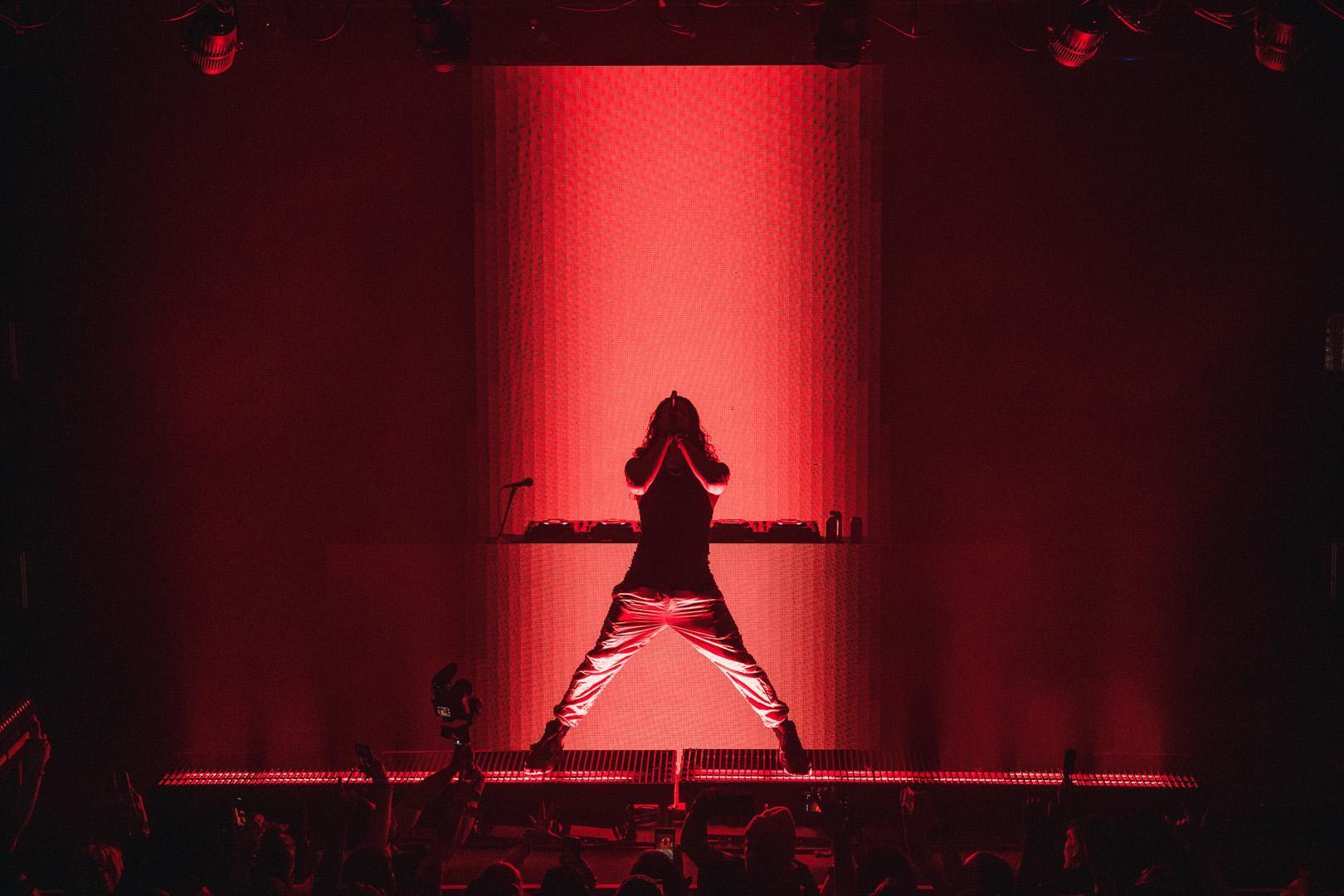
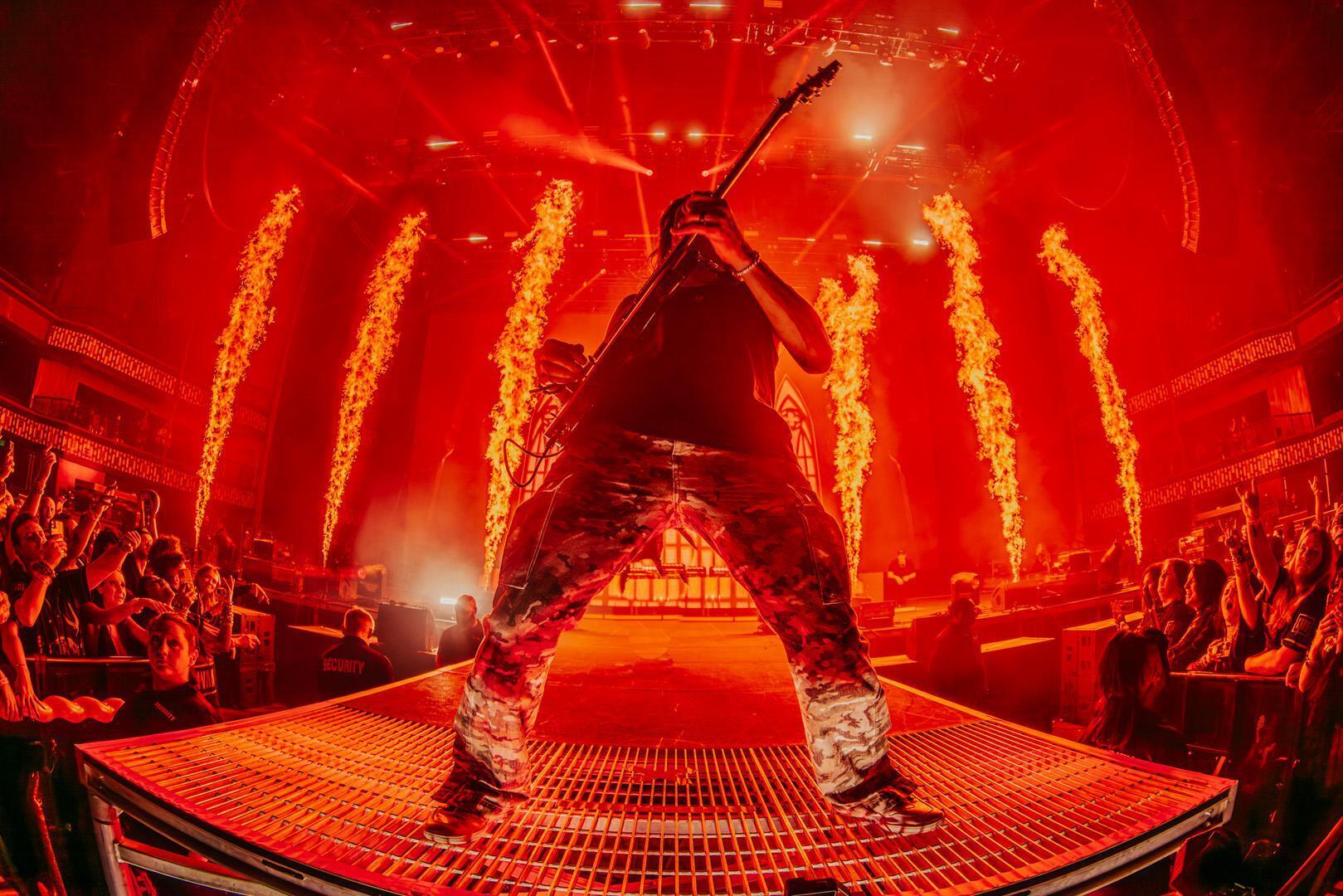
Lasers. Lots and lots of lasers with massive LED walls, cyber-esoteric visuals, Pantera-worthy pyrotechnics, pulverizing riffs, knock-you-off-your-feet bass, and an energy so electrifying you’d put more work into resisting the urge to move than dancing the night away. This year’s Reckless Rocks II (it’s okay if you haven’t seen the first one) was the zenith of all things King, representing a decade-long sonic odyssey, personal evolution, and the artistic possibilities of someone given the power to bring their vision to life.

Okay, Sullivan King’s oeuvre is more than this audiovisual feast; but it’s not not all this, and his obsession with spectacle is anything but hubris. While it’s tempting to view King’s literally explosive performances as the logical extension of his music, in a space defined by high-impact presentation, the final event — and everything in between first drafts and showtime — is carefully considered through every step.
“Nine times out of ten, the music is about the reaction . . . I want people to move.”
It’s clear from spending time with King that his Andrew WK-esque party-rocker persona is merely the uppermost layer of an artist fighting against a system unable to contend with his musical multitudes, a way of giving the people what they want — something weird, something . . . King.
His aptitude for knowing when to ease off the gas and when to put the pedal to the metal is one of the strongest tools in his arsenal. It’s fueled his rise through the hazy aftermath of the initial, early-2010s EDM boom, reinvigorating a space of heavy electronic styles that many assumed would fade once the novelty wore off. But, for as much as his work can be categorized under the linguistic trainwreck that is the term “EDM,” Sullivan King’s intuitive capacity for breaking and reshaping the mold stems from his immersion in virtually everything that’s not EDM.
NWOEHM: New Wave of Electronic Heavy Metal
Within a matter of seconds upon first meeting Sullivan King, he spotted my Justice Cross tattoo. After nerding out over the French duo’s history of innovation and speculating on their then-upcoming fourth LP, it occurred to us that we’d actually attended the same Justice show over a decade prior. They’d headlined the Hard Day of the Dead festival in Los Angeles. That was King’s first festival show and one that would invariably shape his artistic trajectory.
The hallmark Justice fusion of distorted synths, heavy-metal aesthetics, ’70s disco-style glam, and ’80s-rock-inspired motifs defined their 2007 debut record, evolving throughout their career into an audiovisual spectacle of aggressive yet infectiously groovy dance music that mirrors King’s output. Names such as Nero and the Bloody Beetroots emerge during our geek-out, and a pattern of inspiration begins to reveal itself, one that presents his voltaic concoction of electro-metal elements as an impassioned dedication to bearing a torch for historically misunderstood styles.
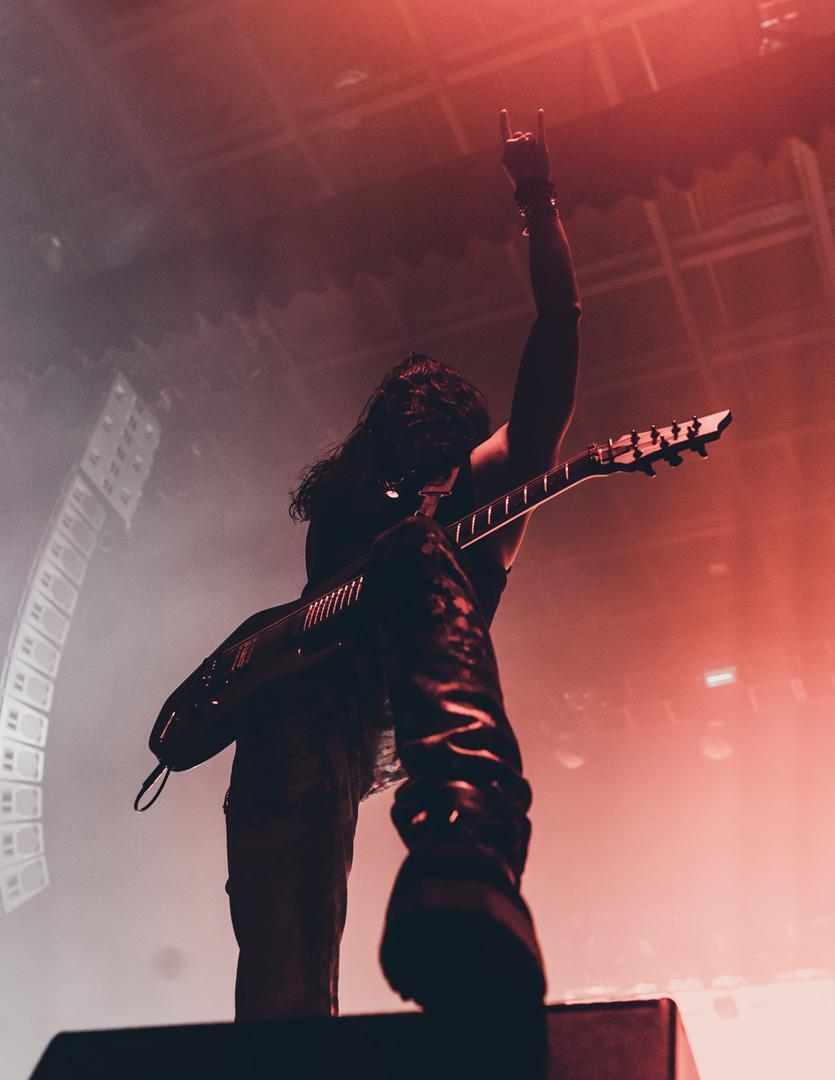
Like his predecessors, Sullivan King’s a product of rock music. Eddie Van Halen is one of his all-time biggest influences, especially as a guitarist, honoring him with his son’s middle name: Edward. Polyphia’s Tim Henson and Scotty LePage, Disturbed’s Dan Donegan, Steve Vai, Avenged Sevenfold’s Synyster Gates, and Guthrie Govan are a handful of names that round out the roster of guitar gurus whose myriad approaches to the instrument inform King’s own playing.
“I started as a guitar player; I love being a guitar player; I’ll die as a guitar player.”
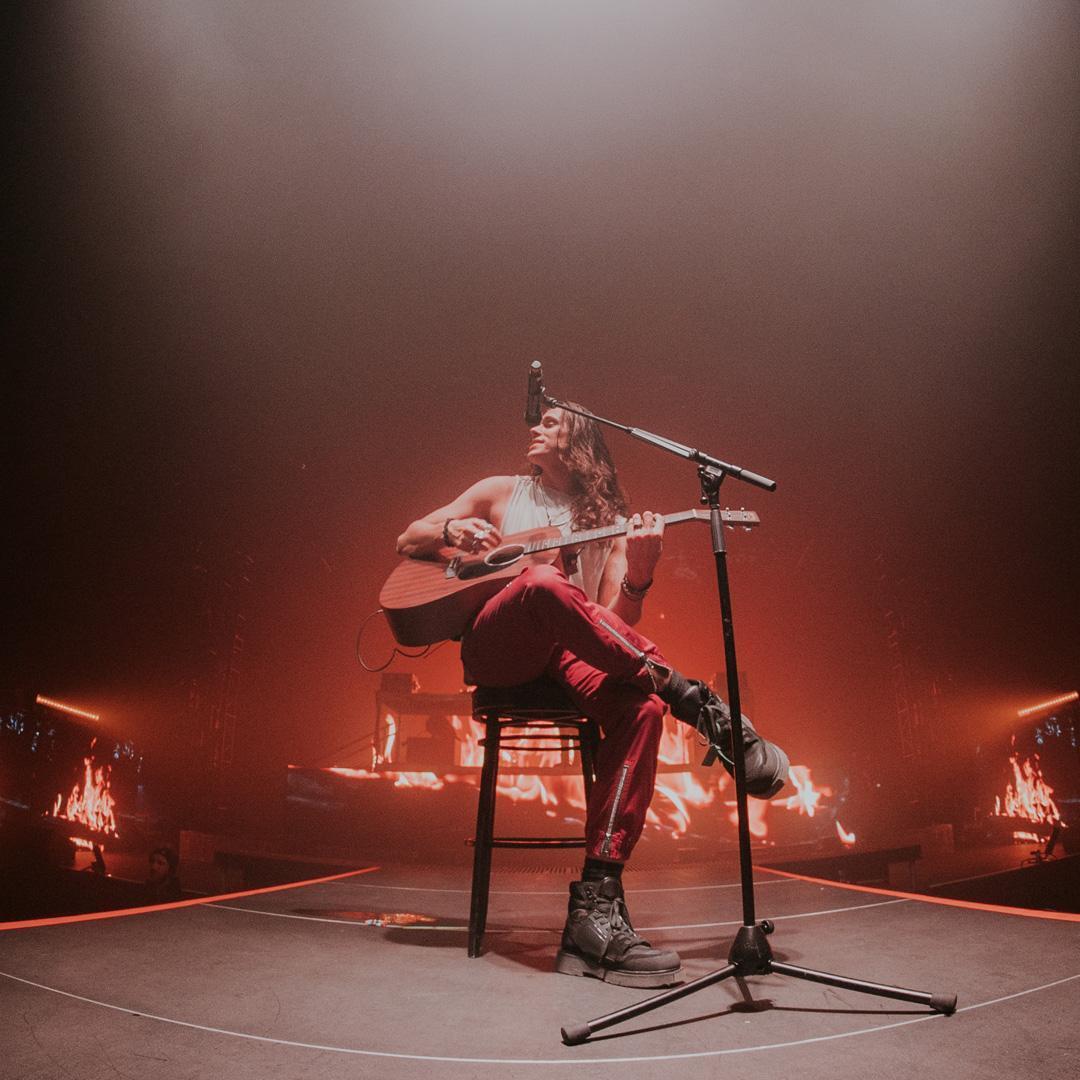
Sullivan King’s reimagined marriage of retro-rock riffage and stadium-shattering electro ensembles was born for the arena, and, boy, it shows. Seeing him weave licks and lasers into a deluge of light, bass, and fire, it is as much an ode to his aural ancestors as it is the unconditioned ultimate of his sonic inevitability. But while the frenzied flames and walls of noise keep the crowd on their feet — in more ways than one — as the set rages on, this keep-you-guessing ferocity is endemic to King’s methodical calculations around performance that make for such a fluid move from record to real life.

If King’s use of the guitar could be described in a word: “disruptive.” Upending the mores of how we unconsciously position the guitar in musical expectations, Sullivan King’s personal relationship to the axe parallels its place in his world. His crusade of creative liberation against a cultural architecture of absolutes, which can’t rectify the uniquely human capacity to see the common denominator of brutal bass and reckless riffs, hasn’t been met without skepticism. Then again, which disruptors haven’t?
In 1999, Smith College’s Steve Waksman — professor of both Music and American Studies — wrote the gripping musicological tome of cultural analysis, Instruments of Desire: The Electric Guitar and the Shaping of Musical Experience. In it, Waksman describes the early days of Eric Clapton’s and Jimi Hendrix’s relationship, wherein Hendrix was so distinguished from his peers, as much in style and showmanship as playing itself, that Clapton’s inability to process what he was perceiving led him to one conclusion: Hendrix was just “putting on”; it was artifice.
This is something distinct from novelty but more complex than a superficial grift. Clapton ultimately conceded to what he knew all along but lacked the language or cultural faculties to assemble — what Hendrix was doing was good. It’s living, breathing art so inextricably interwoven into Hendrix himself that the lines delineating passion, performance, skill, sound, and style had all but eroded.
Sullivan King, like Hendrix and Van Halen before him, wields his guitar as an extension of himself. It’s a hue in the palette of sonic shades that culminate in a presentation of King’s true artistry. While Keaton Prescott wouldn’t liken Sullivan King’s guitar chops to those of Hendrix, Van Halen, or any of the masters that precede him, the ethos King and company share is less about technical skill and more about the disposition required to be a visionary that transcends tradition. At this juncture, the only difference between King and the rest is the elements used to realize that vision, broader in scope and tinged with electronic fervor.
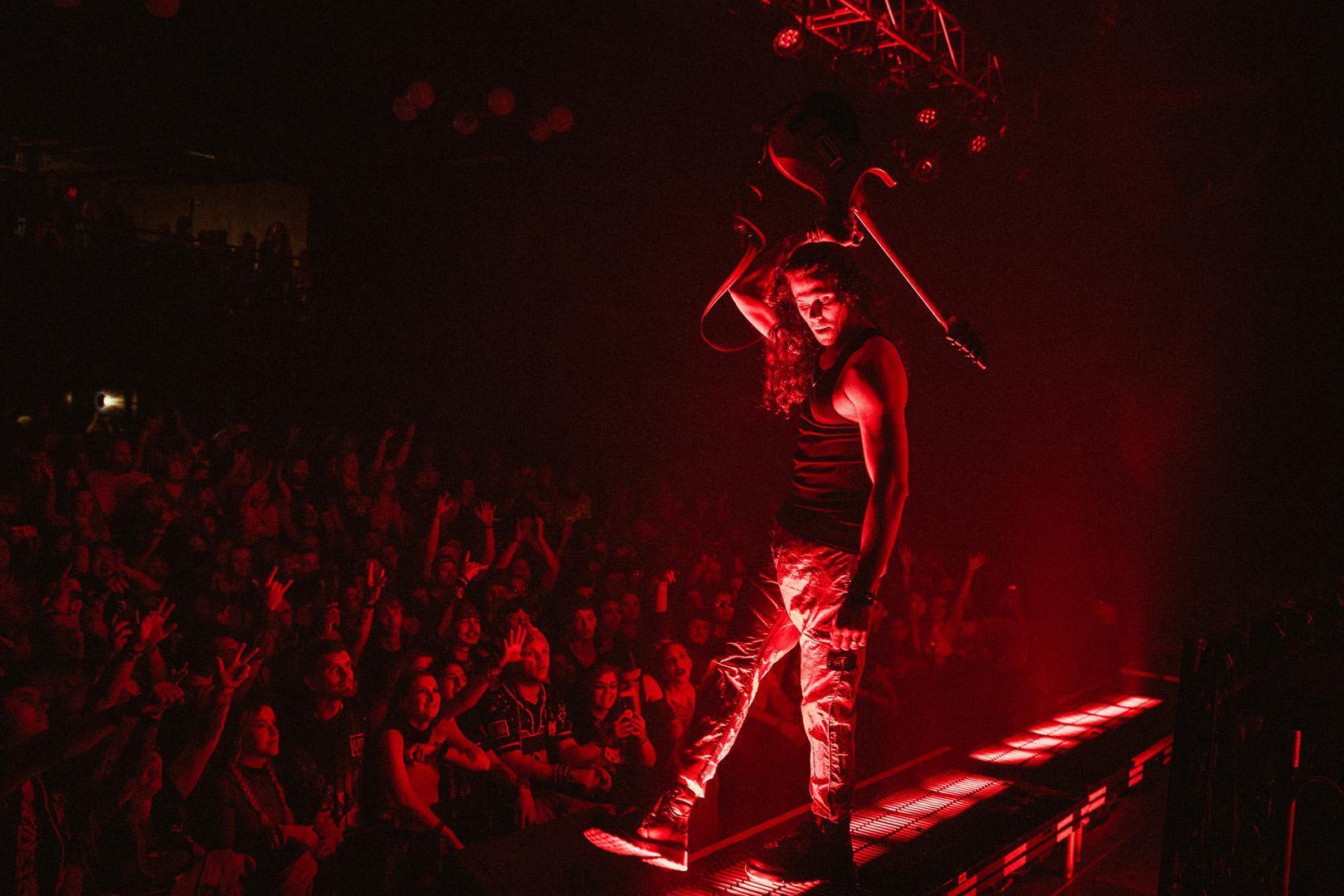
Ultimately, King is no stranger to detractors. From his first real tour, opening for I See Stars, to international festival sets, hesitation is a natural reaction to what appears pop-culturally paradoxical, slamming solos over virtual voltage. But between his character and craft mastery, King is anything but “putting on,” and it’s not just fans and peers who see this truth. Sullivan King bares the rare title of being an electronic artist with a signature guitar: his Schecter Banshee FRS, with an aptly dubbed Obsidian Blood finish, available in both 6-string and 7-string iterations.

“That’s why I started doing what I’m doing. People would say, ‘DJs shouldn’t really play guitar and do this live. No one’s going to get it.’ And I decided that’s probably what I should pursue and figure out.”
“That was absolutely one of the best moves, I think, for me, as far as fulfilling a musical journey, was just doing the things that everyone said, ‘Yeah, I don’t know. It’s not gonna really work, that’s not the normal thing.’ That’s always what I think people should drive into and figure out.”
Communitas and a Kingdom of Sound for All
So, what is Sullivan King? Sitting at the apsis of electro and the aphelion of heavy metal, King proudly dons the gauntlet of weird worn by his forefathers before him. With Reckless Rocks II delivering King at his most galvanizing wave of performance — with plenty of friends and guitars in tow — there are no signs of losing momentum.

King’s journey is nowhere close to finished, with wide-ranging aspirations to explore further avenues of expression, including a potential expansion into full-band territory (maybe even under a different moniker) or having a go at scoring and composition. Beyond the guitar, Michael Giacchino — the Oscar and Emmy Award-winning composer whose work on Lost has motivated aspects of King’s work — and multi-instrumental songwriter and composer Ludwig Göransson are formidable influences on King’s broader musical disposition, hinting at the unexpected reaches his ambitions will almost certainly take him.
Until then, Sullivan King is content to continue his odyssey of building this all-inclusive House of Noise. And he’s in good company. Eptic, Space Laces, Kai Wachi, SVDDEN DEATH, Marshmello, Vastive, Yookie, Lø Spirit, Porter Robinson, Crank Dat, Chase and Status, Reaper, Culture Shock, Phase One, Bring Me the Horizon, I Prevail, ÆON:MODE — I could go on, but there is no shortage of diverse styles across these artists’ works.

As peers, pals, and collaborators (often, all three), this spread of sonic terrain has become the foundation upon which King and company are rhizomatously crafting a community that will settle for nothing less than boundless creative excavation, a movement of coalescing sounds to inspire the next generation to take up the electro-challenger mantle that King and friends have inherited from the likes of Skrillex, Linkin Park, Pendulum, Justice, the Bloody Beetroots, and the Prodigy before them.
King’s an effigy to heavy metal, scorched into the cultural landscape by an incantation of electro-sorcery, refusing recognition of any higher sonic authority that demands he bend the knee. In his unwavering conviction to make the music he wants the world to experience, King’s amassed an army of fans, friends, crew, and artists. Community makes anything possible, and during an era of ever-increasing isolation and overwhelming technological hurdles, Sullivan King has the silver bullet to pierce the haze and raise the beacon for those who want more out of their creative experiences, to engage in life together through art, light, and sound:
Being weird. You can do it, too.
Stream “Sullivan King & Friends” Playlist
We’ve compiled a diverse playlist of artists and friends that inspire Sullivan King. So, now you can stream “Sullivan King & Friends” on the go!