

A sudden renewed interest in pop-punk is being termed a “revival” by many. With a new wave of diverse young bands, My Chemical Romance resuming their reunion tour, MGK’s transformation into a band frontman, and even a comeback record from Avril Lavigne, the question must be asked: did pop-punk ever really die, and if so, when?
Punk’s bouncier, more accessible cousin skated its enormous rise in the mid-’90s following major label debuts from bands like Green Day and Blink-182. A&R talent scouts, hungry for fresh meat as the ’90s struck middle age, saw promise in the sound of young punk-inspired bands coming out of California. Green Day, the major labels’ first true test case for modern pop-punk, took the world by storm with the release of Dookie in 1994. Dookie’s slick hooks, relatable lyrics, and exceptional production shot the band high onto worldwide charts, though not without controversy. This major-label debut drew backlash from punk purists and even got Green Day banned from Berkley’s 924 Gilman Street club over accusations the band had sold out.
But the naysayers stood no chance. Dookie‘s tracks were mixed for the radio, not for die-hard acolytes of basement social clubs where punk diehards proudly wore obscurity on their sleeve. By the 2000s’ arrival, students of the Dookie sound were everywhere, and pop-punk became more or less the de facto sound of young rock ‘n’ roll. It was present not only in usual bastions of youth like MTV, arcades, skate parks, and alternative shopping mall stores but also in more mainstream spaces, with films like 2003’s Freaky Friday featuring Lindsay Lohan as a member of an alt-rock group and Disney stars like Miley Cyrus and Selena Gomez tapping into the sound across various albums and shows. Such avenues gave millions of children, and young girls in particular, a sample of the punk ethos without ever having to ask mom or dad for a ride to a sketchy local venue for an all-ages show.
Pop-punk’s ascendance as the hottest genre in rock only accelerated from there, inspiring countless musicians to form bands and land record contracts with a frenzied speed that showed no signs of slowing down. If such momentum had an unmistakable culminating moment, it was almost certainly the friendly mid-decade arms race between Green Day’s American Idiot and My Chemical Romance’s The Black Parade. These two deliciously decadent punk rock operas seemingly redlined the genre’s potential and entertained millions with elaborately produced stage shows, the likes of which were previously unheard of for bands with even a remote whiff of punk sensibility. Though they’re undeniable feats of music and artistry, in hindsight, it feels almost as if American Idiot and The Black Parade ignited a glorious blaze that started to melt every inch of road pop-punk had left to burn. In classic fashion, the genre’s massive rise from roughly 1994 to 2006 gave it greater heights from which to fall. Die-hard fans stuck around for new pop-punk records from their heroes, but with a critical mass of fans and label support drifting towards hip-hop, pop-punk’s popularity faded quicker than drug-store hair dye or a temporary tattoo.
Get in Loser, We’re Losing Major Label Interest!
Diehard devotees kept the faith and carried on the genre quietly, as they often do when yesterday’s trends lose steam. To quickly cover pop-punk’s murky 2010’s history, new artists in the genre faced many challenges, both from themselves and from greater culture shifts. At best, what new artists of this era could achieve without major label backing (which was scarce) was a spot on the once-thriving but now endangered Van’s Warped Tour festival, the pop-punk bastion and training camp which would succumb to declining ticket sales and a bleeding bottom line before the decade’s end. New artists sometimes found opportunities like opening slots for big-name acts or nostalgia tours, but such pursuits rarely ushered along thriving careers or breakthrough records for the newbies.
For other new artists, pop-punk’s bust brought time for reflection and space. Stylistic and artistic energy, the kind that five years earlier might’ve manifested into yet another hair-gelled MTV band, naturally sublimated into a wave of talent that music press loosely termed the “Emo Revival.” Such artists bore pop-punk’s psychic imprint but had fewer genre purists in tow. The Emo Revival embraced experimentation, a DIY ethos, and a spirit of cooperation. They also tried to adopt less macho behavior than their predecessors and were less likely to be found on Warped Tour. While still firmly populated by white men, the Emo Revival scene was slightly more diverse and socially conscious partially due to internet discourse about gender and race that emerged at the time.
Among these bands were acts like Title Fight, Tigers Jaw, The Wonder Years, Modern Baseball, and Joyce Manor who picked up steam via YouTube videos, forums like Reddit, and the Bandcamp platform. Modern Baseball’s second and third albums You’re Gonna Miss It All and Holy Ghost cracked the Billboard 200 charts with admirable sales at 53 and 97 respectively, a feat accomplished with only minimal label support. As Modern Baseball graduated from basements to clubs and festivals, they intentionally spoke and wrote more openly about struggles such as mental health and even set up hotlines fans could text for immediate rescue from physical or other harassment at the band’s show. Small decisions like these signaled changing seas yet also subtly carried forward a torch ignited by earlier fans and bands.
Rappers . . . to the Rescue?
In the 2010s, tastes and trends turned the popular gaze away from pop-punk, yet countless artists came of age during this twilight era of the genre — the tail end of the pop-rock hey-day and hip-hop’s mainstream ascent as music’s #1 form. Some artists still felt genre loyalty, but many more fed their creativity with diets of contradictory styles. One style emerging from these contradictions was emo trap, a type of music that fused trap beats and rap with sampled guitar played in pop-punk or emo styles. And rather than frequenting pop-punk’s old stomping grounds at MTV and Warped Tour, this emerging scene coalesced around a new live event: Emo Nite.
Emo Nite began as a novelty club night theme in LA and has now expanded into a traveling show that’s hosted events in US cities since 2015. Emo Nite became a creative home base for emerging emo trap artists like Lil Peep and Juice WRLD who were sketching emo trap’s emergent style. Emo Nite acts were ambitious, and the LA events built a reputation for attracting big-name star power. Celebrities Demi Lovato and Cole Sprouse popped in at points, Post Malone DJ’d a My Chemical Romance set, and EDM monarch Skrillex even performed a reunion set with his old screamo band From First to Last. And what drew such star power to this strange event?
Well, the music, of course. Something was clearly sounding fresh, blessed perhaps with a modern stylistic edge that traditional pop-punk had lacked for some time. Crowds, once again, had an underground secret that’s so essential for innovative creativity. Sure, nostalgia is a huge part of the equation, but if you do more than a quick nostalgia check, it’s easy to see there’s more going at Emo Nite than just fond throwbacks to skinny jeans and heavy eyeliner. Pop-punk just might still have some road left to burn.
Can I Interest You in a Used Half-pipe?
But the old must often die and make room for the new to fully bloom. And by many accounts, that’s just what happened when pop-punk recently took a symbolic death blow: in 2018, Warped Tour announced the festival was calling it quits after 24 years of touring. What began as a summer camp roadshow for bands and their fans had absolutely succeeded in turning crowds onto new music. It hosted approximately 1700 bands throughout its history, which also included artists outside of pop-punk (Black Eyed Peas, Yelawolf, Katy Perry, and Avenged Sevenfold all made early-career appearances) and served as a major tastemaker in alternative music.
Though many Warped graduates are now recognized, accepted, and beloved, Warped and pop-punk at large are not without controversy. For many, pop-punk’s currents of misogyny played a role in declining ticket sales and reduced public interest.
A former Warped staffer and current content creator Assata Dela Cruz spoke to us about this sentiment in depth. “Music was my safe place. I was always drawn to alternative music and more specifically pop-punk and emo . . . that was just like my passion.” At age 13 or 14, Dela Cruz went to Warped for the first time, and she was so enthralled that she made the festival an annual trip. Like many, she grew up with mental health struggles and later found herself drawn toward the prospect of working in the industry where she’d found community and escape. At 19, Dela Cruz took a job with the advocacy group To Write Love on Her Arms, a group that would set up merch-style booths with mental health resources at alternative concerts and sometimes take a moment onstage to advocate destigmatization of depression, addiction, self-injury, and suicide. From TWLOHA, Dela Cruz took a job at Warped Tour in 2008 after dropping out of college. “I was in school paying a ridiculous amount of money to do exactly what [I was] being offered to do now,” she said, not regretting the decision one bit because she loved the music and the work. “It was literally my passion; it was my dream.”
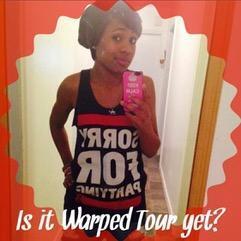
Yet, in hindsight, Dela Cruz feels parts of the Warped experience were not right. “I was this 19-year-old kid from small-town Alabama so [I was] just like oh this is just how things are. A lot of [Warped] was ultimately this boys club like there [were] not a lot of women on that tour like at all, and the women . . . I’ll say my experience, I don’t want to speak for everyone else, but we were treated no differently than what people would consider groupies by like a lot of these bands.” In Dela Cruz’s experience “We [women] were the ones that are getting up at five o’clock in the morning doing setups . . . working until like midnight. There was definitely not this equal balance by the way women were treated on that tour.” Meanwhile Dela Cruz and other Warped Tour staffers, as well as fans, wrestled with private feelings of mistreatment and the publicly accepted belief that “this is just how the music industry is.”
That all flipped, or at least shifted, in the mid-2010s thanks to the widespread adoption of social media and women’s movements like #MeToo. “I feel like it really lined up with [#MeToo],” Dela Cruz says, noting that while women might’ve spoken up before, there was no mass audience standing by ready to act and receive. As is the case for many, Assata recalls Warped Tour’s end as a bittersweet memory. “I felt very conflicted with Warped Tour ending. There was that 11- or 12-year-old girl that like really found herself at Warped Tour who was so sad . . . but then there was also like that adult woman that decided to stop working on Warped Tour because of how toxic and dangerous an environment it had become.” Dela Cruz notes that while misogyny and the poor treatment of women, fans, and staffers will never be the official cause of Warped’s demise, “You couldn’t keep ignoring these women anymore and so people weren’t supporting it.”
Striking a similar chord, Hayley Williams of Paramore took a fresh perspective on some of the genre’s past attitudes the very same year Warped Tour called it quits. 2018 saw Williams swear off her 2007 blockbuster hit “Misery Business” after feeling for some time that parts of her lyrics were anti-feminist and not something she wanted fans to cheer on (though just this week Williams joined Billie Eilish onstage at Coachella for an acoustic rendition of “Misery Business”. Eilish handled the song’s controversial second verse but skipped over a controversial lyric).
Beyond misogyny, larger economic forces also cut into the festival’s bottom line. There was the 2008 financial crisis and digital music’s rise, both of which ravaged the industry. Meanwhile, surviving genre labels like Fueled by Ramen and Hopeless Records also diversified their rosters with waves of new indie stars like Twenty One Pilots. So, no matter how much sweat went into Warped in the 2010s, labels just weren’t reciprocating that input, and without label energy, there’s bound to be fewer fans. By the time the Warped Tour’s half-pipe felt the final plunk of a skater dropping in for one last ride, there was a lot of baggage that couldn’t just be ollied over any longer.
MGK’s Pivot
But the inventive wheels of revival were already turning even as the mixed bag of eulogies and goodbyes for Warped Tour poured in. Scarcely a year passed before pop-punk received a jolt of fresh life, oddly enough from the rapper Machine Gun Kelly.
Born at the dawn of the ’90s, MGK was young enough to experience both pop-punk’s golden era and hip-hop’s mainstream rise. MGK made rap his focus for the first decade of his career, though if you missed MGK in the sea of 2010s rap, it’s tough to blame you. This era produced a dizzying amount of exceptional music but was also oversaturated, an ideal situation for the Internet’s music nerds but not for pop culture’s short attention span.
By the end of the decade, Kelly was ready for a pivot, and he did what few rappers do when they feel they’ve hit a creative wall: he reinvented himself, transitioning to pop-punk with the release of Tickets to My Downfall in 2020. Tickets was a well-received release that hit number one on multiple charts in the US and Canada. And, though this record surprised many, the pieces of MGK’s sudden transformation make perfect sense if you look closely.
Tickets’ major appeal is its updated pop-punk takes with little bits of style and flair taken from hip-hop. Tickets’ 15 tracks are cohesive and jam-packed with authenticity that owes a buck to production and drums by Travis Barker of Blink-182 — this is what pop-punk sounds like in the 2020s. MGK’s songwriting feels fresh thanks to subtle rap influences that creep in between tried and true pop-punk formulas, and while MGK never quite falls back on rapping bars on Tickets, his verses often have rap-esque flows that feel more lyrically dense than any pop-punk of recent memory. Tracks like “Lonely,” “All I Know,” and “Kiss Kiss” wield stadium-ready choruses while songs like “Drunk Face” and “My Ex’s Best Friend” rely on trap beats for a unique feel of genre limbo that add to the record’s scope. Though unconventional, such touches feel like the rational hybrid theory for a man whose rap career could never fully hide his subtle 2000s-alt influences.
New Contenders & Barker’s Clique
The lion’s share of pop-punk revival artists trend much younger than the elder Barker and even Machine Gun Kelly. One young standout is KennyHoopla and his recent album Survivors Guilt: The Mixtape// (2021). KennyHoopla, a Black artist in this traditionally white genre, recorded and refined Survivors Guilt in tight collaboration with Barker who has quietly created a double life as a sought-after producer in the wake of his successful collaboration with MGK. Survivors Guilt delivers mostly summertime sadness bops but breaks from routine with the impressive number “inside of heaven’s mouth, there is a sweet tooth//”, a full-on screamo song packed with earnest vocals that push this young artist’s talent to new heights.
An even more high-profile example is Olivia Rodrigo. Rodrigo is not a Barker prodigy; she’s a former Disney star (Bizaardvark, High School Musical: The Musical: The Series) who’s singlehandedly keeping the Disney to alt-rock pipeline alive. Rodrigo’s childhood memories are colored with scenes of her cool California parents playing ’90s alternative records from Green Day, No Doubt, and Pearl Jam, influences that bleed into her music but don’t define it. Rodrigo’s debut album SOUR recently topped charts worldwide in no small part thanks to promotion from Geffen Records, the same force behind breakthrough records by Nirvana, Weezer, and many more; SOUR bears hints of influence from Lorde’s minimalism, Taylor Swift’s wit, and Adele’s conviction, yet Olivia also knows how to lob in a Paramore-inspired pop-punk riff to take things up a notch.
And plenty of artists without a prior rap or Disney career are riding the revival wave, with significant interest being generated around artists of color. People of color have always been present in the scene as fans and in bands (Whole Wheat Bread, At the Drive-In anyone?), but internet fandom has enabled fans to rally around under-represented bands in new ways.
Somewhere between melodic hardcore and pop-punk sits Action/Adventure, a four-piece that according to their label is comprised “solely of BIPOC” whose mission is “to create #PopPunkInColor and ensure pop-punk is a genre where everyone is represented on and off stage.” Formed in 2014, Action/Adventure gained significant steam in 2020 with the release of a hard-hitting video for their track “Barricades” on TikTok. The video details discriminatory comments spoken to band members at gigs across the country. Members hold up placards with snide putdowns they’ve received including “You sound so white,” and “Let me guess, rappers?” In a feel-good twist, “Barricades” racked up over 1,000,000 plays within three weeks and amplified Action/Adventure’s following to new heights. Their latest release is Pulling Focus (2021) from Pure Noise Records. And while it might be too early to say pop-punk has made a 180° turn, many artists are finding the genre more welcoming to women and people of color than it was in the past, largely because of efforts by bands like Action/Adventure who are carving out space.
For scene veterans like Dela Cruz, it’s a welcome change that’s overdue and a sigh of relief at the same time. “For me, pop-punk was always about those outcast kids. So now to see like Juice WRLD and like all these people . . . just, musically speaking, to see Black kids that are into alternative music and are loners because of it, and they’re talking about mental health, which is not something that’s talked about in Black communities . . . to see that happening is for me what I wanted and what I needed when I got into this alternative music scene. I was not able to see people that looked like me. Fefe Dobson was kind of the extent of it,” Dela Cruz says. “[And] now kids like me are going to be able to listen to music by people that look like them, and that’s like the greatest thing that’s come from all of this.”
One band already fulfilling Assata’s vision is Meet Me @ the Altar, whose members originally met as young teenagers on the Internet and made music remotely while living several states apart. Meet Me @ the Altar pairs sugary sweet vocals inspired by 2000s alt with heavy drums and guitar lines that effortlessly pivot from twinkly riffs and slinky leads to chugging easycore breakdowns. In a slight departure from what one might expect from that sonic description, Meet Me @ the Altar often takes a lyrically uplifting tone that’s totally down to tackle some difficult emotional topics but often by taking an eye towards tackling present challenges rather than reveling in their difficulty. Standout tracks include “Hit Like a Girl” with lyrics like “I’m tough / I’ll save the world and won’t even break a sweat / So what? / I’m rowdy, yeah, I hit like a girl” and “Garden” which proclaims “Is it just luck or is the future looking kind of great? / Time has coped and it has definitely helped me see / That I’ve always had purpose.”
The presence of women and people of color in this genre isn’t new, but their definitive position at the revival’s vanguard is significant, a welcome shift from pop-punk’s stringent white male image. Perhaps if this unfolding new decade of pop-punk has something pithy to add beyond sonic changes, it’s inclusion and openness, both to new styles and artists whose skin tones and genders defy the old-school archetype of what pop-punk looks like. There’s still plenty of angst to be had, but perhaps it’ll find more worthy targets than it has in the past.
Onto the New Age
DIY recording and social media have no doubt allowed this genre to expand its inclusivity and output, but did a global pandemic also play a role? Many young artists such as Olivia Rodrigo and Meet Me @ the Altar are supposedly in the “golden years” of their youth, yet they released their early creative fruits during this pandemic’s social upheaval.
Assata Dela Cruz is an avid social media user, so we asked her what role COVID might’ve played in the current revival. “[It] played a role in two ways,” she says. “One with everything being pushed back online, people were able to go back and like discover all of this music. Then also, a lot of people from my generation, it really pushed us into nostalgia of like ‘oh remember back in the day we could go to concerts?'” Alone, without the trappings of a normal social life, music and fond memories were a portal to sanity for many.
Solo recording was also an exercise for many musicians during the lockdowns, even seasoned pros like Jarrod Alexander of My Chemical Romance. Jarrod’s pre-MCR background includes several melodic hardcore bands, a resume that demonstrates the porousness of pop-punk’s borders. Cooped up with MCR’s reunion tour on hold and out of room for new drums, Jarrod decided to spend lockdown learning more about recording. “Recording is like a whole different game than just playing,” Jarrod said. With help from a few Sweetwater purchases like a Universal Audio Interface, a BAE mic preamp, and other hardware, Jarrod explored recording more in depth than ever before. “I took it upon myself to just start investing in recording gear and learn a little bit about [it] super late in life. The bulk of playing drums for me has been having my eye on like drums and purchasing drums . . . collecting and buying and selling, and I kind of was able to shift my focus,” Jarrod said. At Sweetwater we saw a huge surge of interest in home recording gear during COVID’s height, and we trust that plenty of great music will make its way into the world because of those sales.
The legacy of this revival continues to unfold with new sounds and plenty of fresh faces. Will some of the artists mentioned firmly break into the mainstream? Can we get a new breed of punk rock opera that rivals American Idiot or The Black Parade in the future? The next few months and years will reveal all, and Sweetwater will be here every step of the way to support the artists championing the genre!