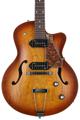
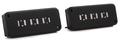
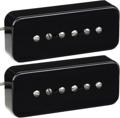
Four years before the Telecaster’s twangy pickup duo, eight years before the Strat’s glassy pickup trio, and a full 10 years before Gibson’s first PAF, the humble P-90 was born — the oldest pickup design that still finds widespread popularity today. Oddly enough, the pickup that fueled the jazz-age elegance of Gibson’s early archtop models is now a standard choice among guitarists who seek a raw, biting tone, and the wide-ranging nature of the P-90’s famous users is a testament to its unmatched versatility. To honor the P-90’s rich heritage, we’ll be taking a look at this classic pickup’s tone, history, and musical legacy — from the first Gibson ES-150 in 1946 to the wildest modern spins on the granddaddy of single-coils!
What Is a P-90?
One of the largest single-coil pickups, Gibson’s P-90 was the predecessor to the dual-coil humbucker, sporting a brighter, more articulate tone that many players still find to be the most versatile pickup design ever created. A plastic bobbin, wire, two alnico bar magnets, a set of screws, a baseplate, and a plastic cover: the P-90’s simple design perfectly reflects its raw, natural tone. But, if it’s such a great design, why did Gibson feel the need to replace it with the humbucker? Two words: “single” and “coil.” 60-cycle hum is something that single-coil fans must simply learn to live with; and, to put the problem in perspective, the P-90 was around long before wax potting, proper shielding, and hum-canceling designs became the norm — it was noisy. Add in the less-than-stellar electrical technology of the first half of the 20th century (we’re talking pre-grounded plugs here), and it’s no surprise that musicians demanded a hum-free way to electrify their instruments.
Thankfully, we live in an age where guitarists no longer need to fear being shocked by their ungrounded amplifier, and there are plenty of ways to mitigate or even completely kill pesky single-coil hum. Even so, the P-90 still stands as somewhat of an underdog compared to the mighty humbucker and Fender’s single-coil offerings, but we firmly believe that it deserves a top spot in the pickup pantheon.
The P-90 Tone
P-90s can be clean, dirty, sweet, mean, smooth, rough — they’re masters of versatility, and they boast a dynamic, “living” feel that no other pickup can quite capture. Many modern guitarists describe the P-90 as sitting somewhere between a Fender-style single-coil and a Gibson-style humbucker — an affront to the P-90’s elder status among guitar pickups! Still, it’s a fairly accurate way to introduce someone to the P-90 sound. Being a single-coil, the P-90 has plenty of high-end articulation, and that’s why you’ll commonly hear words like “bark” and “bite” thrown around. But the thing that most separates the P-90 from, say, a Strat or Tele single-coil is the round low-end thump and rough-around-the-edges feel. A P-90 is also uniquely sensitive to volume controls, and it’s common to see guitarists running them full blast for their dirty tones then rolling back the volume knob to achieve smooth, rich, and harmonic-laden cleans.
P-90 Variations
Barring minor changes like magnet type and output, the P-90 is a rather consistent pickup with only a few significant deviations. The first one of these is the Staple P-90, easily recognizable by its staple-size pole pieces. This pickup offers a more refined and articulate take on the P-90 formula, and many guitarists find that it comes very close to Gretsch’s DynaSonic single-coil. Staple P-90s ran for only a few short years, but now modern pickup makers like Seymour Duncan offer stunning re-creations of their legendary “P-90 meets hi-fi” tone. A more modern Gibson creation is the P-100 — a double-stacked P-90 that reportedly offers the P-90 tone in a hum-canceling design — and Fishman has even introduced their Fluence technology to the Greg Koch “Gristle-Tone” pickup.
If you’re looking for your own P-90 guitar, then you’re bound to run into this pickup’s two different visual styles: the soapbar and the dog ear. As evocative as these names are, the only difference between these two types is the way in which they’re mounted to the guitar. The dog ear is commonly found on archtops, and the soapbar is more often found on solidbody guitars. Another P-90 variation is the Fender Jazzmaster pickup . . . just kidding, Jazzmaster fans! Although it’s frequently mistaken for a P-90, the Jazzmaster pickup is its very own beast, and it shares little relation to the P-90 beside the similar shape.
A History in Sound
As with any musical-instrument company that’s been around long enough, Gibson’s details, dates, and even basic facts can sometimes become muddled — lost to time and questionable record-keeping practices. That being said, to truly understand the P-90’s importance, we have to take a trip all the way back to 1936, when Gibson released the ES-150 archtop, their first “Spanish-style” electric guitar.

This was the first model in Gibson’s Electric Spanish (ES) series of instruments, a name that any guitar aficionado is surely familiar with from the later ES-335, ES-175, and other Gibson archtop models. But what’s that strange-looking pickup? Certainly not a P-90. In fact, the ES-150’s pickup came at such an early stage of electric-guitar development that it doesn’t actually have a name; there were so few electrified guitars around that it didn’t really make sense to differentiate it from the legions of pickups that were yet to be invented. However, jazz guitar virtuoso Charlie Christian was an early adopter, and the pickup is now simply referred to as the Charlie Christian pickup.
The Charlie Christian did well — for a time. While it looks rather neat at first glance, taking a peek underneath the guitar’s top reveals a massive, unwieldy assembly (hence the three screws in the top), and, even with the pickup’s huge cobalt magnets, there was very little output compared to modern pickups. Did we mention it was a full two pounds altogether? Gibson made several refinements to the Charlie Christian pickup’s design, but it was clear that there was significant room for improvement in the world of guitar electronics.
So, Gibson improved. There are plenty of prototypes and one-offs in the 10-year span between the Charlie Christian and the P-90 that come close to the P-90’s final design; but, when the USA entered World War II in 1942, production and availability of materials across all industries slowed to a halt, having been repurposed to supply the war effort. Finally, in 1946, Gibson officially began offering the P-90 as we know it today, designed by Walt Fuller as the successor to his earlier P-13 pickup and as a replacement for the Charlie Christian.

What made the P-90 so different then? For starters, alnico-magnet technology offered higher output in addition to reduced overall weight. The top-mount design was far superior to the overly complicated assembly on the Charlie Christian, and it allowed for greater versatility in placement. The adjustable pole pieces provided greater control over individual string volume. From a manufacturing perspective, the P-90 was also simpler and (most importantly!) cheaper to produce. Tone might be king when choosing pickups in the 21st century, but, during the electric guitar’s early years, simple availability was key, and Gibson’s ability to easily tool up and manufacture the P-90 was no doubt integral to its success.
You might be asking yourself why we’re taking the time to cover these earlier pickups rather than simply stating “the P-90 was first released in 1946” and leaving it at that. The fact is that, while the P-90 might not have been the first electric-guitar pickup, it’s perhaps the first pickup that defined what a pickup should be. Sure, the Charlie Christian is still favored by some guitarists, but modern reproductions make plenty of adjustments, and it was more or less discontinued by Gibson as a standard production model for decades. In contrast, the P-90 that you find on a modern guitar is essentially the same thing as a P-90 found on a 1946 ES-150 save for wax potting and advancements in magnet technology. More than a pickup, the P-90 is a landmark in the development of the electric guitar.
Sweetwater’s old-school P-90 archtops
While it continued to serve as Gibson’s standard pickup throughout the early ’50s, the P-90 would feature on Gibson’s very first solidbody guitar, an instrument you may have heard of called the Les Paul. The P-90’s single-coil bark subsequently fueled much of early rock ‘n’ roll’s raw attitude, and it was famously utilized by artists such as Les Paul on his (surprise, surprise) Les Paul, Scotty Moore with his Gibson ES-295 on Elvis’s early Sun Records recordings, and Eddie Cochran on his heavily modified Gretsch 6120.

(TV Guide, Public domain, via Wikimedia Commons)
As successful as the P-90 was, the pickup’s inherent noise was too much for many guitarists, and engineers like Ray Butts and Seth Lover raced to build the first hum-free design. In 1956, Gibson released the legendary Patent Applied For (PAF) humbucker, and, unfortunately for the world’s P-90 fans, Gibson was quick to outfit their top-of-the-line Les Pauls and archtops with this shiny, new hum-canceling design, relegating the noisy P-90 to their Junior and Special “student” models. It should be noted that the classic PAF humbucker is essentially two miniaturized P-90s — Gibson wasn’t looking to drastically change the P-90’s voice; they simply wanted to kill the buzz.
Sweetwater’s P-90 guitars with early rock ‘n’ roll style
However, the P-90 hummed on. Some of the rock era’s most beloved music was recorded with a pair of P-90s, including the Beatles’ three Epiphone Casinos. Pete Townshend of the Who almost exclusively used SG Specials during the late ’60s as their cutting tone (and the SG’s ease of destruction) made them a natural fit for the band’s manic energy. Neil Young, David Gilmour, Tony Iommi, Carlos Santana — there’s no shortage of iconic rock guitarists who favored the P-90’s aggressive bite. In the late ’70s, the P-90 became the standard pickup for punk rock’s sneering attitude, the result of a strong stylistic influence from ’50s rock ‘n’ roll and the widespread availability of cheap Gibson Junior and Special models.

(Heinrich Klaffs, CC BY-SA 2.0 https://creativecommons.org/licenses/by-sa/2.0, via Wikimedia Commons)
It’s also worth mentioning that the P-90 never really lost its prominence in the jazz crowd — not surprising when you consider how firmly the P-90’s history is rooted in the history of big-band and early bebop music. In addition, plenty of blues musicians prefer the raw, natural feel of a P-90 compared to the somewhat more refined humbucker and the politeness of Fender-style single-coils.
By the latter portion of the 20th century, the P-90 was firmly cemented as a rock-solid classic. The electric guitar’s golden era of innovation began to die down; builders began to look backward rather than forward; and, while Strat pickups, Tele pickups, and humbuckers share the top spot as the most popular vintage-style designs, P-90s have never been far behind.
The Future of the P-90
Luckily for us, the P-90 is experiencing a bit of a renaissance in the contemporary guitar landscape. Modern builders and Gibson’s vintage-style reissues are introducing the old dog ear to a new generation of guitar players. The elder statesman of single-coils is finally getting the respect that it deserves! Boundary-pushing builders like Reverend frequently feature the P-90, and Fender is getting in on the action, too — a P-90 in the neck position is one of the most common Tele modifications you’re likely to see. Fishman has even brought their groundbreaking Fluence technology to the P-90, and, for years now, Gibson has offered the dual-coil, hum-canceling P-100.
It’s clear that the P-90’s future looks as promising as its storied past, and we can’t wait to see what comes next! If you’re looking to add some P-90 punch to your sonic arsenal, then be sure to give your Sweetwater Sales Engineer a call at (800) 222-4700.