

Here on stage, the Marshall noise is piercing through your ears, it kicks your ass, kicks your face, exploding feeling nears… Metallica, “Whiplash” – 1983
From AC/DC to ZZ Top, Slash to Slayer, Def Leppard to the Deftones, Led Zeppelin to Zakk Wylde, Lita Ford to Lemmy, Malmsteen to Megadeth, Randy Rhoads to Rush, Satriani to Static-X, and Hendrix to Halestorm — the iconic list of groundbreaking Marshall (ab)users, past and present, is as long as it is impressive. And it is all down to the vision and drive of one man — the late, great Jim Marshall. Born into a working-class family on the outskirts of London, England, on July 29, 1923, this is Jim’s remarkable story. First though, a brief, but IMHO vital, scene-setting backstory.
The Game-changing Founding Fathers of Rock Guitar
In the minds of many, the men responsible for the sound and spirit of the guitar-driven rock music we both love but also take for granted are pioneer players such as Jimmy Page, Jeff Beck, Eric Clapton, and of course, Jimi Hendrix: three Brits and one American. And they’re not wrong in that attribution — or are they? To my mind, the folk who created the tools with which such groundbreaking guitarists were able to carve and create this brave new musical path are just as important: the product pioneers. After all, however brilliant an artist may be, he or she still needs the paint, brushes, and canvas to create and bring their vision to life.
Enter another quartet of game-changing pioneers in the world of rock guitar, this time consisting of three Americans and one Brit — Les Paul, Leo Fender, Seth Lover, and Jim Marshall. Four guys whose innovative products were the tools that enabled the aforementioned groundbreaking guitarists to create their magic. I mean, can you imagine rock without the Les Paul, the Strat, the humbucker, and a Marshall stack or five? Me neither. I rest my case. Preamble over.

Two late, great legends: Jim Marshall & Les Paul: “It’s all their fault!!!”
Jim’s Early Years
In addition to his humble, working-class upbringing, what makes Jim Marshall’s story the epitome of the classic “rags to riches” tale is the fact that he suffered from tubercular bones as a child — an unfortunate affliction that made his bones so brittle that a mere fall or heavy knock would invariably result in one or more fractures. Because of this, poor Jim spent most of his school-age years literally cocooned in a plaster cast. “I was in plaster from my ankles to my armpits,” he recalled with a grimace. As a result, Jim received no formal education.
Thankfully, Jim grew out of the disease by age 13 and was able to lead a cast-free life. Due to the resulting muscle atrophy, he took up tap dancing to strengthen his legs. And by doing so he not only quickly discovered that he had an innate sense of rhythm but also that he could sing — really well. And because of the latter, he was quickly recruited as the lead vocalist of a busy, 16-piece big band.
Marching to the Beat of a Different Drummer
Even though he enjoyed singing, due to his natural sense of rhythm Jim was drawn to the drums, and when the band’s drummer enlisted for World War II, Jim took over and quickly became a much in-demand drummer. He also started teaching — a lot — and he was good, very good. So much so that his pupils included Mitch Mitchell, who went on to play with Jimi Hendrix, and also Micky Waller, who later played with both Little Richard and Jeff Beck. Jim sold drums to a lot of his students as well.
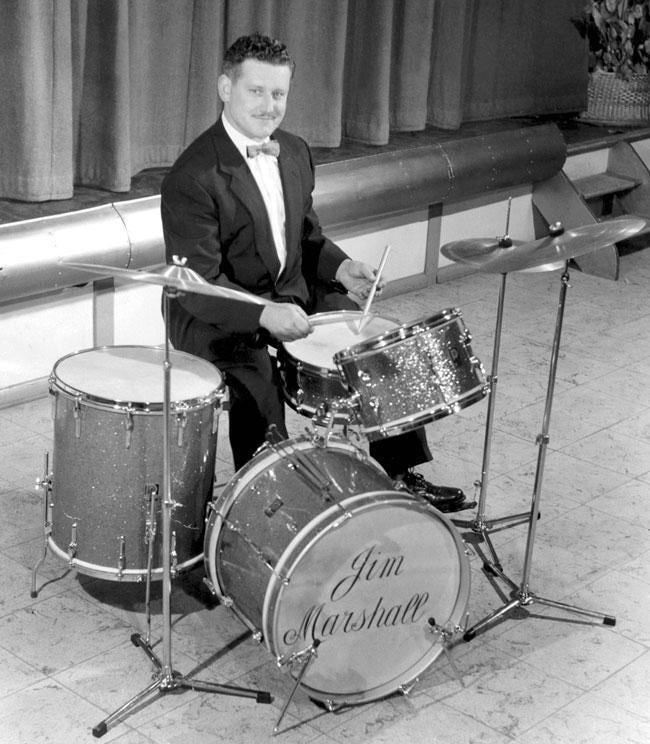
Jim as a drummer in the 1950s…

…50 years later, an iconic legend
The Art of Listening
Remember Jim with love, affection and respect…this was a man who jumped the generation gap. He sided with the young ones, with the noisy ones and not the people of my father’s generation. He was 22 years older than me and yet he spoke my language…well done, Jim. God Bless. Pete Townshend, May 2012
In the early ’60s, Jim opened a drum shop on the outskirts of London, England, and while his competitors shunned the then-fledgling rock community, Jim embraced them. So much so that legendary Who drummer Keith Moon actually worked there as a “Saturday boy”! Because of his open-armed and gregarious demeanor, Jim’s shop quickly became a regular hangout for rock bands and up-and-coming guitarists such as Pete Townshend, who pleaded with him to also stock guitars, strings, picks, and amps. So he did. Jim also listened to what young players like Pete really wanted to hear from a guitar amp. In fact, he listened very closely indeed.
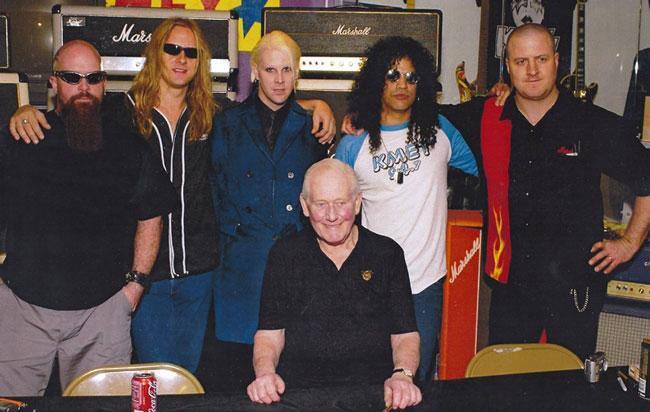
Jim with Kerry King, Jerry Cantrell, John 5, Slash & some English idiot!
The First Marshall Head Is Born
When Jim figured out the sound rock guitarists lusted for and had it firmly fixed in his head, he put together a 3-man team to make it happen. He rejected their first five attempts, and then came prototype number six. That prototype turned out to be the one. “That’s the sound I have in my head,” Jim proclaimed. And thus the legendary Marshall sound was born — purely because Jim was smart enough to listen, understand, and then strive to not only meet but exceed rock guitarists’ expectations! This first Marshall head was called the JTM45, with JTM an acronym for Jim and Terry (Jim’s son) Marshall.
Just as rock guitarists love telling tongue-in-cheek, derogatory drummer jokes, it’s definitely more than a tad ironic that it’s a drummer who is responsible for the creation of such a vitally important sonic cornerstone of rock guitar.
Although Jim initially sold that now-legendary prototype to an eager young player desperate for an amp, he later exchanged it for a production model once one was available, and amp “Number 1” proudly resides where it should — in a glass case at Marshall’s English HQ.
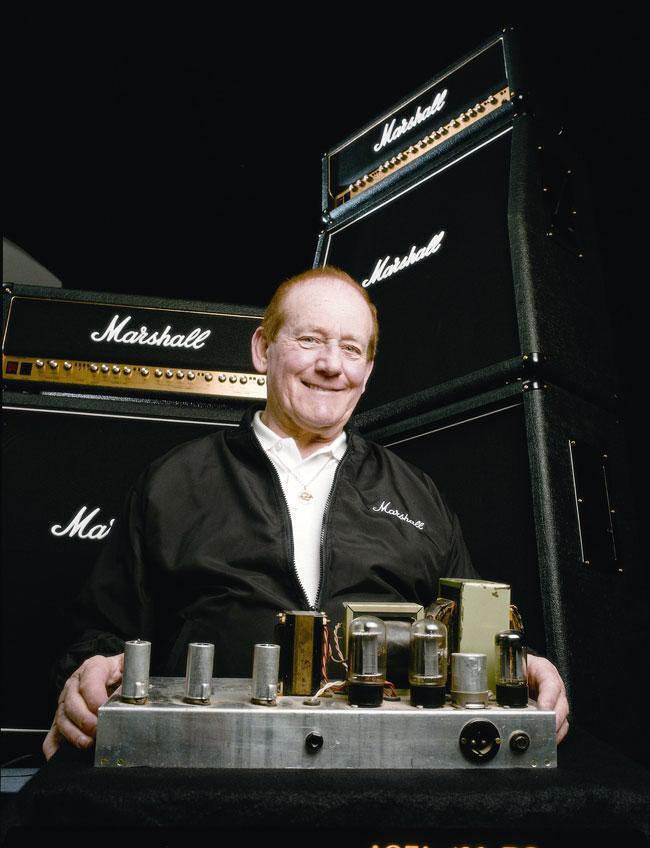
Jim with “#1 Amp” in the early ’90s…
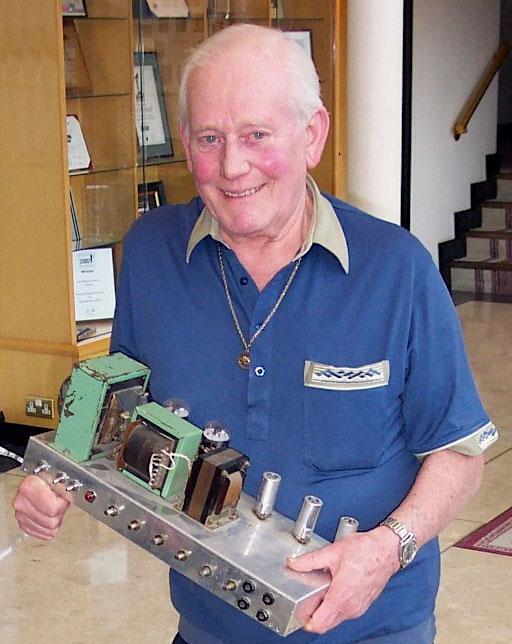
….Jim at 80 & “#1 Amp” at 41 years young!
Hail Me a Cab
To match the JTM45 both sonically and visually, Jim designed the world’s very first 4×12″ cabinet. The head was initially paired with a 2×12″ cabinet, but it “just didn’t give us the sound or projection we were looking for,” Jim recollected. “Plus we kept blowing speakers like there was no tomorrow.”
So the first 4×12″ was born in Jim’s garage. “There was nothing brilliant about the design,” he later stated with typical modesty. “We just built it in the most convenient size we could so it would be easy for the groups to transport.” The very first one Jim made had a straight front, but he didn’t like the look. “It seemed very clumsy because it was essentially just a big box with a smaller one sitting on top of it,” Jim revealed. “Because of this I came up with the idea of angling the top half of the cabinet front so it would make for a neater looking package when the amp was placed on top of it.” This top-selling, now iconic design also ended up having a sonic advantage, but that’s another story.
Mission Possible: The Invention of the 100-watt Stack
One fateful day, Jim accepted a plea from Pete Townshend of the Who. Pete turned up on Jim’s doorstep upset — very upset. The reason for the guitarist’s grief? He could see people in the crowd talking to each other when he was playing onstage, and that was unacceptable in his world. As a result, Pete asked Jim to “build a sonic weapon” that was so darned loud that the crowd simply wouldn’t be able to chat while he was playing. To be exact, he requested several 100-watt heads with accompanying 8×12″ cabs.
Jim happily agreed, but suggested that instead of an 8×12″ he build a straight-fronted 4×12″ that Pete could “stack” an angled 4×12″ on top of. The rationale was a simple but practical one — an 8×12″ would be both unwieldy and also heavy due to its sheer size. Pete disagreed though: “I’ve got roadies!” was his counterargument. Jim was quick to point out that said roadies “wouldn’t be happy,” but Pete didn’t care and insisted that 8×12″ cabinets were the only way to go. So Jim and his team built several 100-watt heads and 8×12″ cabs. Needless to say, Mr. Townshend was delighted.
A few weeks later, however, all of Pete’s roadies had quit, so he returned his 8×12″s to Jim and said, “You were right, Jim. Please chop these in half!” So Jim reverted back to his original idea, and the legendary 100-watt Marshall stack was born.
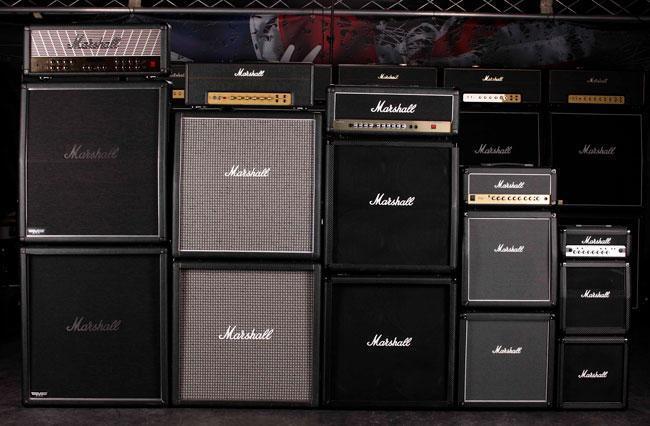
A few Marshall stacks of various sizes and wattages!
Master Volume, High Gain & Marching Forward
The creation of the 100-watt stack once again highlights Jim Marshall’s credo to “listen carefully to what people want, understand it, and then strive to exceed their expectations.” And that’s how Marshall’s popularity and legend continued to grow. He developed a long list of customer-pleasing features: master volume amps, two or more channels, the addition of reverb, FX loops, MIDI switching, high gain, hybrid amps, solid-state amps that sounded and felt right, combos, rackmount units, and more. Each and every new product was developed based on customer feedback. In truth, Marshall was rarely first to market, but when Jim and Co. got there, it was invariably right.
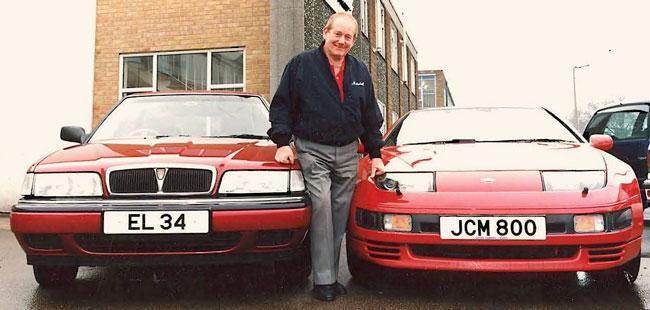
“The Guv’nor,” Jim, with his cars in the ’80s.
Signature Marshalls: Judge Jim by the Company He Kept
Having a Signature Marshall is an elite fraternity and I feel honored to be part of it. When I look across at the names of the guys who’ve got and have had signature models it’s very impressive to say the least. They’re all players I greatly respect and listen to. Joe Satriani, 2012

The one & only Satch with his signature amps & axe.
As already touched on in the opening of this article, the names of bands and artists — past and present — who plugged into Marshalls to help create their magic is a veritable who’s who of rock and metal of all guises. Equally impressive is the list of legendary pickers who’ve had their names on a Signature or Tribute Marshall amp alongside Jim’s. Here’s said roll call:
- Slash
- Zakk Wylde
- Randy Rhoads
- Kerry King
- Jimi Hendrix
- Lemmy
- Yngwie Malmsteen
- Paul Weller
- Dave Mustaine
- Joe Satriani
Any questions? I didn’t think so…
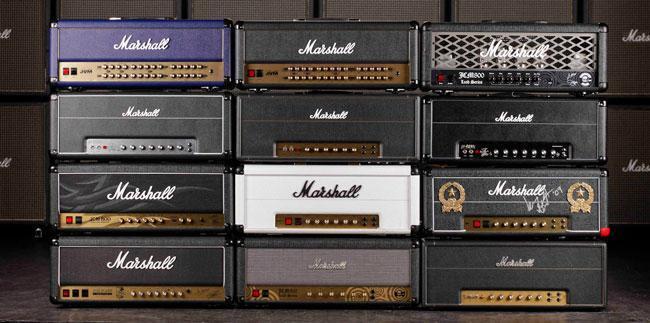
A stack of signature Marshall heads
Celebrating 50 Years
You know that dream you have where all your favourite Rock Gods are playing on the same stage at the same time? Well that’s happening here tonight…
Metal Hammer magazine, “50 Years of Loud” 10/10 concert review.
To celebrate Marshall Amplification’s 50th anniversary, a “50 Years of Loud” concert was held at the prestigious Wembley Arena in London, England, on September 22, 2012. Sadly, Jim passed on April 5 that same year, but he would have dearly loved the sold-out concert. As you’d expect, the list of performers was jaw-dropping: Joe Satriani, Zakk Wylde, Yngwie Malmsteen, Paul Gilbert, Kerry King, Billy Duffy, Doug Aldrich, Phil Campbell, Corey Taylor, Tim “Ripper” Owens, Glenn Hughes, Nicko McBrain, Mike Portnoy, and Brian Tichy. Talk about defining the statement “judge a man by the company he kept.”

Marshall 50th Concert — the view from the front of the audience…

…and the view from the front of the stage.
Lessons Learned from the “Father of Loud”
Jim Marshall was the ultimate rock star. He made us all look and sound better.
Kerry King, Slayer
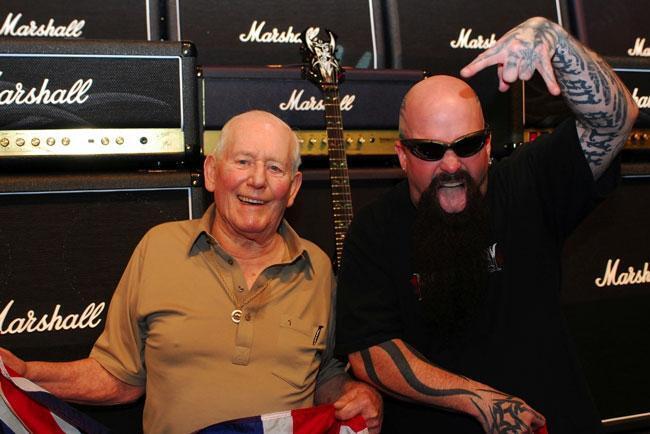
Mr. Marshall & Mr. King playing to the camera.
I had the extreme honour and good fortune of working for and alongside Jim for over 15 years and spent countless hours in his company. In addition to being a generous, humble, and extremely funny fellow, Jim was also a master storyteller who treated his vast legions of fans as if they were family — because, in his mind, they were. He also gifted me with some valuable business and life lessons. Here are a few of my favourites, and not surprisingly, the first three all boil down to the art of actually using your ears.
- “Always listen very carefully and pay close attention to what other people have to say — if you don’t you might miss some of the things you may never have thought of yourself. This whole thing began with me listening to what a few of the boys had to say about the amplification they wanted back in 1962. In my opinion, the most important thing in what we do is the person who’s actually going to play through the amp once we’ve made it. I’ve always said that it’s no good telling guitarists what amp they’ve got to use, because your ideas of good tone are not necessarily what they want to hear.”
- “Never think you know everything. That’s why a lot of people just don’t listen, you see — they think they know everything already. People like that are of no use to me. I’ll even listen to a fresh-faced, 16-year-old lad who’s just started working here. Admittedly, he might not know what he’s talking about, but you never know!”
- Why he’d often outdo artists at both trade and consumer shows by literally signing autographs all day: “Why do I do it? Because I thoroughly enjoy meeting Marshall fans and friends from all over the world. I like to hear what they’ve got to say firsthand and also shake their hand — after all, if it wasn’t for them, I wouldn’t be there in the first place. They’re all part of what I call the ‘Marshall family.’”
- His MO: “I always endeavor to try and improve on what we’ve done in the past, and I don’t mean purely on the money angle. You can’t take it with you — you can only live in one house and drive one car at a time. It’s the name that means everything to me — because it’s my name.”
At this point, it would be remiss of me not to touch on the many millions of pounds and countless hours of time Jim donated to worthy charities during his life. This side of the man is little known because, unlike many celebrities, he never used his charitable work as a publicity vehicle. “It all goes back to when I was a child and had to spend so much of my young life in a cast,” Jim once told me. “I decided at age 14 that if I ever became rich enough, I would look after youngsters who needed help and encouragement. It’s about them, not me, you see. I’ve done well from nothing, and so I’m just putting something back in.”
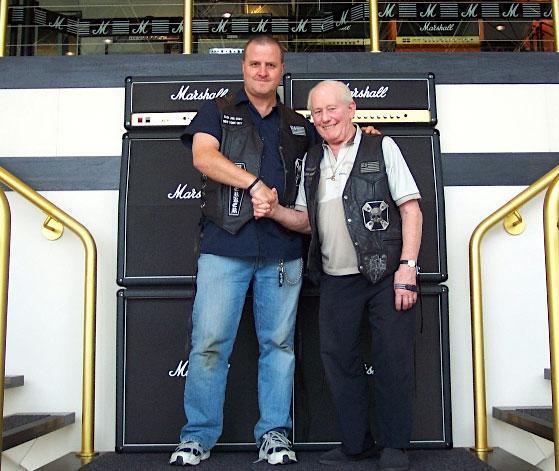
The author & Jim — the legend who always walked his talk.
In Closing
Jim’s passing marks the end of a very loud and colorful era…. Not only did he create the loudest, most effective, brilliant-sounding rock ‘n’ roll amplifier ever designed, but he was a caring, hardworking family man who remained true to his integrity to the very end. His work ethic was unequaled and his passion unrivaled. I consider myself very fortunate to have known Jim. He was such a fantastic individual.
Slash, 2012
Slash’s words really do sum up Jim superbly. His legacy will forever live on as an essential part of the sonic tapestry of all forms of rock and metal. For many, many years, Marshall proudly used the term “the sound of rock” as the company’s slogan. Perhaps what makes that saying resonate so much is the fact that it wasn’t created by a marketing guru, but it was coined by the actual users of Marshall — guitarists.
Love ’em or loath them, the Marshall stack will forever be synonymous with both the sound and, equally important, the “look” of rock. So on behalf of the multitude of people all over the world that love rock and love Marshall:
Thank you for being the “Father of Loud” & living a life that truly “went to 11,” Jim —
Rest in peace.
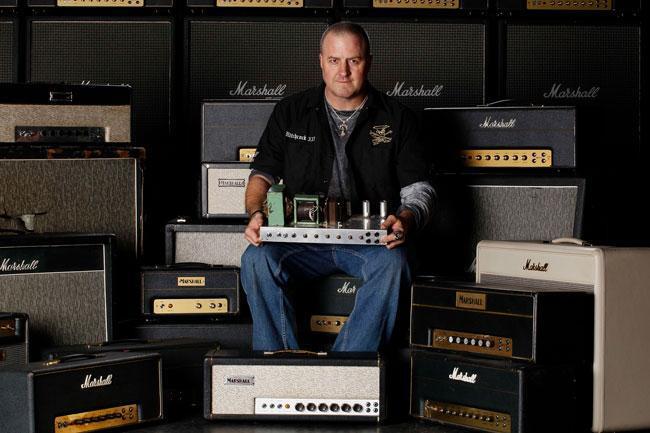
The author with “#1 Amp” and its immediate family.