

What’s the secret ingredient that makes classic rock “classic”? Why have so many songs from the ’60s and ’70s stood the test of time, even to a demographic that is two or more generations removed from the music? There are a lot of theories, and no single answer — but we can start by looking at ways in which music was recorded differently back then compared to how it’s recorded today, and see if there are any potential lessons for us.
A World Without Click Tracks
When you look at the tempo track for a lot of current pop music, it’s a flat line…and we all know what flatlined means. This isn’t necessarily a bad thing, but it’s not always a good thing, either. Songs without a click track have tempo variations that can help a song breathe, but I was curious whether these tempo changes were more or less random, or if they followed a deliberate pattern.
To extract the tempo, I used “the DAW Formerly Known as Sonar,” because you can simply drag audio into the timeline and it generates a tempo map automatically. The results were revealing. Not only did the songs have tempo changes, but they were — whether unconscious or not — deliberate enough to be repeated in similar sections of the song. Here are some examples.
The Beatles
“Love Me Do”
https://www.youtube.com/watch?v=1Au_QW5MJNI
The Fab Four are not only quite consistent, but their tempo variations are very premeditated (fig. 1).
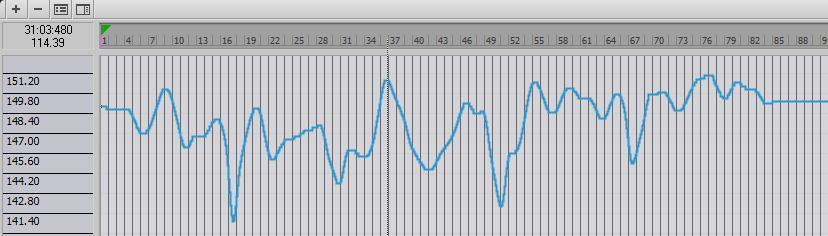
Figure 1: While the tempo changes in the Beatles’ “Love Me Do” may appear random, they follow a definite pattern.
Note the dramatic pause at “so please, love me do” around measure 16 and again at 49. I guarantee they didn’t program those tempo variations in a sequencer — they felt the changes, and then they sped up naturally after that section when it went into the “Love, love me do” verse. They also sped up a bit over the course of the track, which is something I saw in many songs.
The Police
“Walking on the Moon”
Although overall the tempo is very consistent, note the two dips around measures 31 and 52 shown here in figure 2.
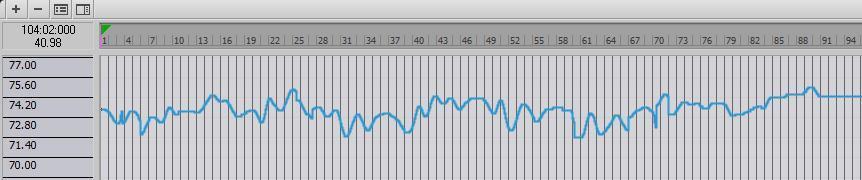
Figure 2: The tempo on the Police’s “Walking on the Moon” dips prior to leading into the bridge.
These measures lead into the bridge, but the tempo is faster the second time around. At measure 59, the band pulls back for the instrumental break. At measure 65, they start climbing out of it and speed up as they head to the end of the song.
James Brown
“Papa’s Got a Brand New Bag”
If any drummer could approach being a human click track, it would be Clyde Stubblefield. But he also had the ability to twist the beat around, as evidenced in figure 3.
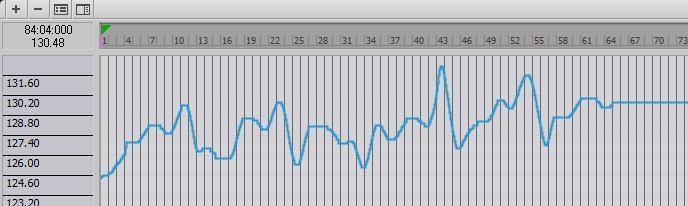
Figure 3: The tempo map for James Brown’s “Papa’s Got a Brand New Bag” breathes with plenty of variations, but also note that the song’s overall tempo increases over time.
The band accelerates until the phrase “Papa’s got a brand new bag,” which starts at measures 10, 22, and 42, at which point it decelerates. There’s even the same change at measure 55, which is musically similar but doesn’t use the same lyrics. After each break, the tempo slides up again.
Smokey Robinson & the Miracles
“Tears of a Clown”
https://www.youtube.com/watch?v=ZaMX0Cs5Bc4
Note in figure 4 how the band accelerates until measure 22, which is just before the end of the verse, and then decelerates down the bridge into the line “tears of a clown,” which starts at measure 31, after which the tempo starts accelerating again.
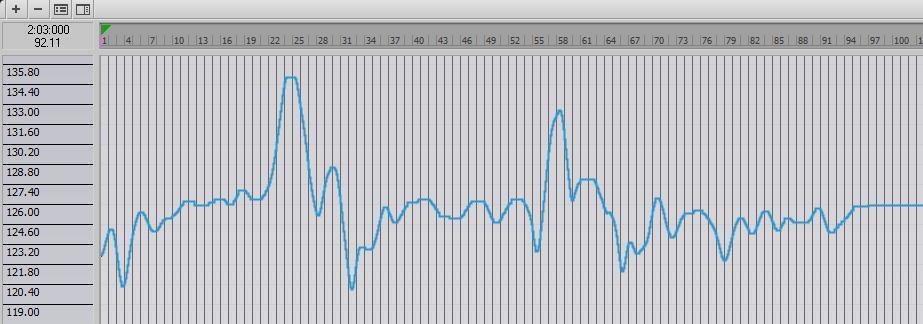
Figure 4: Smokey Robinson & the Miracles “Tears of a Clown” is another song that follows a very definite, deliberate pattern.
The second verse, starting at measure 37, is pretty consistent, but again toward the end of the verse there’s the speedup, the bridge decelerates, and the tempo is slowest when “tears of a clown” is repeated again — this is almost identical to the first set of tempo changes. After that, again the band is pretty consistent.
Pat Benatar
“Shadows of the Night”
There wasn’t enough tempo information in the beginning for an analysis, so I drew a straight line in the beginning of figure 5.
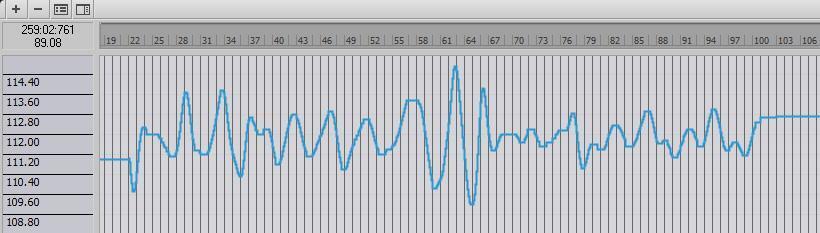
Figure 5: Either by accident or by design, the tempo tracks on Pat Benatar’s “Shadows of the Night” follow the vocal pitch quite closely.
But look what happens starting at measure 22 — it’s like someone applied an LFO to the tempo, the changes are so consistent. The song pretty much tracks Benatar’s pitch; the tempo accelerates up to the higher notes in a phrase, then slides down as the pitch slides down. The most extreme variations occur during the guitar solo that starts at the lowest tempo, then speeds up and slows down cyclically. I’ve always felt the vocal is amazing; I can’t help but wonder if part of that is because of the interplay with the tempo, which may amplify the effect of the vocal pitch changes.
Lessons Learned
One element most of these songs have in common is accelerating tempo up to a crucial point in the song, then decelerating during a verse or chorus. This type of change was repeated so often, in so many songs I analyzed, that it seems to be an important musical element that’s almost inherent in music played without a click track. It makes perfect sense that this would add an emotional component that could not be obtained with a constant tempo.
I’ve used tempo changes in several ways over the years, with the two most common being during DJ-type sets to speed up or slow down over the last part of a song to match the tempo of the following song, and in rock music, to insert what I call time traps — sudden, very short tempo drops to add a slight pause and build anticipation/tension in strategic places (fig. 6).
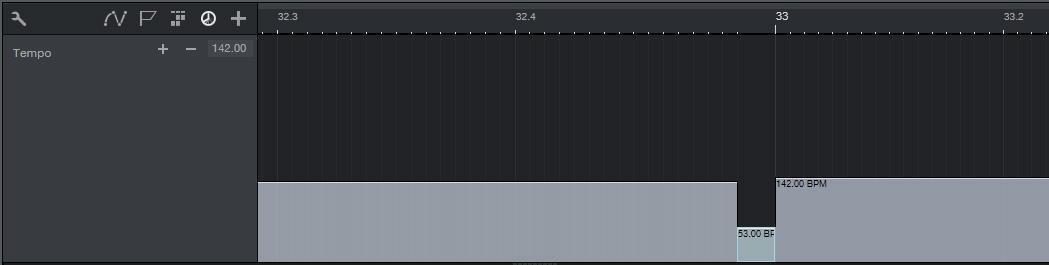
Figure 6: Short, deep tempo reductions can add a dramatic pause without having to move audio around.
However, these studies will encourage me — and maybe you as well — to weave subtle tempo changes within the fabric of the song itself, based on the concept of accelerating to high points, then decelerating.
One other surprise is that I expected to hear tempo changes as something obvious and identifiable, but at least for me, that was not the case. Most changes are felt rather than consciously perceived. For example, I did an EDM song that accelerated from around 125 bpm to 133 bpm over about 80 measures (fig. 7).
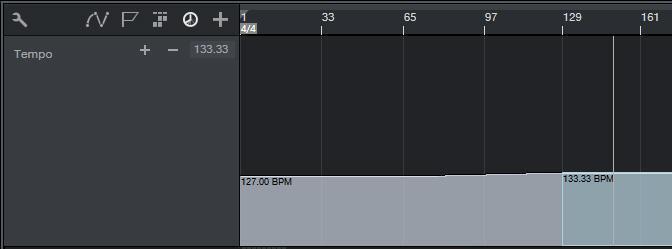
Figure 7: Note the tempo change from 125 to 133 bpm. Even with a tempo change this significant, the effect is almost subliminal because it happens over a long period of time.
Although the tempo change is not trivial, it wasn’t really obvious because it happened over a relatively long period. Also, you’re not really aware of the tempo changes in the songs referenced earlier unless you concentrate on being sensitive to them.
Tempo Changes in the Twenty-first Century
If these changes are desirable, how can we introduce them into our click-based world? Although you can always take the old-school approach and record without a click, if you’re a solo artist, it really helps to have a click for synchronizing delays, MIDI drum overdubs, etc. The trick is creating a click track with the desired tempo variations, and here are some ways to do that.
Create a click after recording an audio part that establishes the song’s tempo. For example, you play the song through in free time on guitar or piano, then use tempo extraction (as used above for the song analysis) or create a tempo map using a recording program’s tap tempo functionality. With the latter, you tap along with the track, and the program translates the results into a tempo track. With tempo extraction, note that it’s most accurate when you have individual parts with a well-defined rhythm — doing extraction with program material is more likely to have errors.
Start a song with MIDI, then create tempo changes. With this method, you can play along with a metronomic click until you have the song’s framework in place. Then, go back and edit the tempo track to create changes in ways that will add emotional impact. Ideally, you’d be able to create the song with a single instrument so that after creating the tempo track from it, you can then record subsequent overdubs to the varying tempo track.
Start a song with audio, then create tempo changes. As with MIDI, you’d record with a click, then add tempo changes after the fact. And again, you’d want to create the song with a single instrument so you can record overdubs to the tempo map. The complication here is that if you want to keep the audio you recorded, it needs to stretch dynamically with the tempo changes.
Converting your part to an Acidized file or Apple Loop (standard, or contained in a .CAF file) is one possibility, but few programs offer that capability. Converting to a REX file will also work, but creating a long REX file is tedious and requires Propellerhead’s ReCycle. Some programs, like Ableton Live and Studio One, can stretch dynamically, and as long as the changes aren’t too drastic, there will be no objectionable artifacts. Cubase offers various ways to stretch audio so that it conforms to a tempo map, like adding hit points that allow a file to follow tempo changes. Pro Tools has Elastic Audio, and so on.
If the tempo changes are stepped rather than linear (e.g., there’s a slight increase in successive measures), another option is to use the host program’s DSP to stretch audio one measure at a time to match the tempo changes you created with the tempo map.
Taking Advantage of a Click with Tempo Variations
Because the click track now has variations, anything that can follow a click track — MIDI sequences, processors that sync to tempo, acidized and REX loops, and the like — will follow the click. Remember too that one of the reasons for playing with a click is to tighten up timing, but hosts with audio quantizing options should be able to follow the tempo variations in a click.
Plan for the Future!
Adding tempo changes after a song is complete can be a real hassle, so if you’re going to mix up the tempos, you really need to do it as soon as possible in the songwriting process. It’s much easier to play along with a varying tempo than to try to impose tempo changes on something that already exists. But once you’ve added some tempo variations, you just might find that creating these kinds of subtle changes can add a magic touch — and classic vibe — that’s impossible to obtain in any other way.
Check out Part 2 of this series: Nailing the Classic Rock Vibe: Feel.