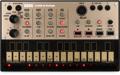
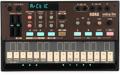
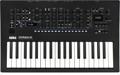
I have always been a geek for fiddling with knobs on anything, whether it be a blender or a large format console. But then again, what audio guy isn’t? A lot of us are tactile, we like to really get our hands on a piece of gear, and with most of my synthesizer experience being software based I have always had the pleasure, or displeasure, of turning my synth knobs with a mouse. We all know this can get really old after a few hours of tweaking. So I decided to take a stab at the hardware synth world with the Korg Radias. After unpacking the unit, I really enjoyed the sleekness of the aluminum chassis, and its “Moog-like” modular design. Make no mistake though, this is far from a Moog knockoff. Upon powering the unit up, I admired its red and orange backlit panel. This thing really looks cool! I was immediately greeted with 256 presets at my fingertips. Needless to say, I was making music right away. After scanning through the plethora of presets, I decided to delve deeper into this unit, and see what it was all about. I made a pass through the quick start guide in order to get an idea of the basic functions and layout of the unit. The manual is practically a small novel, so the quick start guide is great for impatient musicians like myself.
After becoming comfortable with the Radias, I soon began to gravitate towards certain features, the first being the virtual patch bay. This thing is cool. Just like on an analog synth, the output of one parameter can be patched to control another. For example, if I wanted to control the cutoff frequency of Filter 1 with the LFO, all I needed to to was hit the V Patch I wanted, name the source and destination, and I’m in business. No patch cables to hassle with. Another great feature is the Modulation Sequencer. It offers the ability to add motion and character to your sounds very easily. There is a choice of three different 16-step sequencers. You can use all of them at once, or just a single one. You choose the complexity of your sound. The best part of it is that each step is accompanied with a knob to control whatever parameter the sequence is assigned to, whether it be pitch, pan, or an LFO, just to name a few. Now the modulation sequence can be adjusted on the fly in real time. No menus to scroll through, no mouse clicks to make. Really just about any parameter that may need to be adjusted on this unit is just a finger’s reach away. I could go on for a very long time about the many great features of this unit, I am not even scratching the surface, so I encourage you to try it out and discover even more.
The bottom line is, this unit is easy to learn, and it’s really fun! It gives you the freedom to be creative on the fly, without having to stop and think. That is crucial if you want to catch that idea right away. This unit allows a very smooth and enjoyable transition to anyone who is moving from digital to analog synthesis, or vice versa. Korg has captured that crucial point in between analog functionality and digital versatility that synthesis has been lacking. I encourage anyone interested in analog or digital synthesis to give the Radias a try, it will be well worth it.