
In example 1, John uses the following four things to emulate the sound of one of his favorite instruments — the pedal-steel guitar — on his signature Tele:
- Behind-the-nut string bends — achieved by applying carefully controlled downward pressure on the string he wants to bend behind the nut. Photo A captures him doing that on the G string (which is tuned to G# in this example).

Photo A: John 5’s behind-the-nut string-bending technique.
- Tune the guitar to an open E major chord (low to high: E, B, E, G#, B, E).
- Fingerpick the strings, as in photo B.

Photo B: Note — no pick!
- Use clean tone and allow all the notes to ring.
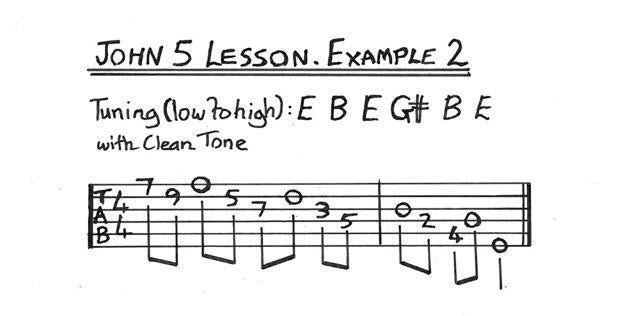
Example 2 illustrates John’s clever use of open-string notes and a diagonally symmetric fingering pattern to create a neat little meandering E major run.
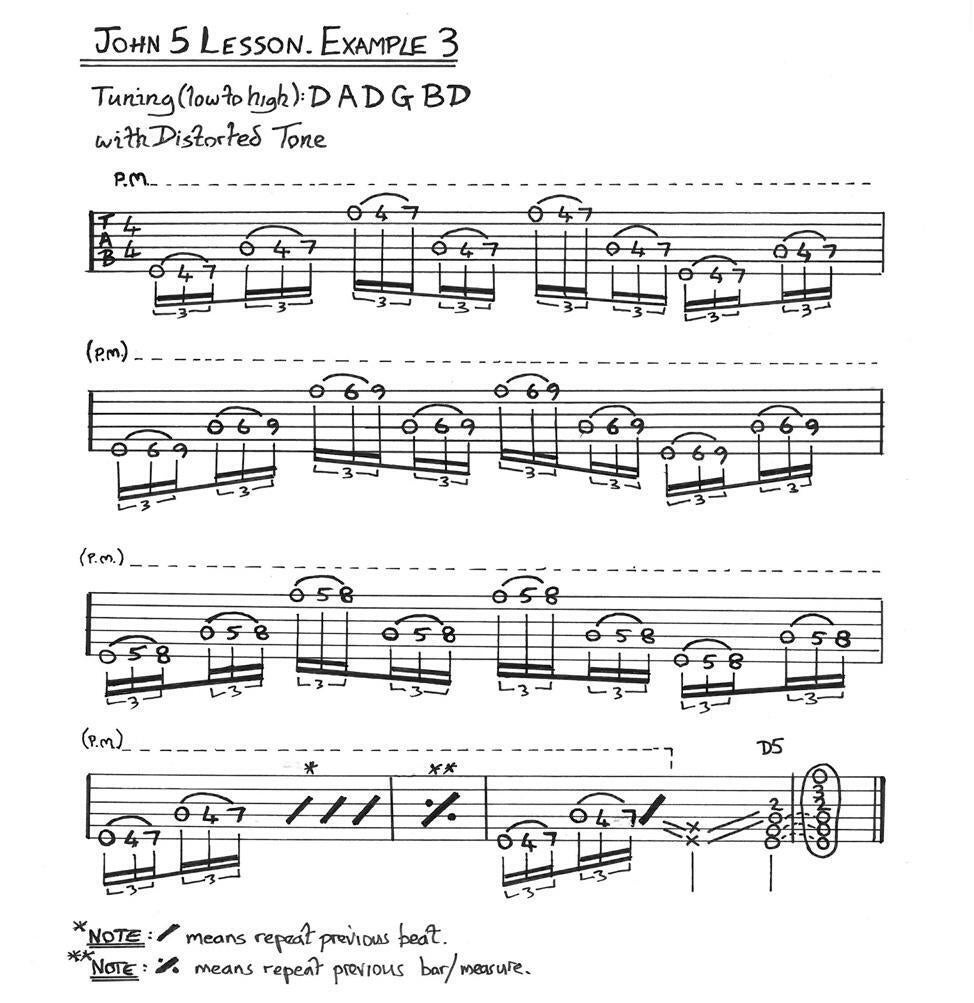
Last but certainly not least, example 3 has John tuning his low and high E strings down a whole step to D — an action that gives him three D strings that are each an octave apart. Then by using these three strings, he combines the open-string notes, rapid-fire hammer-ons, subtle but effective palm-muting, lightning speed, and incredibly accurate string skipping with both hands to create a mesmerizing melodic run with a healthy helping of distortion.
On the subject of picking this string-skipping sizzler: as you’ll see in the accompanying video, John is a deft employer of hybrid picking (using a combination of his plectrum and fingers to pick the strings), a technique well worth mastering when it comes to carrying out string-skipping stuff with both speed and efficiency.