

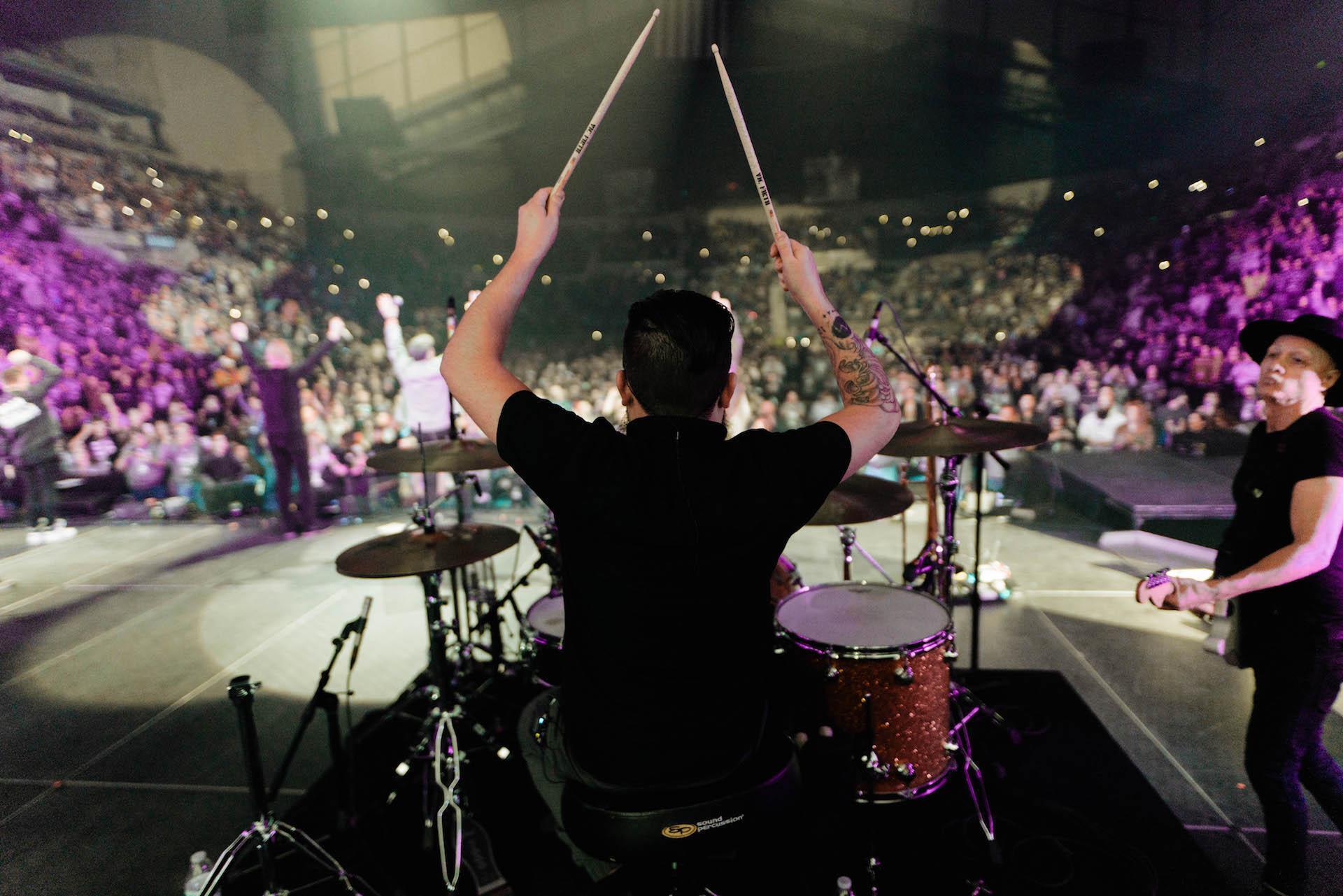
Earlier this year we caught up with David Blascoe, drummer and founding member of Citizen Way while he was in town for the WinterJam music festival. He shared some wisdom he’s learned along the way and shares how important recording was in his development as a drummer.
David thanks for joining us, can you tell us a bit about some of the people you’ve played with?
Currently, I’m on tour with Newsong for the Winterjam music festival. Prior to that I was a founding member of Citizen Way. I was a part of the band for over 10 years. I left to really pursue being a session and touring musician. I also do alot of session work.
I work with alot of smaller, independent artists and I primarily work out of Dark Horse studios in Franklin Tennessee. That’s where Citizen Way tracked most of the most recent record. While there, I became friends with the house engineer, Dave Hagan. I help with their Recording Academy and help students learn how to tune drums and drum sessions.
I also recently recorded drums for a single with Kevin Max and Michael Tait from DC Talk. It was a cool Jazz style arrangement, and got to use brushes. It was a blast, especially since I grew up listening to DC talk!
How did you get started playing drums?
I started playing drums when I was nine years old, after watching the movie,” That Thing you Do”. I didn’t have a drum set at the time, so I would practice “drums” with pencils on the ground. Once I finally sat behind a kit, I could play the part perfectly, because I had “rehearsed” the part so much before then.
My parents bought me a drum kit and I started playing as much as possible, wherever I got a chance. At church, in bands wherever I could, and whoever would let me play with them.
After high school I was in a bar band and did that as my job for a few years. In fact, that experience was so formative and really taught me the difference between being just a drummer and being a musician. It was such an education in musicianship and groove, and helped me realize I’m playing music. I’m playing music, not just drums.
Around that time, I found some producers in Milwaukee Wisconsin and started doing hip-hop drumming and production. We would take these hip hop productions and bring them to life on stage with a band.
I met the Citizen way guys in 2009. And in 2012 we got signed to Fair Trade Services and that was the beginning of Citizen way.
Like I mentioned earlier, I left Citizen Way at the end of this past year to pursue being a session and touring drummer full time.
What is it like moving from a band that you helped co-found to being a “hired-gun”?
Initially it’s terrifying! You’re leaving job security and walking into the unknown. But for me it became apparent that this is what I wanted to do. When you’re in a consistent gig, you often get overlooked for gigs, because everyone thinks-“oh, he’s already got a gig”.
I just got to a place where I realized, I want to play and record with as many people as possible, with as many different styles of music as possible.
It was immensely scary, but immensely freeing at the same time. It’s like I’m now my own business. The next tour I get after this, it’s on me to get it.
It’s intimidating at first, but at the end of the day it’s freeing and empowering.

What are some practical ways to move from being “just a drummer” to being a musician that serves the music in a band?
For me, I started to notice that I didn’t sound like the records I listened to. I was playing way too much. Even the most crazy, over the top drumming, is typically more stripped back than what you think.
I had that moment of realization when I finally recorded myself and heard it back. I realized, I’m not playing the drums right, I’m not tuning the drums right…. I mean, Ringo is a perfect example. There are songs where he’s not even touching the cymbals.. It’s restraint.
Another thing that helped was that I got into playing keys and piano. I’m now a big analog synth fan too. The more I learned and understood songs on piano and played along with recordings, I realized, oh that’s what the other musicians want me to do! I could see the song from another perspective.
The realization of being in that other spot, really helped me. Realizing what the other musicians want and what the music calls for was really eye opening. You have to realize it’s not about you. You’re one piece of the puzzle. You’re one part that helps complete the sound.
So practically, I would suggest, learn another instrument, record yourself, and listen back to the recording, and really learn what the masters are playing on the records. Learn the parts, they’re playing way less than you think.
When you’re brought in to record drums for someone’s session, what approach to create a great part?
It depends on the session. Some sessions have a demo with programmed drums already and some sessions you just have a basic demo-no drum parts yet. If there is a scratch drum track already, I ask how much they want me to stay close to that scratch track.
“Do you want me to mimic the scratch drums, or do you want me to come up with an original part? “. If they want you to stick to the part they already created, then it’s all about feel. You play the beat they created, but you decide how on top of the click you are, or how behind the beat you are. At that point they are hiring you to make the beat they created groove, and make it feel like a human is playing the beat, not a programmed beat.
If I’m creating a part from scratch, I’ll listen through the song once and see how it makes me feel. It’s a physical thing really. Where do I feel like this is taking me? And then I record a first take and go from there. Sometimes you get it on the first take, and then sometimes you chat with the producer or artist on what changes to make and you do it again.
What suggestions do you have for drummers reading this article that want to get started as a session drummer?
These days, I think a Home Studio is very important. If for no other reason, it allows you to hear how you sound when you play. You hear how unbalanced your playing is. You hear how much you overplay. You can go back and listen to what you just played and often realize, it wasn’t as good as you remembered!
It also helps you get you acquainted with the process. Slap a mic in front of the drum set and you should be able to make that sound good. Practice “self-mixing” and adjust how you’re playing the drums to make them sound balanced, even with one mic. You go through the process of setting up gear, learning to mic a kit well, how to play well, how to mix, you’re going to experience and learn it all.
As you’re learning, check out resources on YouTube, check out the Sweetwater blog and keep trying. If you run into roadblocks, there are plenty of resources to help you solve it.
Get your studio setup, learn how to create great sounds, and then reach out to friends of yours and offer to record drum tracks for free. In the early days, record as often and as much as you can. That’s how i got started! I mean, you almost have to be obnoxious with your offers to help. Those early experiences will help you learn so much-so quickly.
Also, don’t underestimate the value of relationships. The music industry is all about relationships. There are millions of people that are great players, but how many of those people are easy to work with? When you’re recording for someone, they are trusting you with their art. When you’re recording, they’re stuck with you in the studio for a whole day, or more. You have to be someone they’re okay hanging out with and spending time with-on top of being a great player.
It seems like recording has really played a big part in your development as a drummer?
Completely. Some of the best advice I ever got was to set up a single microphone in front of your drums and record yourself. If something is too quiet, you’re playing it too soft. If something is too loud, you’re playing it too hard.
When you record yourself for the first time and all you hear is cymbals… it’s eye opening.
You have to learn the concept of self-mixing. You should be able to set up one mic and play and it should sound like a balanced recording. You end up really digging into the lower sounds more, kick and toms, and go easy on your cymbals.
It’s even affected how I play live now and improved my sound as a drummer.
What does your recording setup look like?
As far as the home recording, bare minimum, I often make drum tracks with just two mics. Honestly, just two SM57’s. I have ten of them! I’m so used to how they sound with my setup and have learned how to quickly manipulate them to sound the way I want. In my opinion, if you can’t get the job done with a 57, it’s not the mics fault.
I’ve done shoot outs at my home studio between the 57’s and very expensive mics and with compression and EQ, I can make the 57’s sound just as good as those expensive condenser mics. You can’t tell the difference! I now have presets saved in Ableton that quickly get my 57’s to sound like the character of those expensive condensers.
Really, just two mics?
That’s right! I used to do two mics because I didn’t have a choice, it was my limitation and all I had, but now I often choose two mics because I’m so used to it, and know how to get a big punchy drum sound from them.
You can always reinforce sounds with samples as well. There are four songs on the most recent citizen way record, Love is a Lion, that the drum tracks were recorded at home with that setup. Those are sounds you hear on the record.
What do you use as an interface?
I use an apogee duet and a behringer uphoria interface. I love those behringer interfaces. They’re so affordable and they sound really good. I’ve been using that for tracking sessions on songs. I’ll do tracks for engineers that are gear heads, and when they get the drum track, they’re amazed, and they have no idea it came from two 57s and a $300 interface!
I do drum tracks regularly for artists with that same setup.
You mentioned Ableton earlier, is that what you use for recording?
Yes! Ableton Live 10 Suite is my main DAW for everything. I started using it on stage for multitracks and stems with Citizen Way. It was such a shift for me initially from ProTools or Logic to Ableton, but I quickly fell in love with it. And now I do everything with Ableton. Both Live and in the studio.
What’s your typical on stage setup look like?
My main kit is a Gretsch Brooklyn Kit which I love. The drums sound great and it’s so inspiring to play. I’m a big Gretsch drums fan. This kit has a 22 inch kick, 12 inch tom, 16 inch floor tom and 14 by 5 ½ snare. It’s such a fun kit to play!
As far as cymbals go, I’m a big Zildjian fan. My hats are actually 17″ crash cymbals. The bottom hat is a 17″ A medium crash, and the top hat is a 17″ K custom hybrid. They’re both really thin, but huge, so they’re really drak and mellow sounding. What I love about that setup is that they tend to sit in the mix, instead of on top of the mix.
I have a 22 inch constantinople medium ride, 20 inch K custom dark ride, that I use as a crash, and my other crash is a 20 inch Crash of Doom.
I use REMO powerstroke 2 on my kick, vintage ambassadors on toms, and a control sound with white dot on my snare.
My sticks of choice are Extreme 55A from Vic Firth.
When I played with Citizen Way I would do some synth bass stuff so I’d have my Moog Sub Phatty next to my kit. I’m a big synth fan as well.
For drummers playing at their church, the majority of what they do is playing other people’s parts. Learning and replicating the parts on a record. How do you approach playing other people’s parts with passion and playing the part with excellence?
When I’m stepping into a new gig with someone, like Newsong, my main goal is for them to be comfortable and happy. It’s not the David show, it’s about serving the song and serving the artist. If we walk off stage and they’re happy with teh performance, I know I did my job. It’s not about how many fills I got in that set, or an opportunity to use all my chops in one set.
In fact, I love playing pre-existing parts. It’s almost like it lets you off the hook! Instead of coming up with a part you get to focus on feel. Feel is what separates you from other players.
For example, if you take four different drummers and ask them to all play the same part, you’ll get something that sounds different with each player. That’s feel. That’s my favorite part of being a musician and playing drums.
How does a drummer improve their feel?
You study people. Particularly videos and recordings of the masters. Guys like, Steve Jordan and even more recently, Ash Soan. Mimic the masters at first, and then come up with your own sounds and vibe. And that’s really important. It’s not about what you’re playing, but how you’re playing it. It’s feel.
I think if simplicity bores you, you have a problem. The goal is to develop your own voice on the instrument. Even playing simple parts should feel great. Even a simple groove with great feel is incredibly fun to enjoy and listen to.
Thanks for your time David!