

If you’re putting together a PA system and are in the market for new speakers, what kind should you get? Passive or powered? Do you need 250 watts, 2,000 watts, or 25,000 watts to drive them? And what do all those specs mean? Don’t worry; Sweetwater has your back. In this article, we’ll walk you through the types of speakers that are available, help you decode the important specs, and estimate how much power you need for your application.
What’s a Decibel?
If you’ve spent any time hanging around with audio geeks, you’ve probably heard the word decibel (abbreviated as dB) thrown around a lot. So what’s a decibel? The term comprises two words — deci, meaning one-tenth, and bel, which is a logarithmic unit of measurement named after Alexander Graham Bell (the guy who invented the telephone). A decibel expresses the ratio of one value to another on a logarithmic scale. It is useful for expressing how much louder or softer one sound is compared to another sound.
What’s SPL?
Sound pressure level (SPL) refers to the acoustic volume of a sound, expressed in decibels. Because decibels are logarithmic, you can’t just double a value to get something twice as loud. For example, 100dB SPL isn’t twice as loud as 50dB SPL. Here are a few convenient facts: a change of one decibel is generally considered to be the smallest volume change the human ear can reasonably detect. Doubling the power results in a +3dB increase, which is a noticeable volume increase. To get from 100dB SPL to 112dB SPL requires much more than doubling the wattage of the amplifier. Since each 3dB increase requires doubling the wattage (2x), let’s do the math, assuming that 100 watts of amplification will yield 100dB SPL.
Required SPL – Required Wattage
| 100dB SPL | 100 Watts |
| 103dB SPL | 200 Watts |
| 106dB SPL | 400 Watts |
| 109dB SPL | 800 Watts |
| 112dB SPL | 1600 Watts |
What does that mean to you? It means that doubling the wattage will yield a volume increase, but certainly not twice the volume.
What’s a Watt?
A watt (W) is a unit of energy named after James Watt (the guy who developed the practical steam engine). In the audio world, we use watts to measure the power-handling capabilities of speakers and the power-output capability of amplifiers.
How Does Wattage Relate to Speakers?
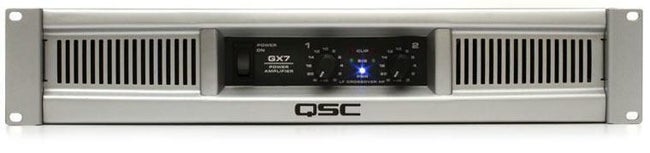
Passive (non-powered) speakers don’t have power amps. When we talk about the wattage rating of a passive speaker, we’re actually referring to its power-handling capability. You’ll find two general values for power handling. The RMS (root mean square) value refers to how much continuous power the speaker can handle. The peak value refers to the maximum power level that the speaker can handle in short bursts. If you have a speaker rated at 50 watts RMS and 150 watts peak, it can handle 50 watts of continuous power, with occasional peaks of up to 150 watts.
Do I Need to Worry About Underpowering My Speakers?
Let’s clarify a common myth: underpowering your speakers won’t damage them — unless you are overdriving the amp. What actually damages your speakers is clipping. If you crank up a lower-powered amplifier, it will reach a level where it’s clipping faster than a higher-powered amp, so be careful if you’re using a lower-wattage amplifier with higher-wattage speakers. If you’re using a 20-watt amplifier with 200-watt speakers, don’t crank the amp’s volume until it distorts. Follow that rule, and you won’t have to worry about harming your speakers.
So How Much Power Do I Actually Need?
First you need to decide how loud you actually need the sound to be. For a choral or classical presentation in any venue, the power requirements will be less than for an EDM or thrash metal concert. Once you know whether you want the system to crank out 95dB SPL or 120dB SPL, then you can decide how many speakers with how many watts you need. And it also depends on the size of the venue and the number of people (sound absorbers) you will have in that space. A medium-sized venue (250–500 people) can be adequately served by 2,000 watts, or it may require as much as 20,000 watts, depending on those variables. Your Sweetwater Sales Engineer will be happy to help you determine how much power you need.
What About Powered Speakers?
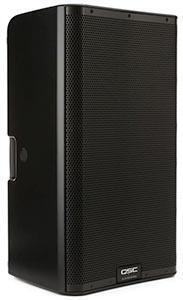 If you’re building a large, complex sound system, passive speakers are great. Because of the immense level of power these systems require, having separate amplifiers and speakers allows custom designs tailored to the venue’s needs. And unencumbered access to the amplifier ensures easy maintenance (scaling walls and climbing rafters every time you need to make an amplifier adjustment is not fun). But if you’re a gigging musician and managing your own sound system, you should look into powered speakers. What are powered speakers? Powered speakers have built-in amplifiers that are accurately matched to the speakers. This is great for you, since you won’t have to worry about pairing your speakers with the correct amplifier — it’s already been done for you. And they’re a breeze to use — setup is as easy as plugging your speaker into an electrical outlet and connecting your mixer, media player, mic, or instrument to the speaker.
More Wattage Means More Volume — Right?
Contrary to common belief, you should never assume that more wattage equals more volume when comparing two speakers. While wattage is a significant factor when you’re choosing speakers, sensitivity is even more important. What’s sensitivity? Well, it has nothing to do with a speaker’s ability to empathize with your feelings. Rather, it’s a measurement of a speaker’s ability to effectively convert power into sound, expressed in decibels. It describes the SPL that a speaker can produce from a 1-watt signal at a distance of 1 meter. It’s a major indicator of a speaker’s overall loudness, and one reason why a 1,000-watt speaker isn’t necessarily louder than a 500-watt one. In fact, a 500-watt speaker with a sensitivity of 98dB will actually be the same volume as a 1,000-watt speaker with a sensitivity of 95dB.
You also need to be wary of comparing the wattages of two different powered speakers. Why is that? Since RMS values refer to continuous, real-world usage, they’re better than peak values at gauging a speaker’s performance. Unfortunately, some manufacturers market their equipment using only peak values, because the larger numbers look more impressive. So be sure to take this into account when comparing speakers. That 200-watt speaker may not really be a 200-watt RMS-capable speaker, and thus, you may not be making an apples-to-apples comparison.
How Much Power Do I Actually Need?
Electrical engineers and mathematicians use complex mathematical formulas to determine how much power is needed to fill a given space with sound. If you enjoy that sort of thing, go ahead and crunch the numbers. But while you’re doing that, the rest of us will create educated estimations by examining our intended application, along with the size and number of seats in the room we’re using. It all comes down to common sense: a 50-seat coffeehouse doesn’t require as much power as a 250-seat auditorium. And remember that each audience member absorbs sound from your speakers, so more people equals more absorption.
Ultimately the best way to make an informed decision when choosing amplifiers and speakers or complete PA systems is to give your Sales Engineer a call at (800) 222-4700. They’ll be happy to help you navigate the PA speaker and amplifier jungle.