

There are some obvious advantages to miking instruments and ensembles in stereo; stereo miking provides a more natural image of the sound field and the width of the stereo field gives listeners the ability to hear sources at specific points in the sound field. Listen to a great recording of a symphony orchestra on a high-quality system, for example, and not only can you hear violins on the left and celli on the right, but in between the extremes, it’s possible to hear where the trombones are sitting in relation to the trumpet section. (The Deustche Gramophone recordings of the Berlin Philharmonic are wonderful examples of this, by the way…).
But there is one major disadvantage to stereo miking — and it’s inherent in the physics of using two microphones to capture a single sound source. That issue is mono compatibility. It works like this: the stereo image depends on small differences in the arrival time of sound between the source and the microphone. If the two microphones are summed to mono rather than panned hard left and right, those time differences show up as phase cancellation resulting in comb-filtering, where some frequencies are reinforced and others are partially canceled — or can disappear all together. While your brain processes these slight time delays between the left and right channels as cues to create the stereo field, when the left and right channels are summed to mono the cues are missing and all that’s left is the comb-filtering. While some stereo miking setups (such as coincident or X-Y miking) minimize this time delay, the farther apart the microphone capsules are placed, the greater the chance for comb-filtering to occur.
There is, however, one method of recording sounds in stereo that is completely mono compatible, and that’s the Mid-Side or M-S technique. The M-S technique allows for a variable stereo image; by controlling the level of the mid signal in relation to the side signal, the width of the stereo image can be expanded or collapsed — all the way to a pure mono signal if desired.
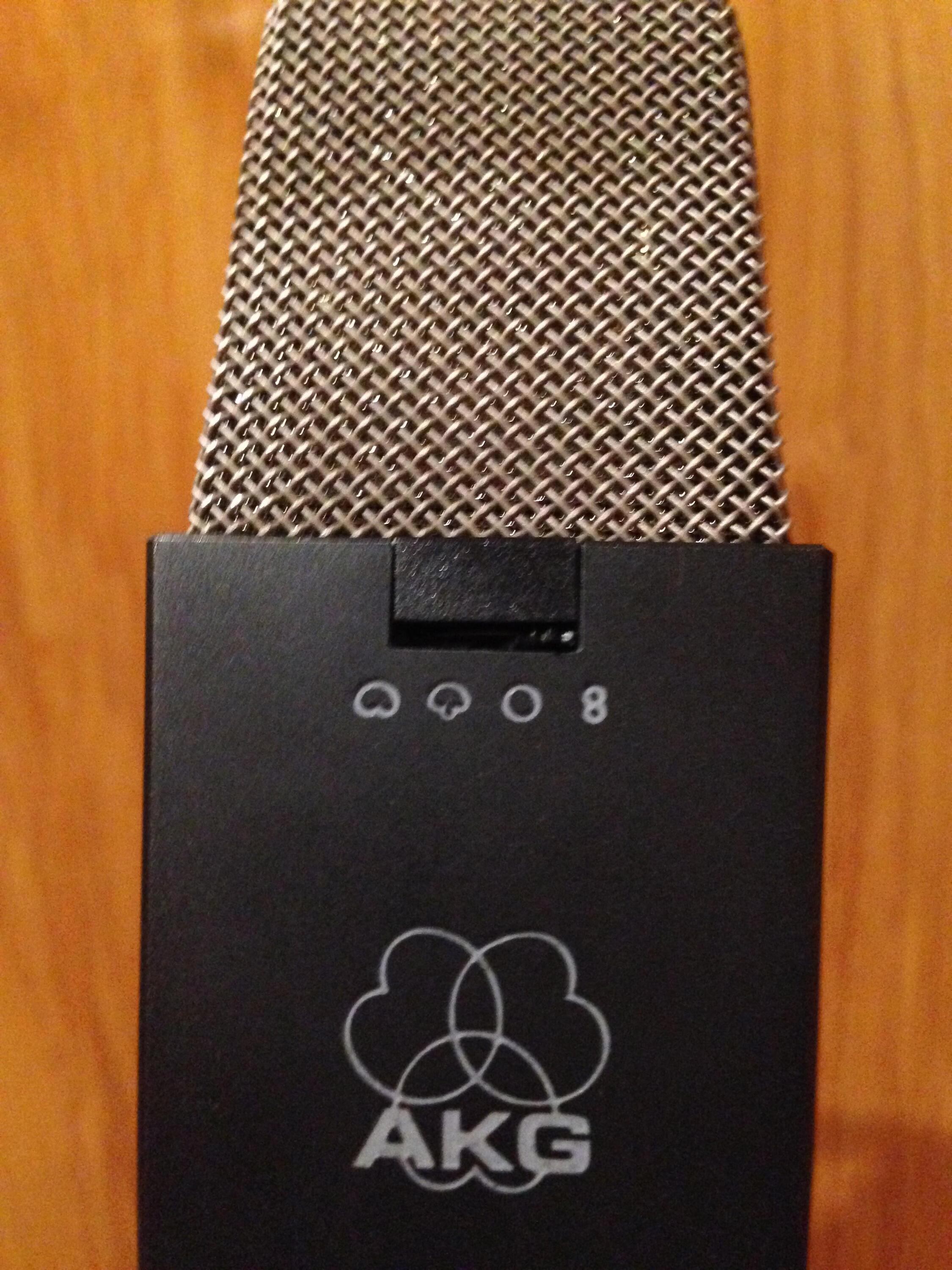
The Mid-Side technique uses two microphones — one with a cardioid element and one with a bi-directional (or figure-of-8) element — in a coincident arrangement (meaning that the elements are as close together as possible). Place the microphones so that the cardioid mic (the “Mid”) points directly at the source to pick up primarily on-axis sound while the bi-directional (the “Side”) element points left and right and picks up off axis sounds. Once the two mono microphones are in position, a bit more processing is required to yield a stereo signal; here’s how you do it:
Start by recording to two tracks in your workstation, with the Mid (cardioid) mic on one track and the Side (Figure-of-8) mic on another track.
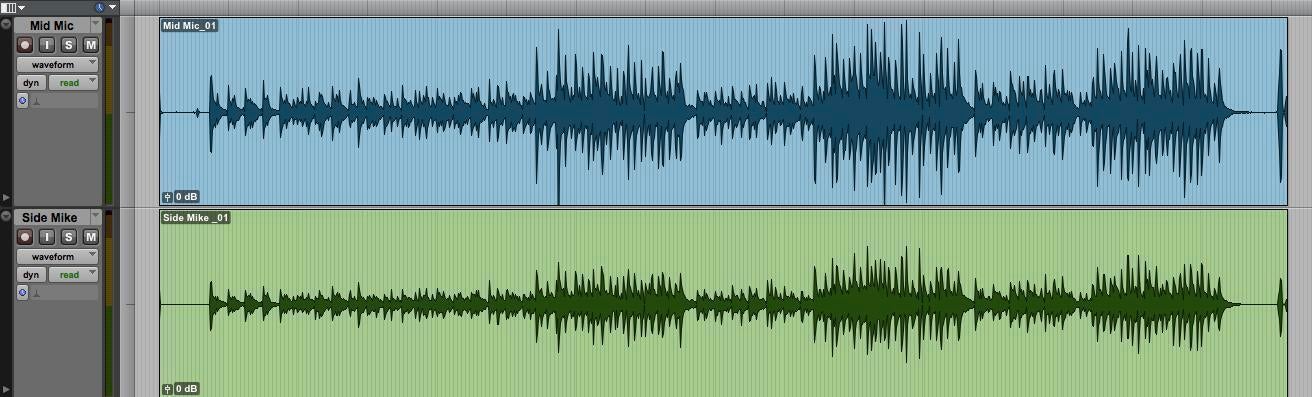
After recording, build an M-S matrix. This is not as hard as it sounds, by the way.
(A) Duplicate the Side, or figure-of-eight track, so you have the one Mid track and two identical Side tracks (most DAWs have a command that will quickly duplicate a track).
(B) Pan one of the Side tracks hard left and the other hard right. Pan the Mid track to the center.
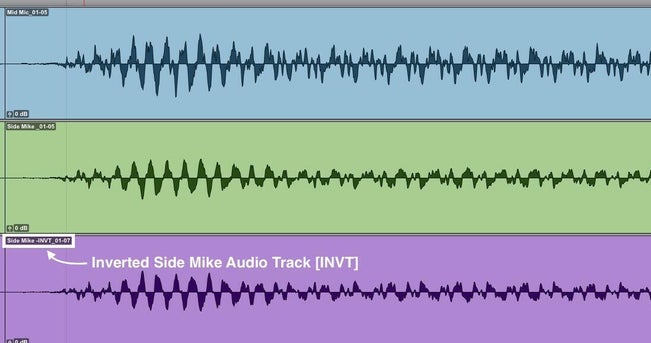
(C) Reverse the polarity of one of the two Side tracks. This can be accomplished either of two ways, as shown in the images below.
-
1) Invert the polarity of the duplicate Side track at the track level using the INVERT function in your DAW, as shown below.
-
2) You can reverse the polarity of the second Side track by using a plug-in that has a polarity reverse option, as shown below.

(D) Group the two Side tracks so that changing the level (fader) of one affects both of them — we need them to always have matched volume levels.
What you’ve done by reversing the polarity of one of the two Side tracks is to make the two tracks completely out of polarity with one another. If you pan the two tracks to the center, they should cancel each other out and disappear entirely.
Now, when combined with the Mid track, bringing the level of the Side tracks up will make the stereo image wider while turning the Side levels down will narrow the image. If you pan all three tracks to the center, the Side tracks will, as mentioned earlier, cancel each other out and disappear, while the Mid track (the cardioid mic) will remain, providing a mono version of the recording. Thus, the whole M-S recording is completely mono compatible, which is why the M-S technique has been widely used in broadcast and film applications.
Keep in mind that the Mid and the two Side tracks need to be exactly time aligned. If the Side tracks are not aligned with each other, they won’t completely cancel when summed to mono. If you use the second method mentioned above (adding a polarity reverse plug-in) realize that this requires that the plug-in doesn’t add any processing delay or that your DAW has plug-in latency compensation — the safest bet is to add the same plug-in to all three tracks (M-S-S) but reverse the polarity on only one of the Side tracks. That way the latency is identical on all tracks.
Remember that all of the various miking techniques were developed to help creative people achieve sounds that they imagined; experiment with as many techniques as you can to find what works best for you — and have fun!