

As a coach who specializes in a proven, safe, and effective way to create extreme vocal effects without vocal degradation, I’m surprised that I still see online conversations among singers who are in firm disbelief that anyone who sings rock or metal with any sort of range, power, or distorted sound can do so without blowing out their voice… even though this fallacy has been discredited for decades.
Yet, with all the studies by vocal scientists proving that a singer can create distorted sounds and hit high, piercing screams without damaging their voice, many singers still fear the metal scream.
The belief that “metal screaming will only damage your voice” is 100% false. I’ve been screaming since 1986, blasting out tunes by AC/DC, Alice in Chains, Judas Priest — all without ever losing my voice.
So can you… and, when done correctly, it’ll feel like a vocal-cord massage!
Proper metal screaming is about adjusting to the correct closure of the vocal cords and some narrowing above them. Actually, it’s much deeper, but I am not here to explain vocal anatomy. I’ll forgo the medical terminology and teach you how to properly “feel” a metal scream so that you’ll know you’re screaming correctly without causing vocal damage.
Above all, learning to scream correctly is learning that it doesn’t take brute force; you don’t need tons of volume and air nor to squeeze the neck muscles until your head turns purple. It’s about finesse through muscular balance. Once you have balance, you’ll be able to “scream easy.”
Speaking of screaming easy, I created a system called “Scream Easy” decades ago as the basis for my Extreme Scream series to teach anyone to scream without strain or vocal fatigue.It truly is easy to scream, and it will feel like a vocal-cord massage once you learn to feel what I call the “flutter,” which is a rumbling in the roof of your mouth that serves as your guide to safe screaming.
Whether you sing blues, pop, rock, or metal; whether your screams and wails fall into the Whitney Houston, AC/DC, Shadows Fall, Prince, or Thirty Seconds to Mars category; you’re covered because this system will work for any style. Rasp, grit, screaming, distortion — whatever you want to call it — is simply an effect, just like a distortion pedal. You will learn to turn your vocal “effect” on and off at will.
Before we tackle screaming, please read the article”How to Increase Your Vocal Range” because metal screaming starts with mastering your clean-voice technique, which is about breathing, support, and placement.
Now that you are “technique ready,” let’s learn to scream easy.
Gargle and Fry
Have you ever watched Star Wars? Remember Chewbacca’s signature sound? I call that “gargling tone,” and it sounds like gargling water without water.
When making this sound, you’ll feel a fluttering or rumbling sensation in the roof of your mouth. You can also feel this when making a vocal-fry sound. That is your on and off switch for distorted sounds. When you feel it in the roof of your mouth, your switch is on; but when you don’t, your “correct” scream is off.
Listen to these audio clips and practice imitating these sounds. They are key to learning where to feel it in the palate to know the scream is safely on.
Finding One Note
Now that you know where to feel the distorted sound, finding your basic scream is about discovering one single pitch in your range where you can easily turn on that distortion. We do this by testing all the notes in our range, beginning on a clean tone on a “yay” and transforming that tone into a raspy sound… clean to raspy, that’s it. It’s much like letting out a frustrated sigh; but we don’t want that breathy sound, so think of it more like a Tuvan throat singer. Listen to this audio clip.
Non-pitched Scream
Once you’ve found your easiest note, make it a game and practice that note every day for one week. Find songs that have that same note and turn on your distortion just to sing the words that land on that same pitch, adding a bit of rasp. The more you learn to sing with a touch of rasp on individual words, the more comfortable rasp will feel.
You must also practice sustaining that same pitch 10–25 times a day. Always make sure it feels like a vocal-cord massage. If you feel the rumbling flutter in the roof of the mouth, then you’re performing the sound correctly — and the massage effect should be there, too.
As the weeks progress, you simply add another note above and below your original note and continue playing. In week two, you’ll have three notes to practice; week three gives you five notes; etc. Over several months, you will have the ability to use distortion throughout your range.
By the way, you should notice from the audio clip below that this exercise didn’t take much volume or air to produce a distorted tone. Remember, it isn’t loud volume or tons of air that creates these sounds. You can do them loudly if desired, but only after you’ve mastered the technique.
But wait, there’s more. You can also produce non-pitched screams. This happens with a tiny shift in the throat. As you diminish the pitch and move toward a “white-noise” sound, the upper throat will feel as if it is narrowing a bit, but you should still feel it in the roof of the mouth. Listen to this audio clip.
E-Scream
Now, this lesson isn’t only about distortion. Some metal screams are clean. So, I want to add one more exercise called the “E-Scream,” taught to me by my coach Jim Gillette. The E-Scream helps to develop what is called the “Pharyngeal Tone,” which is how Robert Plant sings the wails at the beginning of “Immigrant Song” and how Rob Halford sings (blending with distortion) the chorus of “Painkiller.”
You simply make a wide smile and sing a falsetto “eeeeee” on a low volume, and then swell the volume while trying to stay in that falsetto tone. Though this is a falsetto exercise, going loud and bright will teach you to sing higher notes with falsetto bite while sounding more like a full-voice tone. Like the other exercises, play with the E-Scream throughout the day. Listen to the E-Scream audio clip below.
There you have it: You turned on your first distorted tone, learned to make a non-pitched scream, and are starting to develop your high-voice banshee wails by practicing E-Screams. It really is that easy to scream. It is simply a game. Just play with these sounds randomly throughout the day, but don’t overdo them. If it hurts, stop; if you lose the flutter in the roof of your mouth, stop. Take a break. You’re either overworking the muscles or doing something wrong. Mastering these vocal effects takes time.
Keep incorporating these new techniques into your songs, and, in a matter of a few months, you’ll be an amazing lead screamer!
There are other types of distorted sounds, like a raised larynx for blues grit and variations of white-noise effects, but these three core sounds are enough to start your metal-scream journey.
Here’s a snippet from a song I recorded called “Forbidding” by my band Angel Fire East — extreme vocal effects made possible by practicing E-Screams and non-pitched screams.
Happy screaming!
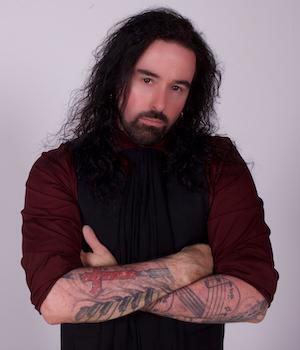
About Jaime Vendera
Vocal coach Jaime Vendera is known for his glass-shattering voice, as seen on MythBusters and The Dr. Oz Show. He is the co-creator of the online school Vendera Vocal Academy; author of Raise Your Voice, Mind Over Music, The Ultimate Breathing Workout, Unleash Your Creative Mindset,and Rebalance Your Voice;and co-creator of the Extreme Scream series. Some of his clients include James LaBrie (Dream Theater), Brian Burkheiser (I Prevail), Dustin Bates (Starset), Eric Emery (Skyharbor), Mixi Demner (Stitched Up Heart), Kevin Rudolf, and Clayton Stroope.
To learn more about Jaime’s products, to hear him sing, or to book a lesson, go to JaimeVendera.com and SingersNation.com.