Achieving a modern metal guitar tone that is both brutally heavy and remarkably clear can feel like a complex balancing act. How do you get massive saturation without turning your riffs into an indistinct wall of noise?
To demystify the process, we sat down with Misha Mansoor of Periphery, who walked us through his personal method for crafting a tight, articulate, and powerful metal sound. Here are his essential tips for building capital-T TOAN from the ground up.
Find Your Amp Gain Sweet Spot (Hint: Less Is More)
The first instinct for many guitarists is to crank their amp’s Gain knob to its maximum setting. However, Misha reveals a core principle that governs his approach: “I found the trick is to use as little [gain] as you can get away with.” This doesn’t mean your tone should be clean; you still want the amp to compress and saturate. The goal is to find the sweet spot where the amp just begins to crunch and offer sustain on palm mutes without becoming overly saturated.
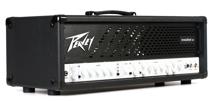
A good starting point for any amp is to set all the EQ knobs to noon. As Misha notes, “If it’s a good amp, it should sound good there, and then you can just tweak it.” Using Channel Two on his Peavey Invective.120, Misha demonstrates how the noon settings provide a solid foundation that can be fine-tuned for more attack and sustain.
From this neutral position, you can slowly increase the gain until your palm-muted notes begin to sustain and feel powerful under your pick. If you go too far, you’ll hear the notes start to blur together, a clear sign to back it off.
Sculpt Your Sound with EQ
Once your gain is set, it’s time to shape the character of your tone with EQ. For a modern metal sound, Misha often starts by pulling the mids back slightly and boosting the high end. This creates a more defined and aggressive sound with an accentuated pick attack to help cut through a dense mix.
When it comes to the low end, you have a couple of powerful tools at your disposal. Beyond the standard low EQ control, many modern metal amps like the Invective feature a Resonance control. Misha calls this a “super useful way to get some more bottom end without affecting the actual character of the sound.” Increasing the Resonance adds weight and body to your tone by emphasizing the low-frequency response of the power amp section — post-preamp EQ — giving you a full, powerful sound that doesn’t become woolly or flub out.
Tighten Up Your Tone with a TS9
This brings us to a technique used by countless metal producers and players. “What a lot of people don’t necessarily realize,” Misha explains, “is that their favorite metal tones are usually the combination of a boost, a drive, or an overdrive of some sort in front of a high-gain amp.”
Misha demonstrates using his signature Horizon Devices Precision Drive pedal, but the principle applies to many TS-style overdrives — including the ever-popular Maxon OD808 and Ibanez TS9 Tube Screamer. The key is to keep the pedal’s drive control at or near zero, while turning the volume (or level) up high. This pushes the front end of the amplifier harder, tightening the low-end frequencies and adding percussive bite and articulation to the strings. The result is a more focused, controlled, and aggressive distortion.
Gate Your Gallops for Gutteral Precision
With high-gain settings, hiss and noise are inevitable. This is where noise gates become essential for a professional, polished sound. Misha engages the gate on both his drive pedal and the built-in noise gate on the Invective.120. The result is a dead-silent rig between notes, allowing for incredibly precise staccato riffing. If you’ve ever wondered how bands achieve such clean starts and stops amidst crushing distortion, Misha provides a clear answer: “That’s the answer: noise gates.”
Get It Right at the Source with Your Guitar and Pickups
Of course, your signal chain is only as good as what you feed into it. Misha uses his USA Misha Mansoor Signature Juggernaut HT6, which he considers a “very, very nice guitar.” It’s loaded with his signature Bare Knuckle Juggernaut pickups, which he praises for their clarity and versatility across clean, mid-gain, and high-gain applications.
Finally, Misha shares a simple but incredibly effective pro tip for getting the tightest possible tracks. He places a piece of tape over the strings just above the nut to eliminate sympathetic string resonance. “It will work against the gate, believe it or not, and add just extra noise in between notes.” While a cheap piece of tape works wonders, many players use products specifically designed for this purpose, like the popular Gruv Gear FretWraps, to achieve the same clean result.
Key Takeaways from Misha’s Metal Tone Master Plan
By combining these techniques — starting with a conservative gain setting, sculpting with EQ and resonance, tightening the signal with a boost pedal, and using noise gates aggressively — you can transform a good amp tone into a world-class modern metal sound. It’s not about a single piece of gear. It’s the cumulative effect of how each component works together to create a cohesive, articulate, and aggressive sound.
Special thanks to Misha for graciously sharing his tone secrets. If you have questions about the gear used here or want to explore options for your own rig, don’t hesitate to reach out to your Sweetwater Sales Engineer. They have the expertise to help you find the perfect tools to achieve your sound.