The theremin was accidentally invented by Russian inventor Leon Theremin over 100 years ago (1919), and it has mystified and intrigued everyone who’s seen and heard one ever since. And, although it’s pretty remarkable to see a theremin played, it is equally mesmerizing to hear its gliding melodies in many songs and soundtracks around the world.
This article will cover several aspects of the theremin, including its history; its uses in live performance, audio recordings, and movie soundtracks; as well as more recent uses as a hands-free synthesizer controller via control voltages (CV) and digital MIDI messages. I’ll also discuss which theremin might be best for your artistic needs.
History
A Soviet-sponsored research project on proximity sensors took a turn when Leon Theremin noticed that a pitch, coming from his latest incarnation, would change based on how near or far he was to the device. He soon realized that this could be utilized as a musical instrument unlike anything the world had ever seen or heard. The instrument was refined and patented in the 1920s as the etherphone. Leon Theremin later moved to the United States in 1928 and received a US patent.
Design
This magical device uses two antennas. One, a vertical metal pole on the right side, is used to change the pitch of the theremin’s voice. The other, left antenna is a sideways loop of metal (like a tennis racket turned on its side) that controls the volume of the theremin’s voice. Because there are no physical connections between the performer and their theremin, its sound has a haunting, eerie, gliding quality that fades in and out of silence. Because of this, the theremin has often been used in horror and sci-fi soundtracks to give the audience goose bumps during scenes of fear, fascination, and mystery.
After performing with his theremin all across Europe with great success, Leon performed in the US and sold production rights to RCA, which produced the Thereminvox in 1929 (right after the Great Stock Market Crash of 1929). Although audiences were excited to see it performed live, far fewer bought one. Dedicated thereminists such as Clara Rockmore and Leon performed in the 1930s, but the popularity of the theremin as a personal instrument never really took off. Leon Theremin mysteriously disappeared back to the Soviet Union (during the era of Stalin) and was out of contact for 30 years until the late 1960s.
Interesting Note: Strangely, the one song that most people associate with the theremin, “Good Vibrations” by the Beach Boys, was actually performed on a device called an Electro-Theremin (or Tannerin) based on a physical knob controlled by two strings connected to a ring that was moved side to side to change the pitch.
Robert Moog’s Role
The story of the theremin accelerated when Bob Moog started designing and selling variations of the theremin to help pay for his Ph.D. in engineering physics at Cornell University in New York. Suggestions given by his customers and other musicians led to Dr. Moog’s development of the voltage-controlled oscillator (VCO), voltage-controlled filter (VCF), envelopes, and control wheels.
Since then, there have been many variations of the theremin made by Moog Music and other companies. Some are palm-size trinkets mainly used for novelty, but others, such as the new Moog Claravox Centennial, are fully professional performance instruments.
Buying a Theremin of Your Own
Now, on to the important stuff. If you’re reading this article, then it’s because, every time you see or hear a theremin, you secretly think about owning one. I can empathize because I’ve wanted a theremin of my own since I first read about them in Popular Science magazine way back in the late ’60s. But it may seem difficult to justify owning a theremin if you’re not planning on living off your live, solo theremin performances. (It might be easier to get into the NBA or NFL!) But other uses for theremins make owning one seem (almost) reasonable.
One of the aspects of playing theremin as a solo performance that makes it so hard is that, without any resistance or anything to use as a physical guide, it takes serious effort to play notes perfectly in tune with confident motion between each note. But if you treat a theremin more as a mysterious sound machine that glides around the desired pitches, then you will create melodies, harmonies, and sonic effects that would be nearly impossible on a standard guitar or keyboard. (Listen to the trippy bridge of Led Zeppelin’s “Whole Lotta Love” to hear the back and forth between a theremin and Robert Plant’s vocal wailing.) Plus, the visual effect of playing a theremin live is quite mesmerizing to the audience. Whenever I use a theremin in my live shows, the line of people wanting to talk to me after the show always wants to ask about my theremin.
The Modern Theremin
The single most exciting feature of a modern theremin is its ability to send control voltages (CV) to any other synthesizer or effect pedal that accepts CV or Expression inputs. Not only does it allow you to effortlessly sweep through pretty much anything that can be voltage controlled, but it also has the benefit of delivering your audience perfectly analogous hand motions that clearly connect to the wild sound sweeps they’re hearing. Imagine having an arpeggio with theremin control over the Filter Cutoff parameter. Unlike the uncertainty you’ll feel when trying to play perfect pitches, sweeping pretty much any other parameter (delay time, panning, vibrato depth, effect feedback, arpeggiator tempo, etc.) is completely intuitive and, again, smoother than trying the same trick with a knob, expression pedal, or slider.
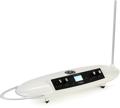
The digital Moog Theremini is especially good for this as it has a single CV out and two MIDI CC (continuous controller) outs (via USB) that can control pretty much any parameter in any of the VSTs you use with your DAW. And its ability to quantize pitch to any scale in any key removes the last obstruction when trying to play it for melodies.
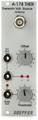
The low-cost Doepfer A-178 Eurorack Theremin Control Voltage Source is great for adding hand control to your Eurorack rig. This unit does not produce sound; it only controls voltages.
The new Moog Etherwave is a step up as it is a true analog theremin that also provides two separate CV sources (one for the pitch antenna and one for the volume antenna).
Finally, the Moog Claravox Centennial theremin is, without question, the ultimate theremin you can own with its analog and digitally controlled waveforms, analog filter, Modern and Traditional modes, 5-pin DIN MIDI In/Out as well as USB MIDI, two CV outputs, pitch and scale quantization, a wide 7-octave pitch range, and a true analog BBD delay effect with delay time, feedback, and amount parameters.
If you even have a slight desire to add theremin to your instrument arsenal, then check out my videos (listed below) to see and hear them in action. Then contact your Sweetwater Sales Engineer at (800) 222-4700 to determine which theremin might be best for your needs.