

On August 8, 2017, Glen Campbell finally lost his fight against Alzheimer’s Disease, passing away at the age of 81. Here’s our tribute honoring the life of one of our all-time favorite guitar players and a truly singular talent.
Glen Campbell is one of the most important musicians to ever make an impact on the great American songbook. With an enviable catalog of A-list credits as an LA studio session guitarist, more than 50 years of experience as an ultra-successful solo artist, as well as many TV and film appearances, Campbell’s resume is unmatched by any other musician. It has also served to shape the sound and personality of popular culture through the last five decades. Glen is in the Country Music Hall of Fame, has won numerous Grammy awards, has been honored with multiple Ovation Guitars signature models, sold millions of albums, played on some of the most ground-breaking recordings in history, had his own hit TV show, and much more. For all of that, Sweetwater Sound pays tribute to the original Rhinestone Cowboy himself, Mr. Glen Campbell.
From Arkansas to California
Glen Campbell was born April 22, 1936, and grew up in rural Delight, Arkansas. After being bitten by the music bug, Campbell packed up and moved out to Albuquerque, New Mexico to play with his Uncle’s band and perform on his Uncle’s radio show.
By the time the 1960’s came around, Campbell had relocated to Los Angeles, California, to plug into the city’s legendary music scene. He quickly joined the band “The Champs” and was picked up as a staff songwriter by American Music. This led to a wide variety of session work as a guitarist and eventually landed him a spot in a group of A-list studio musicians, legendarily known as The Wrecking Crew.
The Wrecking Crew
The Wrecking Crew consisted of such highly respected musicians as bassist/guitarist Carol Kaye, guitarist Tommy Tedesco, drummer Hal Blaine, and keyboardist Leon Russell. They were Los Angeles’ answer to Motown’s The Funk Brothers, Stax Records’ Booker T. & the M.G.s, and Muscle Shoals’ The Swampers. The Wrecking Crew was responsible for just about every hit record to come out of LA in the 1960’s and ’70’s — not to mention Phil Spector’s immediately recognizable Wall of Sound productions. Campbell began working with The Wrecking Crew and his guitar work left an indelible impression on the artists he played for. For example, Campbell played on an Elvis cover version of the Ray Charles hit “What’d I Say?” Later, when Elvis was recruiting his stage ensemble in 1969, his first two choices were Campbell and the Telecaster master, James Burton. Burton landed the gig.
But Elvis wasn’t the only one. Campbell played on many of the hits on the Beach Boys’ Pet Sounds album, including “I Get Around,” and “Help Me Rhonda.” Campbell would later replace Brian Wilson for a time, touring with the Beach Boys from December of 1964 to March of 1965, a time he called “one of the hardest of his life.” Glen would remain close to the Beach Boys, and included a medley of Beach Boys tunes in many of his performances.
One of the biggest mysteries about his studio career centers around The Monkees self-titled debut album. Many years after the album’s 1966 release, there are still questions about who played lead guitar on the iconic “Last Train to Clarksville.” When asked about it in interviews, Campbell would claim to have no idea who played lead – and then wink at the camera.
Glen Campbell the Star
As Campbell was carving out a name for himself as a premier studio ace, he was simultaneously writing and recording solo material for Capitol Records. Boasting a powerful combination of top-shelf playing ability, good looks, and a smooth tenor voice, it wasn’t long before Campbell put himself on the map with such massive hits as “Galveston” and “By the Time I Get to Phoenix.”
Because of his background playing on super-slick pop albums like the ones produced by Phil Spector, these country songs’ glossy production, thick string arrangements, and pop-conscious writing became a trademark of the Glen Campbell sound. It’s that sound that created one of the first and largest crossover success stories between pop and country in history, paving the way for many of today’s modern-country super stars.
https://youtube.com/watch?v=jrtWZiguvuY
Throughout the 1960’s and ’70’s the hits kept coming for Campbell. His singles “Gentle on My Mind” and “Wichita Lineman” became two of the most played songs of the decade. He hosted his own successful variety television show, The Glen Campbell Goodtime Hour. Even John Wayne, the Duke himself, requested that Campbell be cast as La Boeuf in the 1969 film True Grit.
But Campbell wasn’t done yet. In the mid ’70’s he released what would become his best selling single of his career, “Rhinestone Cowboy.” Through this song, he eloquently depicted the sacrifice, triumph, pain, and glory of pursuing a career in music. It’s fitting that this would be the song to cement Campbell as a radio and pop-culture staple for decades to follow.
A New Beginning
Beginning in the 1980’s, after years of hard work and harder living, Campbell achieved maybe his greatest accomplishment when he left Los Angeles and overcame the demons and addictions that had plagued him throughout his career. But far from laying low, Campbell released solo albums throughout the 1980s and ’90s. He even voiced the character Chanticleer in the well-received 1999 animated film Rock-a-Doodle.
The 2000’s marked a renaissance for Campbell. After being inducted into the Country Music Hall of Fame in 2005, he re-signed to Capitol Records in 2008 for a string of albums that included Meet Glen Campbell, which saw him covering songs by artists as diverse as the Foo Fighters, Jackson Browne, and U2. He followed that with his final album of new material, 2010’s Ghost on the Canvas.
Wrapping Up a Legendary Career
With a lifetime of triumph that seemed never ending, it sent shock-waves through the international music community when, in 2011, Glen Campbell announced he had been diagnosed with Alzheimer’s disease. Not one to slow down, he also announced he’d be undertaking a world-wide farewell tour. The year-long tour found Campbell and his band, which included three of his own children, conquering stages all around North American and Europe. Much of the tour was captured in the critically acclaimed documentary, Glen Campbell: I’ll Be Me. His final live performance came on November 30, 2012 in Napa, California.
After a legendary music career that spanned seven decades, countless hit songs, unending studio credits, hit films and TV shows, even more hit songs, and legions of devoted fans around the world, the time had come for Glen Campbell to hang up his trusty Ovation guitars. But not before gifting his fans with a thank you in the form of his final studio album, See You There. Partially recorded during the Ghost on the Canvas album, See You There found Campbell reliving some of his greatest hits, rerecorded with a more raw sound that brings his aged-yet-untarnished tenor to the forefront. By many accounts, Campbell’s last few albums are a high point in his career and serve as a fitting book end to a career that is unequaled in the world of music.
Glen Campbell was truly a legend. It’s musicians like him that inspire all of us at Sweetwater and remind us why we love to do what we do. There isn’t a facet of the music industry Campbell didn’t impact for the better. From the Ovation Guitars he played to The Band Perry’s recent hit cover of “Gentle on My Mind,” Glen Campbell’s contributions to the world of music carry on. And for that, Sweetwater thanks you Glen Campbell. Our musical world wouldn’t be the same without you.
The Glen Campbell, Ovations Guitars Connection:
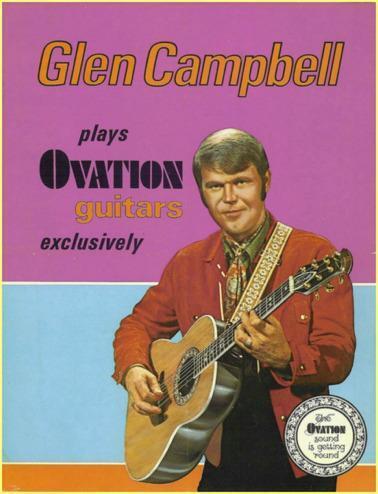
In 1968, Charlie Kaman delivered one of the first Ovation Balladeer acoustic guitars to Glen Campbell in hopes that he would like it. Glen immediately took to the volume, articulation, and comfort that the guitar’s round Lyrachord back afforded him. From then on, whenever you saw Glen Campbell performing, his trusty Ovation Balladeer was never far away. Campbell’s success and high visibility, thanks to the Glen Campbell Goodtime Hour TV show, helped to cement Glen’s on-screen image and effectively launched the Ovation Guitar Company as we know it.
There have been many Glen Campbell signature Ovations through the years. But every model they craft owes much of its design to the input Campbell gave at the very beginning. Glen Campbell knows guitars, and he chose Ovations for the last fifty years.
Awards and Accomplishments
10 x Grammy Awards (Including Lifetime Achievement Award)
10 x Academy of Country Music Awards
3 x American Music Awards
2 x CMA Awards
3 x GMA awards
2005 induction into the Country Music Hall of Fame
Sales of 45 million albums
21 Top 40 hits
2 x #1s
6 x Top 20 albums
9 x Country #1 albums
Recording and Performance Credits
Elvis Presley
Merle Haggard
The Beach Boys
The Monkees
Cher
The Everly Brothers
Dick Dale
Lee Hazlewood
Willie Nelson
The Bee Gees
Tanya Tucker
Johnny Cash
Patsy Cline
Brian Wilson
Nancy Sinatra
Bobby Darin
Gram Parsons
Emmylou Harris
Loretta Lynn
Joe Cocker
The Oak Ridge Boys
Jefferson Airplane
Bob Dylan
Jakob Dylan
Chris Isaak
Billy Corgan
Keith Urban
Alan Jackson