

I remember hearing “Beautiful Day” by U2 on the radio years ago and hearing it totally wrong. Instead of hearing the intro beat as it was:

“Beautiful Day” by U2 original beat.
I was hearing it like this:

How I was hearing the beat in “Beautiful Day.”
So, when the band kicked in on the very obvious, very heavy downbeat for the chorus, it suddenly felt like, “Woah! What was that?!”
Led Zeppelin’s “Misty Mountain Hop” is another song with an intro that throws many people off the first time they hear it. They think they know where the groove is, only for Bonzo to thunder in and prove them wrong. At the time of my U2 debacle, I’d been playing drums and listening to prog rock and some jazz for several years, so I was reasonably familiar with Western music that deviated from our stereotypical 4/4, 120-bpm, ABABCB pop-music paradigm. But it was this experience with U2 that really got me thinking. I remember feeling stunned at how one slight eighth-note displacement could trip me up so badly . . . Admittedly (and undeservedly), I felt slightly stupid that this “mistake” didn’t come from some jazz standard or 20-minute prog rock epic but rather a Top 40 four-minute pop song! It was a humbling experience that inspired me to learn more about rhythmic displacement, polyrhythm, and syncopation.
So, I’d like to provide you with some basic exercises that develop these concepts and listening recommendations for songs that utilize them effectively. I’ll also add some production techniques you can try out in your DAW of choice for creating cool rhythmic patterns that hopefully spark your creativity. I’m using Steinberg Nuendo, but the concepts will apply to any DAW (though the terms may differ). Note that entire books and online courses are devoted to these ideas, so this article is not a definitive guide. I have simplified some ideas for the sake of brevity. Nevertheless, I think the adventurous drummer or producer will be able to get a lot of mileage out of these ideas with just a little bit of practice.
I would also like to highly recommend that whether you’re practicing these rhythms on a drum set or shifting things around inside your DAW, you turn on a metronome!
Defining Terms
Let’s start by defining some concepts.
Rhythmic Displacement
Rhythmic displacement is when you take a pattern within a phrase and reposition it forward or backward by a number of rhythmic subdivisions (an eighth note, 16th note, etc.). For example, in my “Beautiful Day” mishap, I mentally displaced the pattern forward by one eighth note. Though I did it accidentally at the time, rhythmically displacing things on purpose can yield very creative and equally mind-bending results! One popular, contemporary, and advanced drumming technique involves purposefully displacing individual notes (from a kick drum, for example) so that they don’t land perfectly on the beat. Meanwhile, the hi-hat/ride cymbal and snare remain perfectly locked in time. This gives the music a disjointed, staggered kind of feel. Finally, in programming, many DAWs feature a “swing” or “humanize” function that essentially displaces notes off of the grid to attain a more human feel (i.e., the drums aren’t perfectly quantized).
Polyrhythm
This term confused me a lot as a young drummer when I played, say, half notes on my kick drum, quarter notes on my snare drum, and eighth notes on my floor tom, yet my teacher would tell me that I wasn’t playing a polyrhythm! It sure felt like I was playing multiple rhythms at once! And from a linguistic perspective, I was. The term literally means playing multiple rhythms simultaneously. Generally speaking, this term has the connotation of feeling like different meters are being played together, with two against three or three against two as classic examples. So, in the context of a single instrument, like a drum set or a piano, one hand playing quarter notes and the other hand playing eighth notes is, linguistically speaking, a polyrhythm. After all, the hands aren’t playing the same rhythmic pattern. This specific combination isn’t typically considered polyrhythmic in a musical context because both rhythms are mathematically related. Thus, the brain doesn’t necessarily interpret them as being all that different from each other.
Thinking of polyrhythms in ratios may be helpful. Rhythms such as 2:4, 4:8, etc. are closely related mathematically and are therefore not considered polyrhythmic (though they are polyrhythmic from a literal, semantic point of view).

Rhythms such as 2:3. 3:4, etc. are a much starker juxtaposition of feels (at least to Western ears) and are therefore considered polyrhythmic in a musical context.

You’ll notice I italicized the word feeling above because even though polyrhythms might make you feel like a different meter is being played, that isn’t necessarily the case. When a truly different meter is being played simultaneously, this is known as — you guessed it — “polymeter.” The prog-metal band Meshuggah produces excellent examples of music that are often assumed to be polymetric. In actuality, much of their music consists of polyrhythms imposed upon a 4/4 time signature. But for our purposes here, I won’t go down this rabbit hole of dissecting what’s considered polyrhythmic versus truly polymetric.
Syncopation
In traditional European classical music, syncopation is the concept by which the “weaker” beats of a time signature are emphasized instead of the “stronger” beats. For example, in one bar of 4/4 time, beats 1-2-3-4 would be the strong downbeats, so stressing a note placed anywhere else within the bar could be considered syncopation from this perspective. I like to think of polyrhythm and rhythmic displacement as falling under the umbrella of syncopation. As you’ll hear in this next drum example, the accented snare drum happens on the upbeats, so this is a basic example of syncopation.

As you’ve probably already noticed, there’s some overlap between the three concepts. Different musicians think of and define them in different ways. The lines can get seriously blurred when you consider the myriad of musical backgrounds and cultures worldwide. But before we get too bogged down in semantics, let’s look at a pattern I created for my group, DOC, and how I used these ideas in practice.
I initially thought of this synth pattern as a note grouping of 3-2-4-2, which I put in a 16th-note grouping of 7/16, 5/16, 9/16, and 5/16. Here’s how it sounded (both with and without the metronome so you can hear the subdivisions):
And here’s what it looked like:
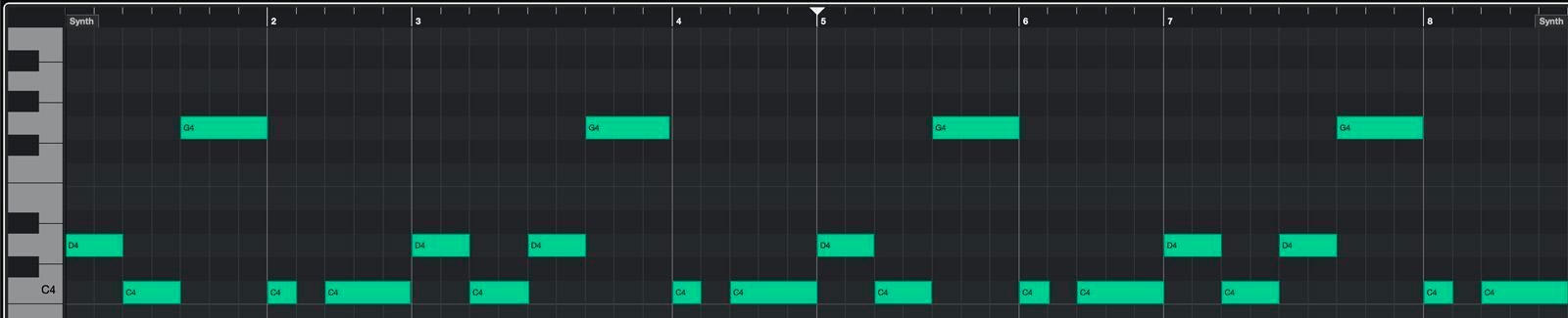

Once added up, the phrase equals 26/16 (7+5+9+5), which equals 52/16 when doubled. And since this fits nicely into the number four (52/4 = 13), I decided to see if I could double the phrase so that it would work more musically against 4/4. Then, I decided to try and put a 4/4-sounding groove underneath it. Doubling the synth phrase with the same notes sounded boring, so I threw a couple of new ones into our burgeoning ostinato, and voilà:


The resulting groove is: eighth notes on the hi-hat with accents on every quarter-note pulse; snare on the second and fourth beats to give that underlying 4/4 backbeat feel; and the bass drum is behaving polyrhythmically by accenting different notes in the synth pattern and giving it a syncopated groove.
This pattern eventually developed into a song called “Entropy” and was subsequently released on our Northern Electric Shadow album, produced by D-Force Records. Though the finished song was slightly different when recorded, it sprung out of this pattern. The song was nominated for “Best Rock Single” at the 2016 Douban Abilu Awards (with the album itself nominated for “Best Rock Album”), so I’d like to think that this pattern was a good idea! If you’re curious about how the song turned out, then you can find it on Apple Music!
Programming Exercises for Practice
The proliferation of DAWs and their tools means that programming these polyrhythmic, syncopated ideas is easier than ever. And, by simply nudging your pattern left or right — thus throwing some rhythmic displacement into the mix — you can create some wild grooves, ostinatos, and even lush harmonic textures. Plus, drummers can make some crazy exercises to practice on their kits! Let’s look at some simple exercises you can do in your DAW to spice up some of your productions.
Looping Odd Patterns Against Common Time
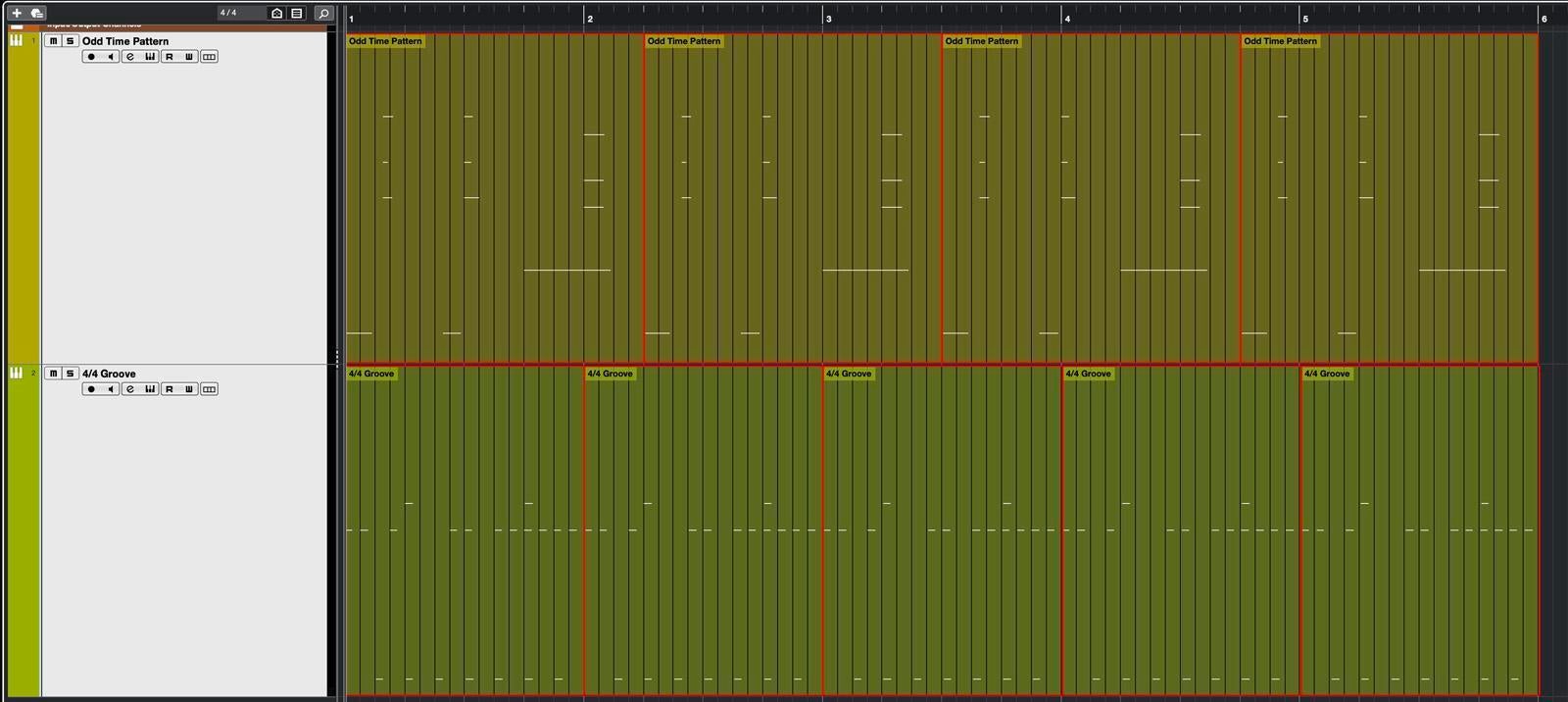
Create a MIDI pattern with an odd number of notes or beats, consolidate the pattern, and then loop it until it ends nicely within a 4/4 framework. For example:
- Here, we have a 5/4 ditty that you all may know and love, with the metronome set at 4/4. Notice how I looped/duplicated the pattern until it ended at a solid bar line on my DAW’s grid (in this case, the sixth bar).

- Create a 4/4 groove and loop/duplicate it until the groove and the odd pattern line up. Once you get things lined up, you can consolidate your tracks and change your MIDI instrument sounds and season to taste. (Have you ever wondered what Dave Brubeck would sound like with the Devin Townsend kit from Toontrack Superior Drummer 3? Here you go!)
Displacing & Stacking Patterns
This technique relates to a traditional European, classical music contrapuntal technique called “imitation” (of which there are different forms, but I won’t dive into those here). Imitation creates a delayed effect that can make very nice textures when spread among different voices.
- Create a pattern in 4/4 (or use a loop/sample you like). For demonstration’s sake, I have a nice little guitar arpeggio.
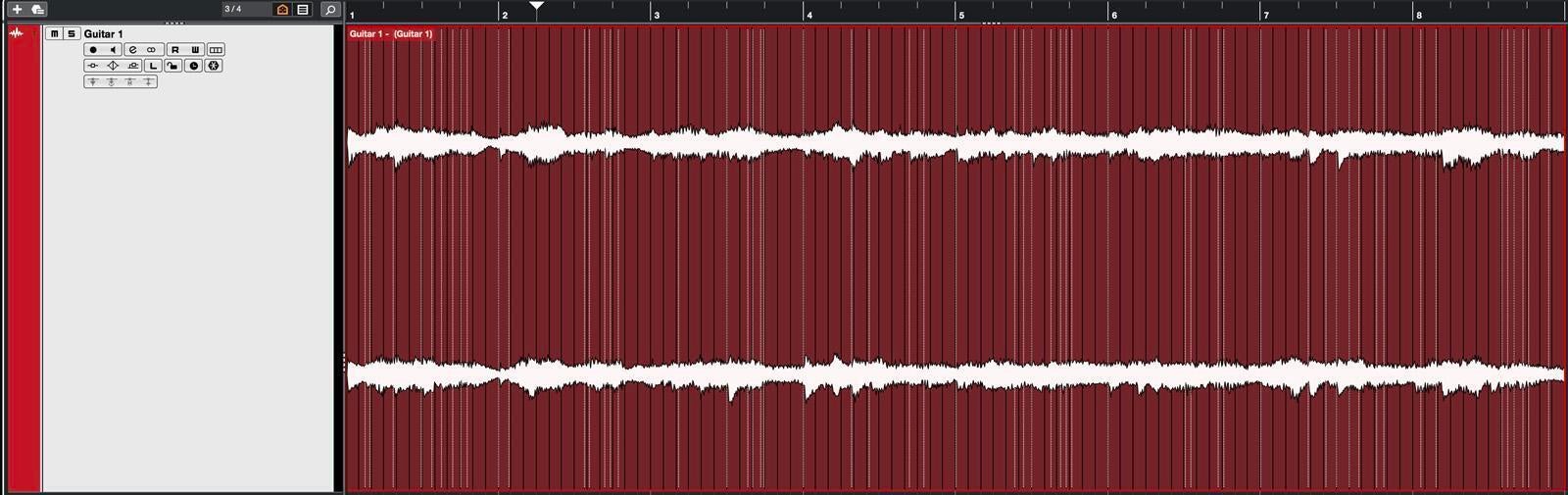
- Duplicate the track and nudge the entire pattern forward by your chosen subdivision (I decided on a half note). If you’re using MIDI, then try selecting different instruments and finding which ones complement each other well. In this example, I’ve panned the two guitars hard left and hard right so you can hear the imitation more easily. I’ve left the metronome off because it sounds too heavy-handed amidst these dreamy guitars.
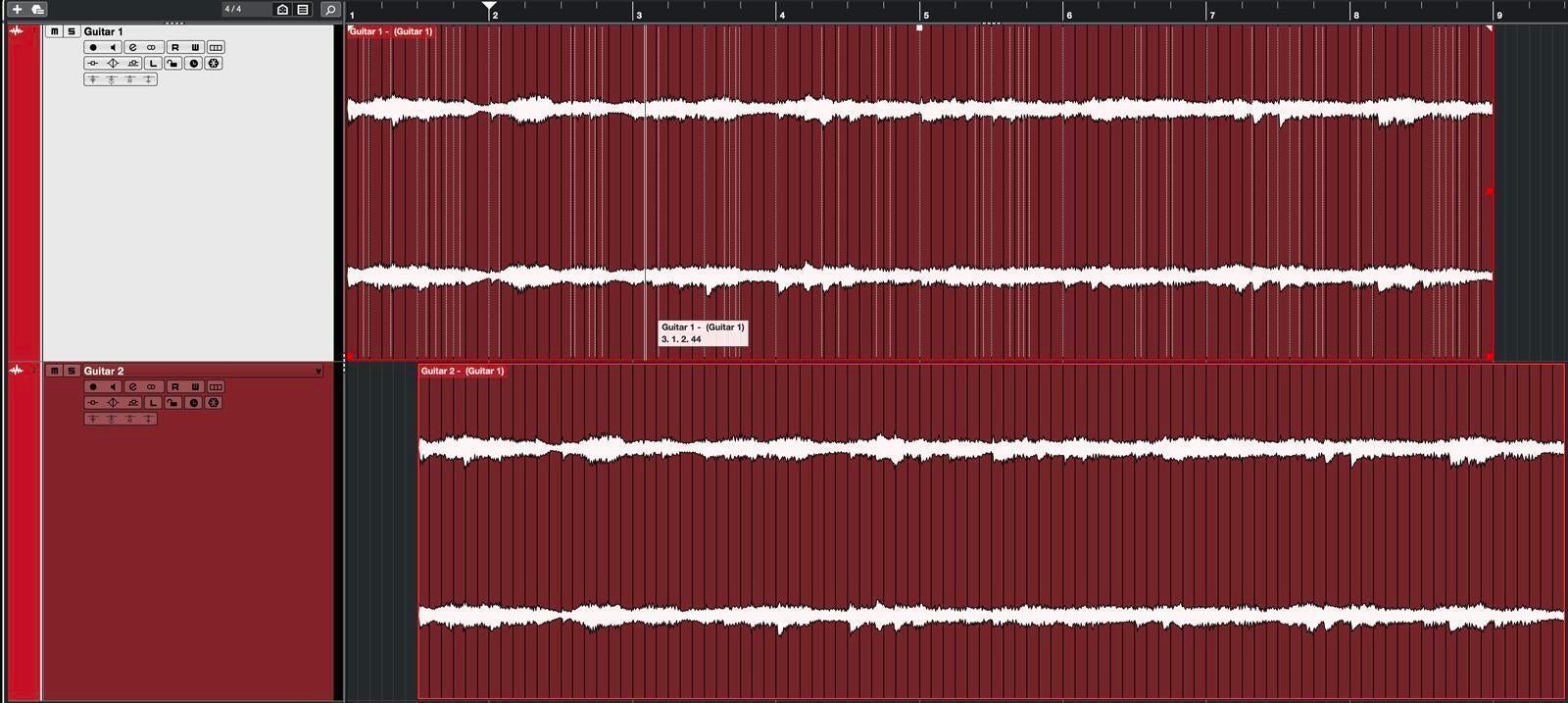
- Continue for as long as you like! In addition to soundscapes, this technique can create some advanced exercises for drummers. On your kit, try playing along with grooves that you’ve displaced from the metronome by a 16th or 32nd note and feel your mind start to melt! Offsetting one or two voices at a time instead of diving into the deep end of displacement by offsetting everything all at once has helped me out.
The following example contains eight total measures of straight 4/4. In measures three and four of the first variation, the kick and snare drums are displaced forward by a 16th note. Leading into measures seven and eight of the second variation, the kick and snare drums have been moved backward by a 16th note.
Listening Recommendations
Now we get to the fun part! Below are some songs that use these ideas very musically.
Build on Your Backbeat Basics
Rhythmic displacement, polyrhythm, and syncopation are hugely featured in most of my favorite pieces of music. The immensely useful tools available in modern DAWs (such as the piano roll and score editor) make it easier than ever to create musical ideas that use these concepts. It’s easy to share them with other musicians, too. Whether you’re looking for a great DAW to practice programming these ideas or an awesome drum set to practice pummeling these ideas on, Sweetwater has you covered. Call (800) 222-4700 to speak with one of our Sweetwater Sales Engineers today!