

Dolby Atmos for cinema debuted in 2012, but Dolby Atmos Music is still a relatively new paradigm for music creators and mixing professionals. As I chatted with Shawn Dealey, Sweetwater Studios’ Chief Engineer, about Atmos mixing, it became clear that there were many acronyms and standards that I didn’t know or understand. I put together this glossary of terms that you’ll need to know to get started mixing in Dolby Atmos. All this information is publicly available on the internet, but it would take you days to seek it out and compile it all. You still might need to talk to someone who knows Atmos and immersive mixing and who is experienced in working in the format. So, that’s what I did. Using sources from the internet I built a glossary and these terms are below in alphabetical order. Most importantly, I consulted with the experienced Dolby Atmos mixers here at Sweetwater: Shawn Dealey and Jason Peets.
Dolby Atmos Terms You Should Know
- ADM
- Album Assembler
- Apple Spatial Audio
- Audiomovers Binaural Renderer for Apple Music
- Audiomovers Omnibus
- Bass Management
- Bed Audio
- Binaural
- Dante Virtual Soundcard
- DARDT
- Deliverables
- Dolby Atmos Music Panner
- Dolby Audio Bridge
- Downmix (Atmos Fold Down)
- Height
- LFE Channel
- Loudness Target
- LTC
- Dolby LTC Generator
- Measurement Microphone
- Object
- Object Bed
- Reference SPL
- RLP
- Renderer (Dolby Atmos)
- Re-render
- SMAART®
- Sonarworks SoundID Reference
- Spatial Audio
- Speaker Configurations
- Surround Sound
- Upmix
- X, Y, Z Axes
ADM
Acronym for “Audio Definition Model,” an ADM BWF (Broadcast Wave Format) file is the master WAV file that can have up to 128 channels of audio along with the metadata that determines the spatial placement of objects for playback.
Album Assembler
Dolby Atmos mastering software used for assembling ADM BWF files into an album playlist. It allows inserting song markers, editing song durations, applying fade-ins/outs, adjusting song levels, and applying EQ and limiting. The final, assembled album can be auditioned through the Dolby Atmos Renderer application.
Apple Spatial Audio
Apple’s proprietary encode/decode technique used to render immersive audio that is in either 5.1, 7.1, or Dolby Atmos that applies directional audio filters to simulate an immersive experience with sounds coming from all around, especially effective through Apple AirPods Pro and AirPods Max headphones.
Audiomovers Binaural Renderer for Apple Music
A software tool that allows you to reference what your Dolby Atmos 7.1.4 immersive audio mix will sound like when spatialized on Apple Music.
Audiomovers Omnibus
Multichannel audio-routing software that allows routing between software and virtual hardware audio devices, such as Dante Virtual Soundcard.
Bass Management
Reinforcement of low frequencies that are derived from the localized channels of the surround speakers. To obtain consistent performance throughout a Dolby Atmos speaker system, bass management is used to reproduce the low frequencies that cannot be produced by the individual speakers, resulting in better performance across the system.
There are two types of bass management:
Global Bass Management: A single crossover frequency is applied to the entire system. This may be the setting appropriate for similar-sounding speakers with less low-frequency output.
Individual Bass Management: Allows for greater flexibility since each speaker is treated separately. Different monitor-control devices will provide different controls for filter type, filter slope, cutoff frequency, etc.
Bed Audio
A fixed 7.1.2 multichannel routing bus that comprises the first 10 channels of an ADM file. This bed is attached to fixed surround positions in this configuration: left, right, center, LFE, left surround, right surround, left-rear surround, right-rear surround, left top, and right top. There can be multiple 7.1.2 beds in an ADM file.
Binaural (Regarding Atmos)
A 2-channel presentation of an immersive mix that simulates the sound heard by human ears, created by applying a head-related transfer function (HRTF) to mimic the way humans interpret spatial positioning. In Dolby Atmos and Apple Spatial Audio, an immersive mix is folded down to a 2-channel binaural simulation of the original when listening on headphones.
Dante Virtual Soundcard
Dante Virtual Soundcard is a software application that allows you to turn your PC or Mac into a Dante-enabled device. It allows Dante audio traffic to be transmitted and received between Dante-enabled devices via standard Ethernet.1
DARDT
Dolby Atmos Room Design Tool is a macro-based Excel document to help plan and configure your Dolby Atmos speaker room. It allows you to model and predict the space with different speakers and distances to conform to Dolby’s specifications for Atmos Music mixing. The DARDT is available to download from Dolby’s website.
Deliverables
An ADM BWF is the master file that is uploaded to distribution services. It needs to accompany a stereo master and match the exact length of the stereo master. ADM files cannot be the only file uploaded to distribution. The deliverable specifications for loudness are -18 LKFS (Loudness, K-weighted, relative to full scale) and -1 dBTP (decibels, true peak).
Dolby Atmos Music Panner
A plug-in for positioning audio objects in a Dolby Atmos Music mix when used in a supported DAW and connected to the Dolby Atmos Renderer. The Dolby Atmos Music Panner runs on MacOS, and the installer includes AAX, AU, and VST3 versions.2
Dolby Audio Bridge
Software that connects the Dolby Atmos Renderer to a DAW running on the same computer.
Downmix (Atmos Fold Down)
When an Atmos mix is played on a system with fewer than 7.1.4 speakers, it will be folded down to fit the playback system’s capacity.
Height
The channels and speakers that represent elevation in the vertical sound field. Can also be referred to as “tops” and in such naming conventions as LTF and RTF (left top front, right top front). These speakers are positioned overhead in a configuration of four or more speakers.
LFE Channel
Abbreviation of “low-frequency effects channel,” an audio channel located in the 7.1.2 bed of the Atmos mix and the “.1” in the 7.1.2. This channel should be limited to frequencies below 120Hz. Even if there are multiple subwoofers in an Atmos room, it is still only referred to as “.1.”
Loudness Target
Loudness should be measured with the Dolby Atmos Renderer. To be in line with popular music services, you must adhere to these guidelines:
- True peak level should be -1 dBTP for the Dolby Atmos loudness measurement.
- The integrated Dolby Atmos loudness measurement should be -18 LKFS or less (within ±0.1 LKFS).3
The Dolby Atmos Music Master Specification can be found here.
LTC
Abbreviation for “linear time code.”
Dolby LTC Generator
A plug-in that is used to synchronize your DAW to the Dolby Atmos Renderer. It is placed on a mono audio track and routed to output 129 or 130.
Measurement Microphone
An omnidirectional small-diaphragm condenser microphone with an extremely flat frequency response that is used to analyze and calibrate playback systems within an environment. It can be used in combination with measurement software, such as SMAART, to make adjustments/corrections to a Dolby Atmos speaker installation.
Object
An audio path that allows for 3D placement in the Atmos space and that represents its position in the listening space as X, Y, and Z coordinates. The objects carry metadata from their creation all the way to playback. The use of audio objects frees individual sounds from channels and allows the sound to be positioned precisely in three-dimensional space.
Object Bed
A multichannel routing bus created to accommodate larger bed mixes than 7.1.2, usually 9.1.4 or 9.1.6. It is created using a combination of the 7.1.2 bed and objects placed in relation to where speakers would be in a 9.1.4 or 9.1.6 configuration.
Reference SPL
Every speaker must be capable of delivering 85dB(A) at the RLP (reference listening position) with 20dB of headroom to meet the Dolby Atmos for Music Mixing specification.
RLP
Reference listening position. This is the center point equidistant from all the speakers.
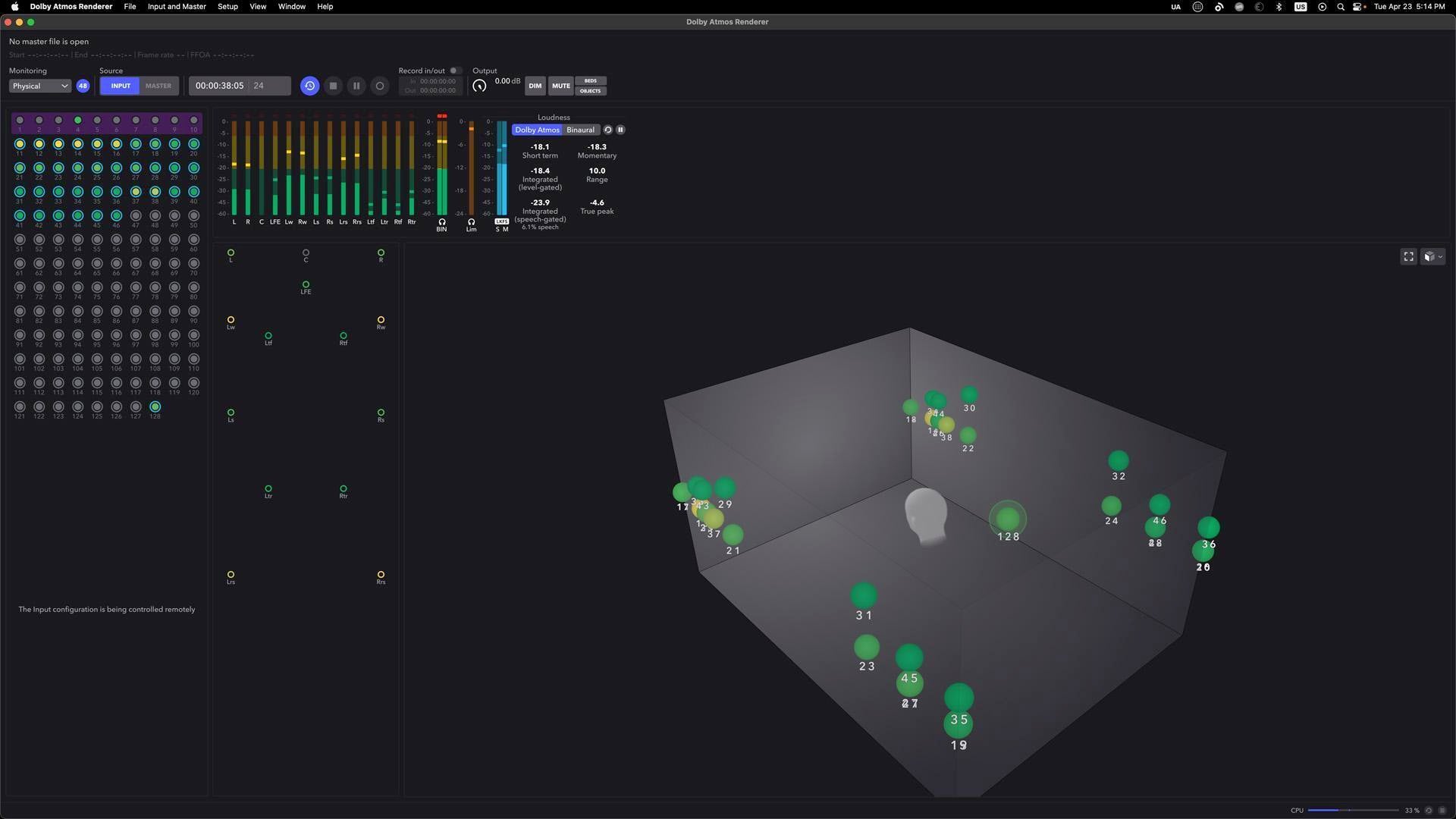
Renderer (Dolby Atmos)
A Dolby application designed to encode Dolby Atmos from 128 channels of audio. It is a multi-format encoder and processor that can create ADM files, handle speaker processing, and generate re-renders.
Re-render
The process of changing the output format of your Atmos mix for listening to the results of different playback formats. Re-renders can be a variety of channel widths (7.1.4, 5.1, 2.0, etc.) and can contain a full mix, objects, beds, or a custom mix made from user-defined groups.
SMAART®
Acoustic analysis software (Windows and macOS) for sound-system measurement, optimization, and control that allows users to measure and correct their listening environment. The acronym is derived from “System Management Acoustic Analysis Real-time Tool.”
Sonarworks SoundID Reference
Automatic headphone and speaker calibration software (macOS) that enables correction of any playback system to achieve nearly flat results.
Spatial Audio
Also referred to as “immersive sound,” it is audio that has been tailored to play back and emulate a three-dimensional soundfield whether on speakers, soundbars, headphones, or devices. Apple uses the phrase “Apple Spatial Audio” to signify their proprietary playback format for Apple Music.
Speaker Configurations
- 2.0 — 2-channel stereo (L/R)
- 2.1 — 2-channel stereo (L/R) plus subwoofer (sub)
- 5.1 — 6-channel surround (L/C/R/LS/RS) plus sub
- 7.1 — 8-channel surround used for THX Spatial Audio (L/C/R/LS/RS/LR/RR) plus sub
- 7.1.2 — 8-channel surround with sub plus two height channels (LT/RT)
- 7.1.4 — 8-channel surround with sub plus four height channels* (This is the minimum requirement to meet Dolby Atmos best-practice specifications.)
- 9.1.4 — 10-channel surround with sub plus four height channels
- 9.1.6 — 10-channel surround with sub plus six height channels
- 11.1.6 and larger — 12-channel surround with sub plus six height channels
Surround Sound
A channel-based sound-reproduction technique that goes beyond stereo by using speakers that “surround” the listener to create an immersive listening environment in a single plane (no height channels). Examples of surround sound formats are Dolby Digital and DTS. Common formats are 5.1 and 7.1.
Upmix
In reference to Atmos content, these techniques are used by mix engineers to allow stereo source material to be expanded into Atmos-based channel formats and spatialized in Atmos space. NUGEN Audio makes Halo software that does this for you.
X, Y, Z Axes
These three axes represent the planes in a listening field, where the X axis is the horizontal, left-to-right plane; the Y axis is the horizontal, front-to-rear plane; and the Z axis is the vertical, low-to-high plane. Sounds can be localized in a nearly 360-degree field by defining their positions along each of these three planes.
Now You Know
That’s a lot of information. But just like mixing in stereo, once you learn the terminology and how to use the tools, it’ll become second nature to you. If you have any other questions about Dolby Atmos or mixing in immersive or if you’re ready to set up your 7.1.4 mix room or a listening room at your home, please call your knowledgeable Sweetwater Sales Engineer at (800) 222-4700. They can answer your questions, and they’re eager to help.
We’ve watched as the field of Dolby Atmos mixing has evolved rapidly over the past few years. If there are other terms that you don’t know or think Atmos engineers need to know, then reach out to us via email, and we’ll consider adding them.