

Trends in music are cyclical, as we know. There was a time when it seemed like every guitar sound on every recording had some sort of chorus effect on it. Naturally, there was an anti-chorus rebellion and for a time, the chorus effect was all but gone from every guitarist’s arsenal. The pendulum has swung once again and chorus is back! I for one, am glad to see so many new chorus pedals and updates of classics available. The rapid advancement of pedal technology and quality over the past few years means that the latest breed of chorus pedals are functionally and sonically better than ever.
The chorus effect can range in intensity from barely noticeable to near chaos, while retaining musicality in all contexts. Eric Johnson regularly uses chorus on his clean sound to create a stereo image; almost not there but you’d notice if it was missing. Zakk Wylde uses chorus liberally to add depth and dimension to heavily-distorted solo tones and John Scofield uses a fast, wide warble, almost like an out-of-control Leslie, to create an altogether different voice for the guitar.
Originally, the chorus effect was designed to imitate a Leslie rotating speaker, like so many modulation effects. Roland put their chorus effect into the Jazz Chorus amplifier. It used two speakers in the same cabinet, one with a modulating vibrato-type effect and one with a dry signal. The combined sound created a chorus effect. The Boss CE-1 was introduced in 1976 as a stand-alone, floor-version of the Roland JC amplifier’s chorus circuit. This was the jumping-off point for chorus pedals and is still considered by many to be the benchmark for chorus effects. Of course, different designs and technology took the chorus effect beyond what the CE-1 was capable of so the range of sounds available from a chorus pedal is pretty wide-pun intended.
Here are three cool chorus pedals, that have caught my attention.

Strymon Ola
Strymon is so good at updating classic effects by retaining everything you love about the original and fixing the stuff you didn’t. That takes an understanding of not only technology but guitarist’s needs and expectations, which are almost two separate worlds. The Ola uses Strymon’s proprietary dBucket chip to nail the feel and tone of classic chorus and vibrato sounds with amazing fidelity. With the addition of Ramp and Envelope modes you get real-time manipulation of these classic sounds as well. Ramp works like the ramp-speed on a Leslie, speeding-up or slowing-down, at whatever rate you pre-set, by holding the bypass button down. Envelope changes the chorus intensity based on how hard or soft you play the guitar.
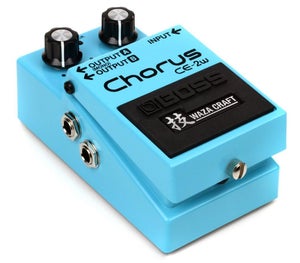
Boss CE-2W
Boss has an amazing legacy of chorus pedals and the CE-2W may be their crowning achievement. The original CE-2 became the go-to chorus pedal of the time. Compared to the CE-1 it was smaller, simpler, and could operate with a 9v battery (the CE-1 was AC operation only) so the convenience made it a no-brainer. More importantly, it sounded really good. The CE-2W keeps all of those things intact with some significant additions: Boss’ new, cleaner-sounding buffer circuit, stereo outputs, and two different CE-1 modes. The CE-1 chorus is warmer and wider compared to the CE-2 sound and on the CE-2W you get both. The other CE-1 mode is the classic Vibrato, which is the modulated-side of the signal; a nice bonus!

MXR M234 Analog Chorus
If the name isn’t clear enough, this is an all-analog chorus using bucket-brigade IC chips to create the warm sound associated with classic, chorus pedals. MXR has been doing this with amazing success for many decades, but the Analog Chorus does it with a couple of different twists. The addition of Bass-and-Treble cut controls gives the option of mellowing the top-end and/or taking congestion out of the low-end. Also, the Analog Chorus allows you to connect in either mono or an interesting stereo or 2-output setup. If you use the THRU output and the MONO output simultaneously, the THRU side is your unaffected guitar signal and the MONO output is the delayed/modulated signal only. To get the full, swirly effect, set yourself in the center, between your speakers or combo amps and move them a few feet away, creating a triangle-shape with you and the speakers. You’re in the sweet-spot now!