

In September 2022, Jim Irsay displayed his collection of rock ‘n’ roll, pop culture, and history memorabilia for the citizens of Indianapolis — a homecoming of sorts. If you live outside the Midwest and don’t follow NFL football, the name Jim Irsay might not make your guitar radar go off. Still, Irsay, the owner of the Indianapolis Colts and music enthusiast, has gathered perhaps the world’s most impressive collection of music memorabilia. He plans to take the show on the road — there were exhibit dates in Nashville, Washington D.C., Austin, Los Angeles, New York, and Chicago in 2021. The collection features 200+ instruments, many of them guitars that were owned by the likes of Kurt Cobain, David Gilmour, Pete Townshend, Bob Dylan, the Beatles, Prince, and Journey, but the collection also includes amps, road gear, and pro audio equipment along with pianos from John Lennon and Elton John.
As one of America’s wealthiest business owners, Irsay has the unique ability to chase (and buy) significant artifacts like few else can. The concept is nothing new — wealthy individuals have long dabbled as collectors and caretakers of history. But Irsay has gone all in on the world of rock history and has made some fascinating acquisitions, the extent of which we’ve never seen. No other entity has gone all in on caretaking music memorabilia to this degree — chasing guitars with the same fervor that the Smithsonian National Museum of Natural History might pursue dinosaur bones and wooly mammoth tusks.
In concept, the Jim Irsay Collection falls somewhere between Cleveland’s Rock & Roll Hall of Fame and the wall-display backdrops of America’s finest Hard Rock Cafes but with noticeable touches of curation that rival America’s finest museums in quality and scope. And, unlike other rock ‘n’ roll destinations, the Irsay Collection is mobile so they can “take the show on the road” — a perfect way to display guitars.
People feel strongly about music, and that’s doubly true for the collection’s passionate team of caretakers and curators I spoke with before attending a collection exhibition at Lucas Oil Stadium on September 9.
“Mr. Irsay was born in 1959. He has certainly lived through such a wide breadth of rock ‘n’ roll history,” says Marc Johnson, the collection’s expert guitar tech who has a decorated music background including Grammy nominations and co-ownership of Pop Machine, Indianapolis’s premier audiophile studio. “Jim knows how to play guitar,” Johnson says. “His passion for his collection is driven by his passion for music overall. He loves all the iconic artists whether it be the Beatles or Bob Dylan, Pink Floyd, Jerry Garcia, the Grateful Dead, Stephen Stills — it’s really the great music of our time.”
According to chief curator Larry Hall, this collection developed organically but is now an intentional project. Seeds were planted around 2001, when Irsay bought the manuscript for Jack Kerouac’s proto-hippie novel On the Road for a reported 2.43 million dollars. The manuscript is a string of typewriter pages taped together into a 120-foot long “scroll.” Next, Irsay purchased Jerry Garcia’s famous Tiger guitar and some Beatles instruments and stage ephemera — all fitting choices following the Kerouac scroll. The Beatles, of course, borrow their name’s spelling from Beat poets like Kerouac. Kerouac was just one step removed from Jerry Garcia and the Grateful Dead by their mutual friend Allen Ginsberg, a Kerouac confidant during the ’50s. Ginsberg, who later joined Ken Kesey’s Merry Pranksters, facilitated the Dead’s rise to fame in the ’60s. More than any other piece, the scroll, Hall says, “spurred the spirit of collecting” that drives the team today.
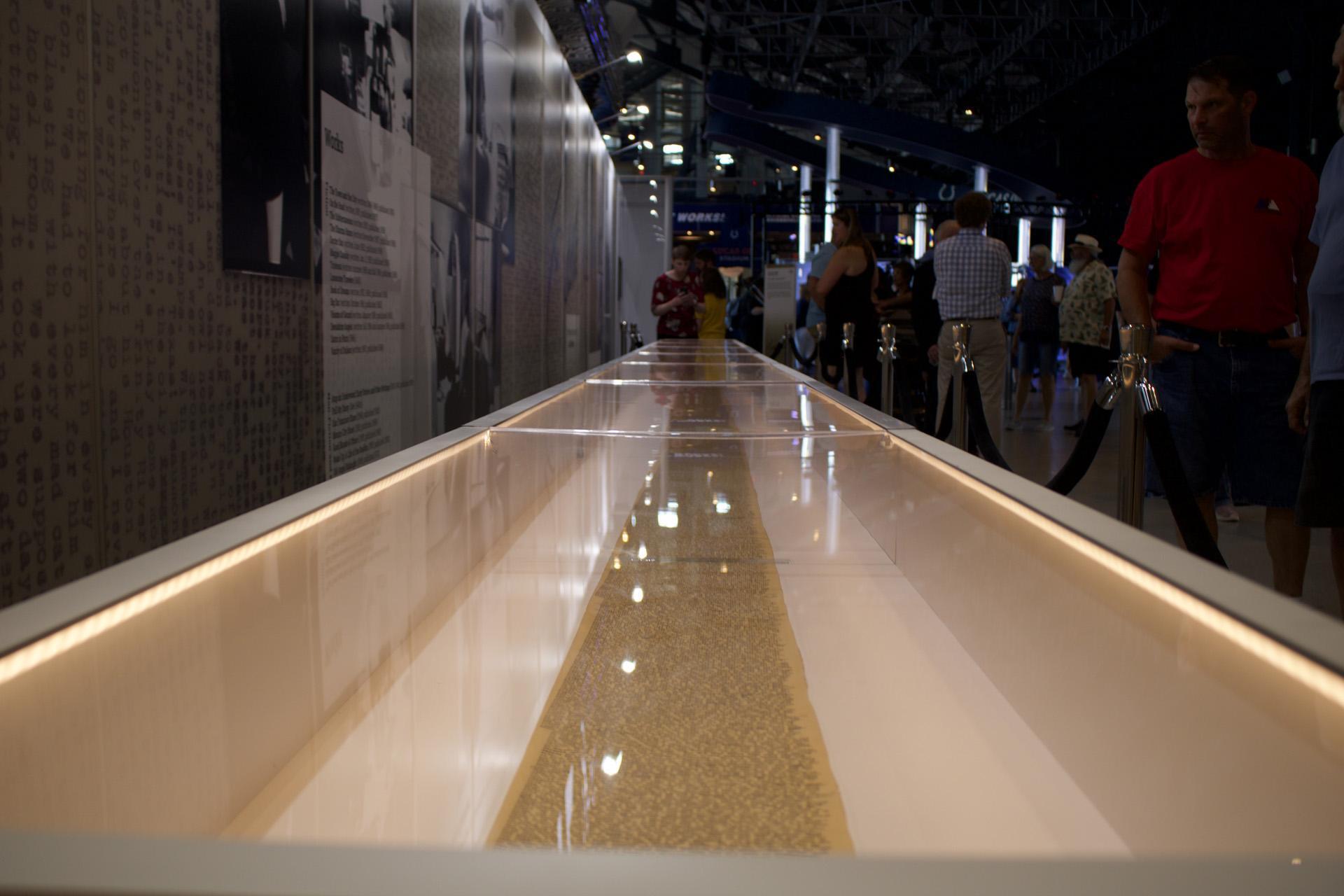
The team has certainly been busy. When the Irsay Collection comes to town, there’s likely something for everyone. You can check out guitars owned by David Gilmour, Bob Dylan’s Newport Folk Festival Stratocaster, and Muhammad Ali’s “Rumble in the Jungle” title belt in the pop culture section. Then stroll over to the history section to see an original wanted poster for John Wilkes Booth and letters handwritten by Ernest Hemingway in a delightfully sloppy scrawl that nearly falls off the page. “How many museums would we have to visit to see all this?” mused one of the exhibit’s impressed guests.
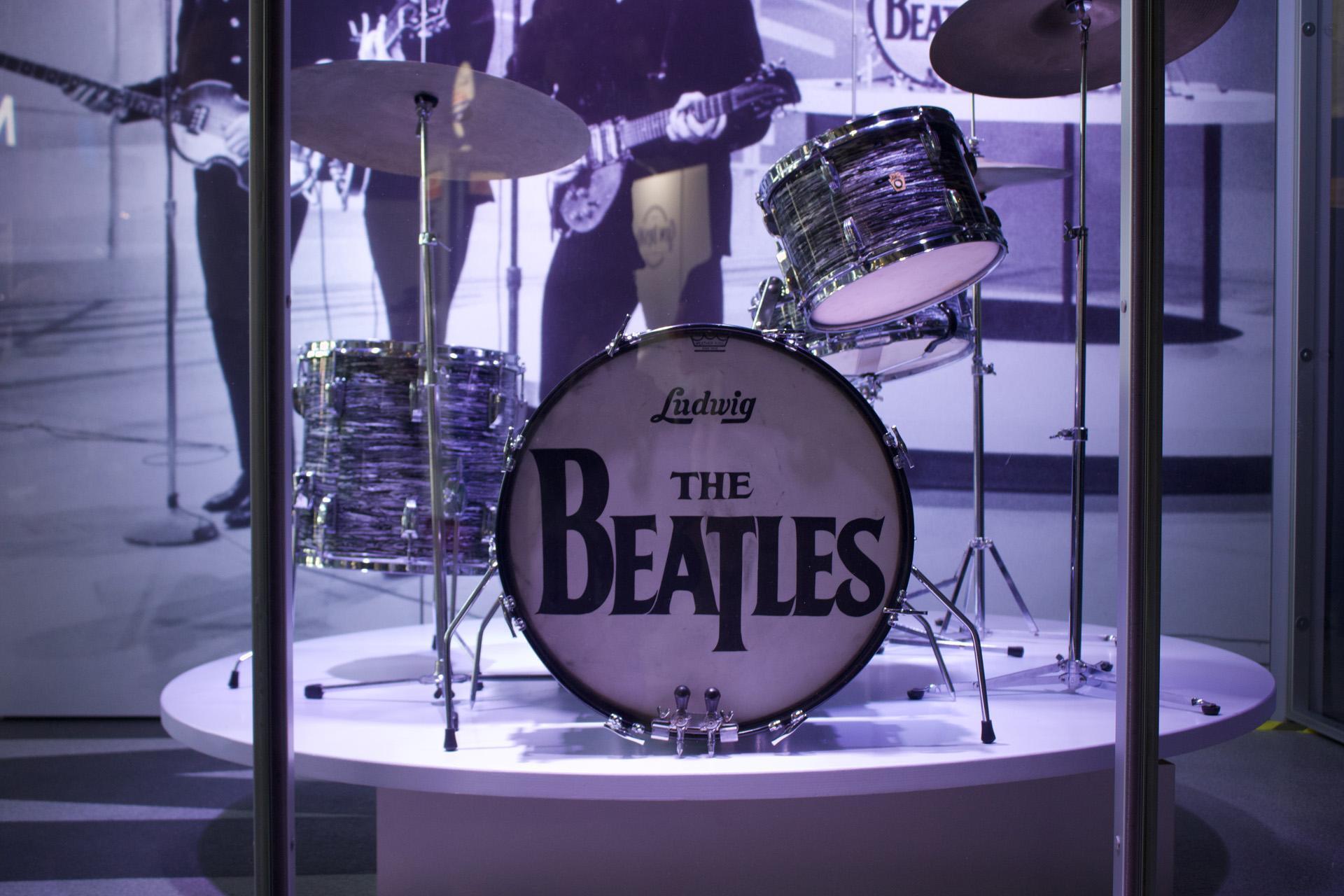
Ringo Starr’s first Ludwig drumset, a 1963 Ludwig Oyster Black Pearl three-piece drum kit.
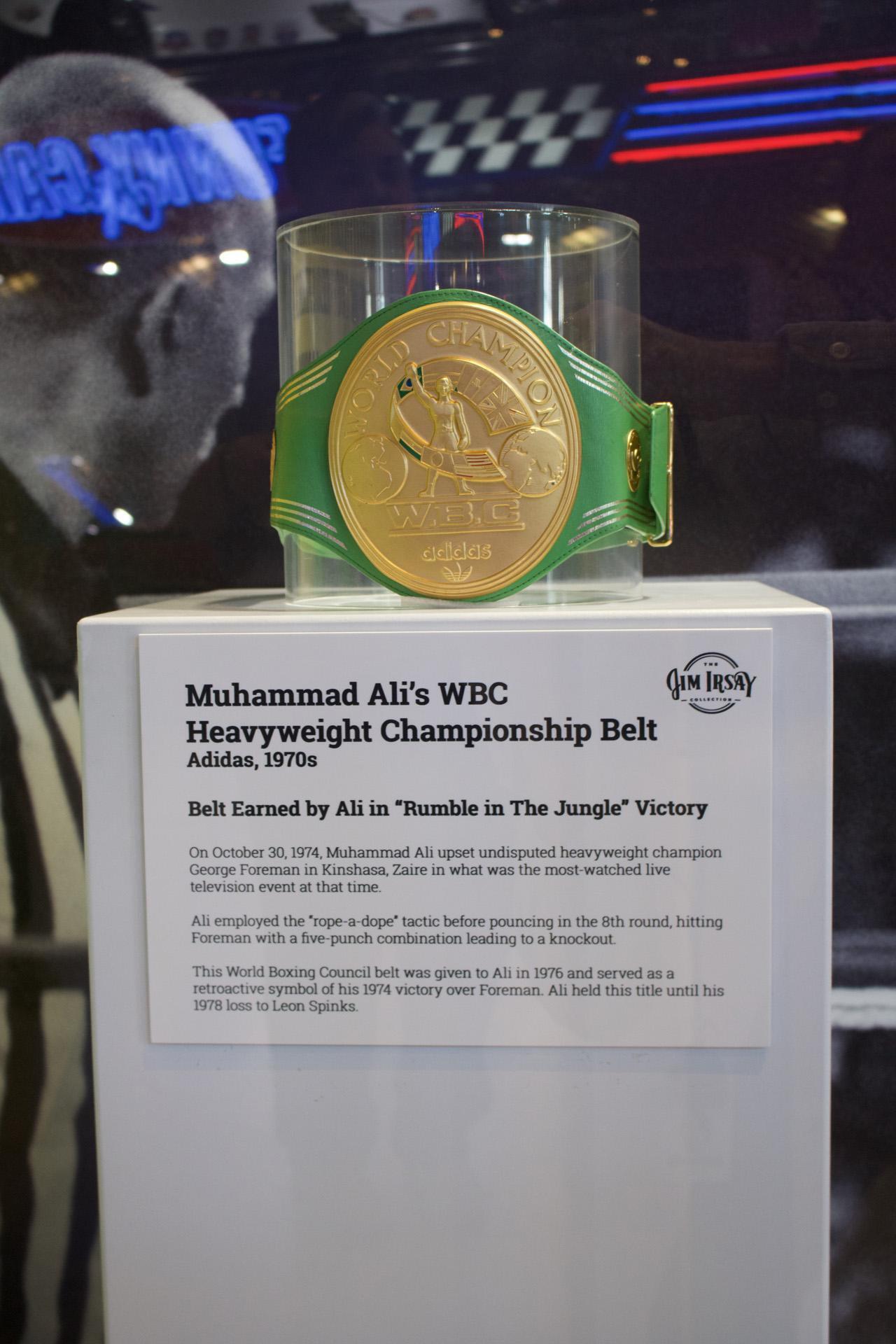
Muhammad Ali’s “Rumble in the Jungle” Heavyweight Championship belt.
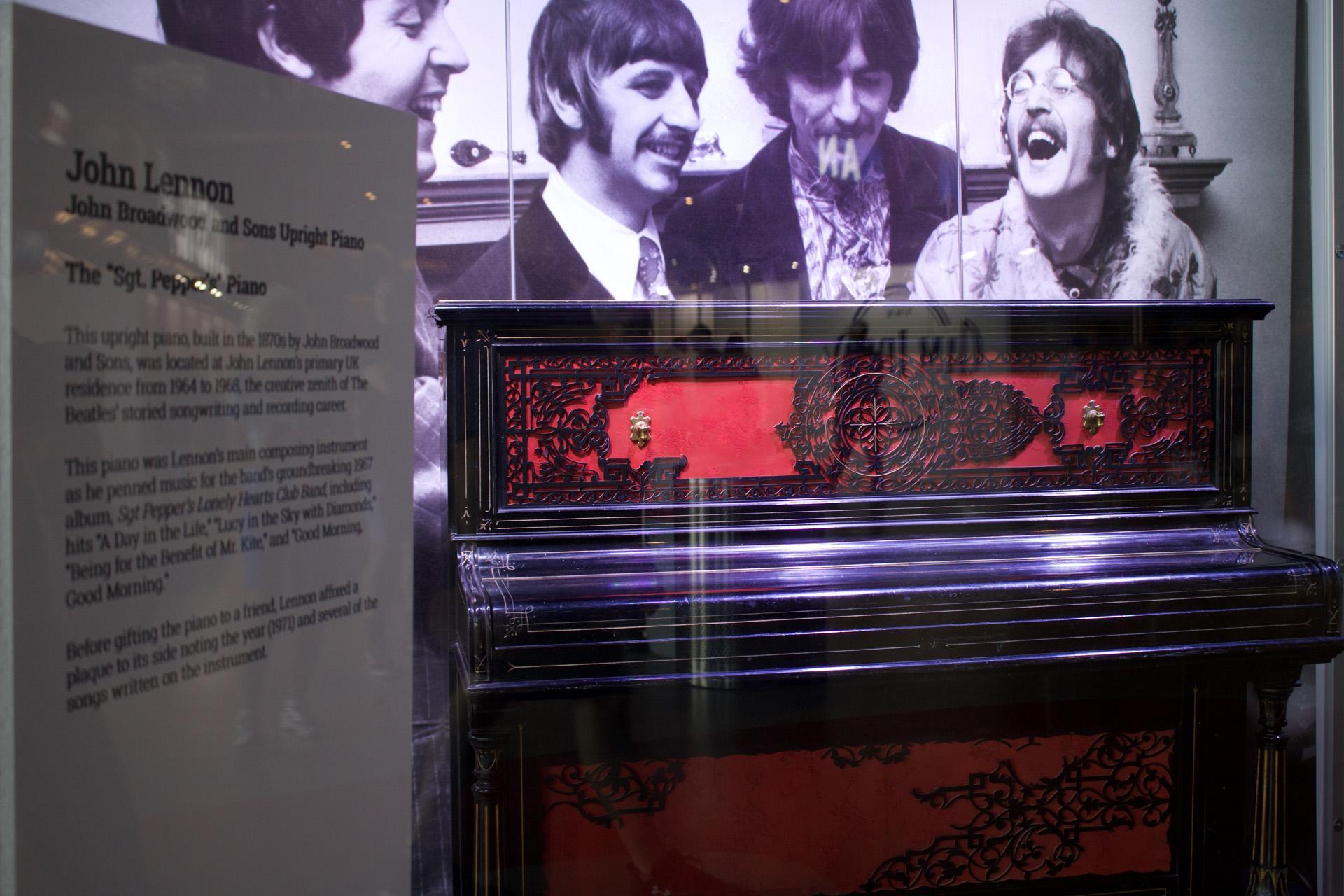
John Lennon’s primary UK piano from 1964 to 1971, used most famously on “Sgt. Pepper’s'”.
This collection tugs on the heartstrings by encouraging guests to reminisce about their personal, political, and downright sentimental history. Just ask any of the show attendees! I overheard an elderly woman standing near the guitar exhibit discuss how one of her family’s most cherished possessions, a vintage Les Paul, now belonged to her grandson. She definitely cherished that family heirloom more than any of the celebrity axes on display. There was also the man near the Beatles section I heard reminiscing about his favorite Honolulu bar known for their “upside-down margaritas.” Later, after John Lennon’s death, he discovered it was a frequent watering hole of Lennon’s assassin, Mark David Chapman.
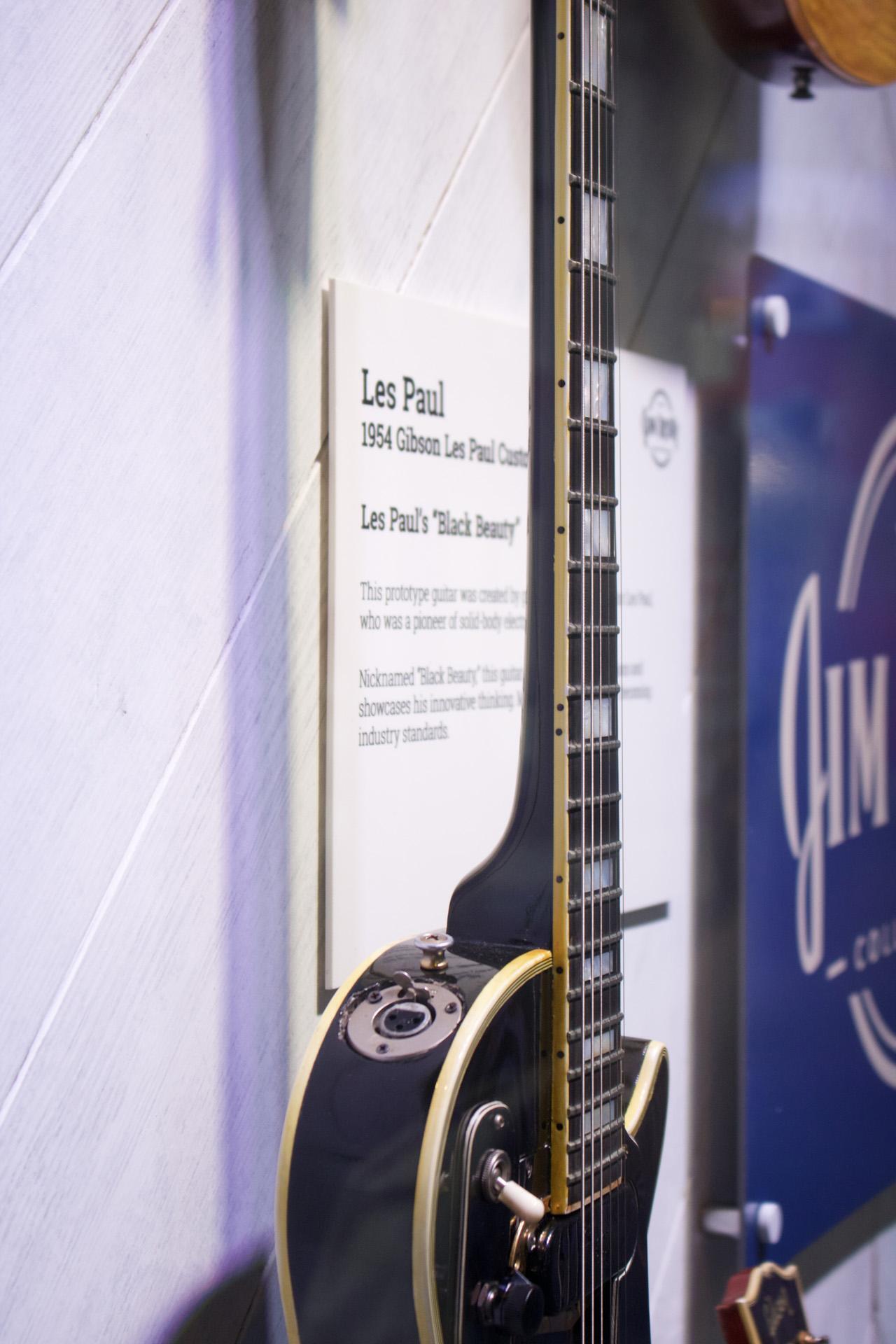
Trust in Provenance
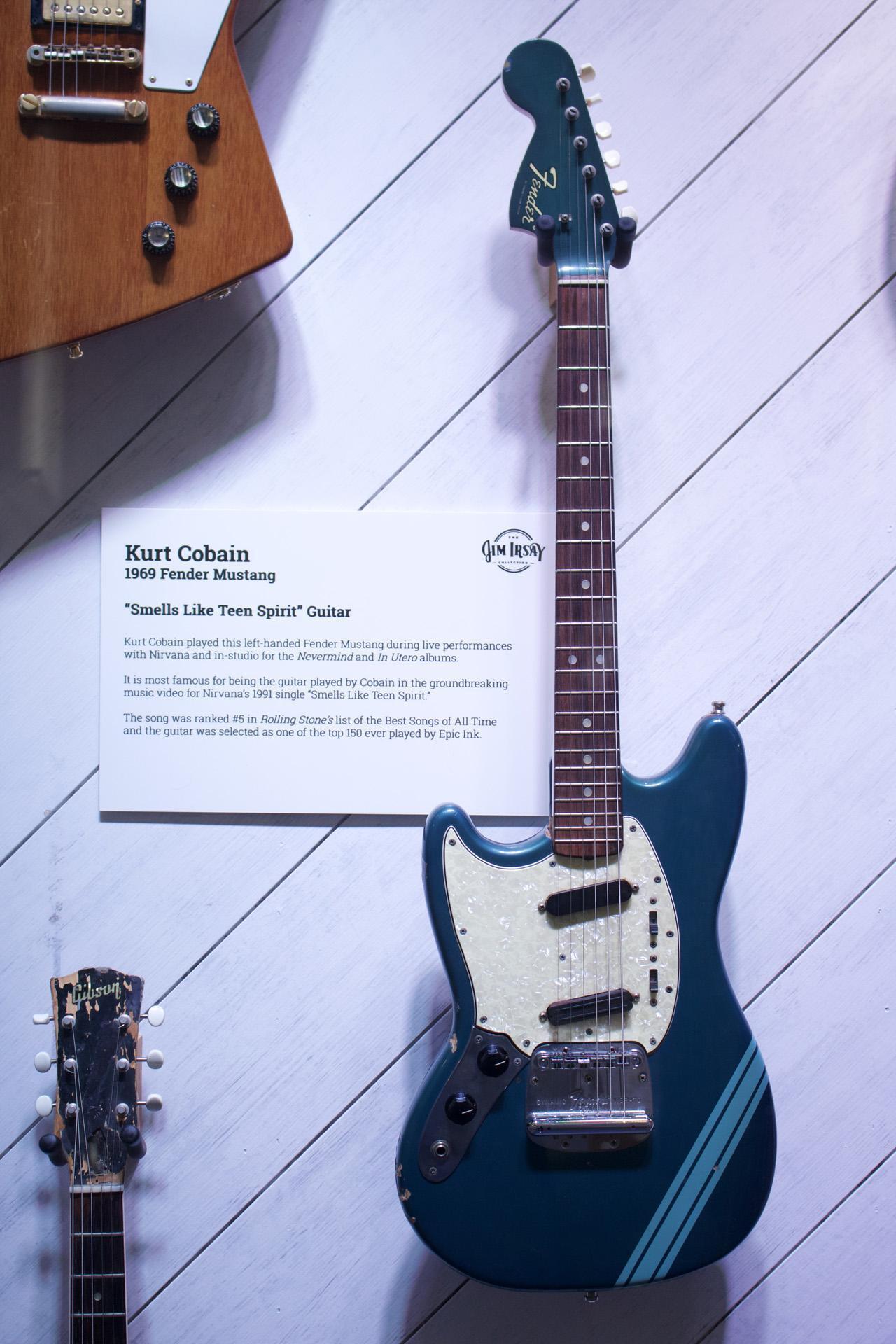
The Irsay Collection’s most recent major acquisition was a $4.5 million purchase — a remarkably well-preserved 1969 Fender Mustang that belonged to Kurt Cobain. This is the guitar Cobain used during shoots for the “Smells Like Teen Spirit” music video and boasts the second-highest price ever paid for a guitar at auction. First place goes to a Martin D-18E, also owned by Cobain, purchased for $6 million in 2022 by RODE Microphones owner Peter Freedman. The incredible prices paid for Cobain memorabilia signals the emerging open season on ’90s nostalgia. These guitars were anticipated to sell for much less but shattered records like never before.
As people wandered intently through the collection, I knew what to expect — dim lights, snippets of plaque inscriptions muttered between spouses and friends, a general sense of awe. But I wanted to know what it takes to buy a guitar for $5 million (besides the $5 million).
During their roughly five-year tenure with the collection, Larry Hall and Marc Johnson have navigated many acquisitions and have overseen tremendous growth in the collection. The growth process means staying privy to high-end public auction houses like Christie’s, fielding probes from private sellers, and occasionally getting tipped off by Mr. Irsay himself. Sometimes Hall’s team passes on opportunities that can’t or won’t put their best foot forward. “There’s been a couple times we’ve been close to recommending a purchase, and we keep digging deeper . . . more contacts, more vetting.” It’s his team’s job to go over the history of any potential item with a fine-tooth comb and turn that research into a purchase recommendation (or hard pass) for Mr. Irsay. The work is fascinating with inherently high stakes given sale prices that often exceed six figures. With prices like that, how do you confirm that the seller owns what they say they do? How do you avoid getting scammed?
“Due diligence,” says Mr. Hall, who then dropped the word “provenance” on me. (I had to Google it later.) Provenance is essentially any record of an artifact’s transmission and history, and it’s a lot like crime-scene evidence — a chain of custody that reveals the who, what, when, where, and why of an object’s history. From factory to final owner, provenance traces ownership and seeks to fact-check stories we tell. Through investigating and verifying this history, buyers like Mr. Irsay gain confidence and bid hundreds of thousands, or even millions, without fear of buying a meticulously crafted hoax.
“Provenance always steers the car,” Hall says. Establishing provenance might be simple — take for instance the Cobain Fender Mustang purchase or David Gilmour’s Black Strat. “Those we have 100% confidence in,” Hall says. Kurt’s blue Mustang came directly from Cobain’s estate to Julien’s Auctions while the Black Strat came straight from David Gilmour himself. These guitars had tidy, clear-cut histories that were easy to verify.
The average bread-crumb trail is frequently less concrete than that. Take, for instance, a Pete Townshend SG that was ultimately authenticated by the Who guitarist himself, yet Pete did so without accounting for the guitar’s entire history. This guitar, a 1963 Gibson SG Special, came to the collection via a private seller, Guy Pratt, a prominent session player and Pink Floyd’s post-Roger Waters bassist.
Pratt’s supposed SG Special had previously been broken and repaired, which helped establish some initial provenance since Townshend spent most of the Who’s heyday smashing guitars every night. On the other hand, a guitar that’s been broken or damaged leaves room for potential trickery and deception. When you’re buying guitars at six-figure sums, confidence — or rather provenance — is essential.
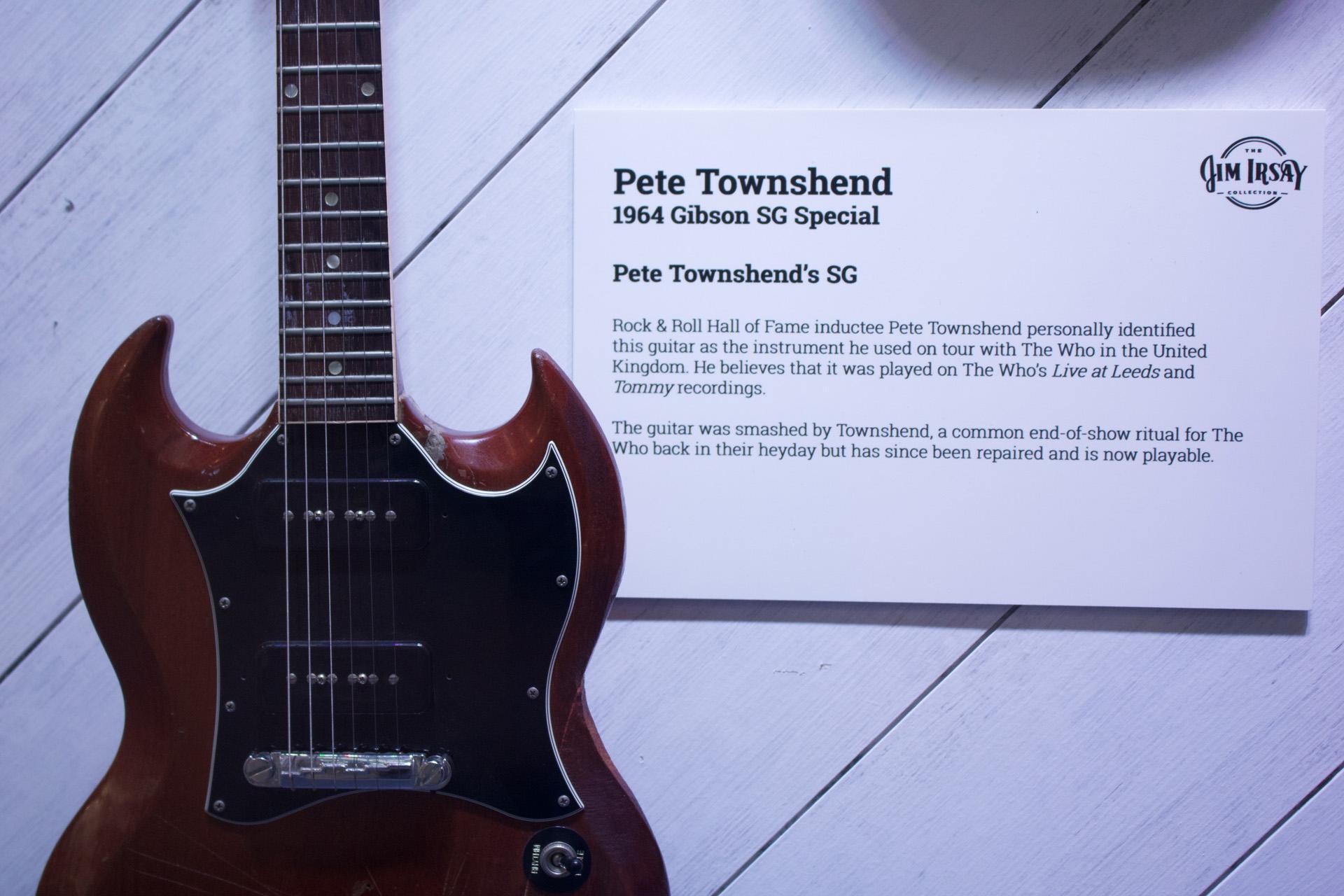
Interestingly, Pete vouched for this guitar once before; Guy Pratt had a letter of provenance from Townshend where Pete stated that he owned the SG and repaired it himself. When the Irsay Collection team went to reverify this letter in the interest of due diligence, they connected with the Who’s longtime manager Bill Curbishley, who reached out to Pete. Townshend still claimed the guitar was his and said it could’ve been used at either The Rolling Stones Rock and Roll Circus taping or one of the band’s famous festival performances at Isle of Wight or Leeds.
However, Marc Johnson recalls that this time Townshend took specific issue with what he termed a “sloppy” repair job on the SG — Townshend suggested the quality of work is something he would’ve never done or accepted himself. Perhaps Townshend was feeling unkind toward his past luthier work that day; but, then again, memory is fleeting and subject to change, especially where rock ‘n’ roll is involved. A famous quote about the ’60s comes to mind: “If you remember the ’60s, you weren’t really there.” Regardless, Pete’s consistent claim to the guitar was all the team needed to hear. The guitar was indeed the thing they wanted to own and display. “That’s a ninety-nine-point-five percenter,” Hall says, referring to their confidence in the authenticity of the buy.
Beyond provenance, the team also leans heavily on experts from the world of high-end antiques. It’s an involved process that demands serious research, social finesse, tolerance for uncertainty, and lots of experts. Hall states that the Irsay team works with appraisers on both the West and East Coasts with decades of experience handling musical instruments and vintage items. “It’s a constant conversation,” Johnson says of their process. “We started off really good, but we continue to get better.”
Maintenance, Care, and Preservation
Unlike important paintings that sit in museums, old instruments — vintage Martins or Stradivari violins — were built to be touched and played. You’d certainly get some odd looks and some security presence if you picked up van Gogh’s The Starry Night during a visit to MOMA and rubbed your hands across the canvas. A guitar, however, is built for precisely this sort of thing. That’s one aspect that the Irsay Collection takes very seriously.
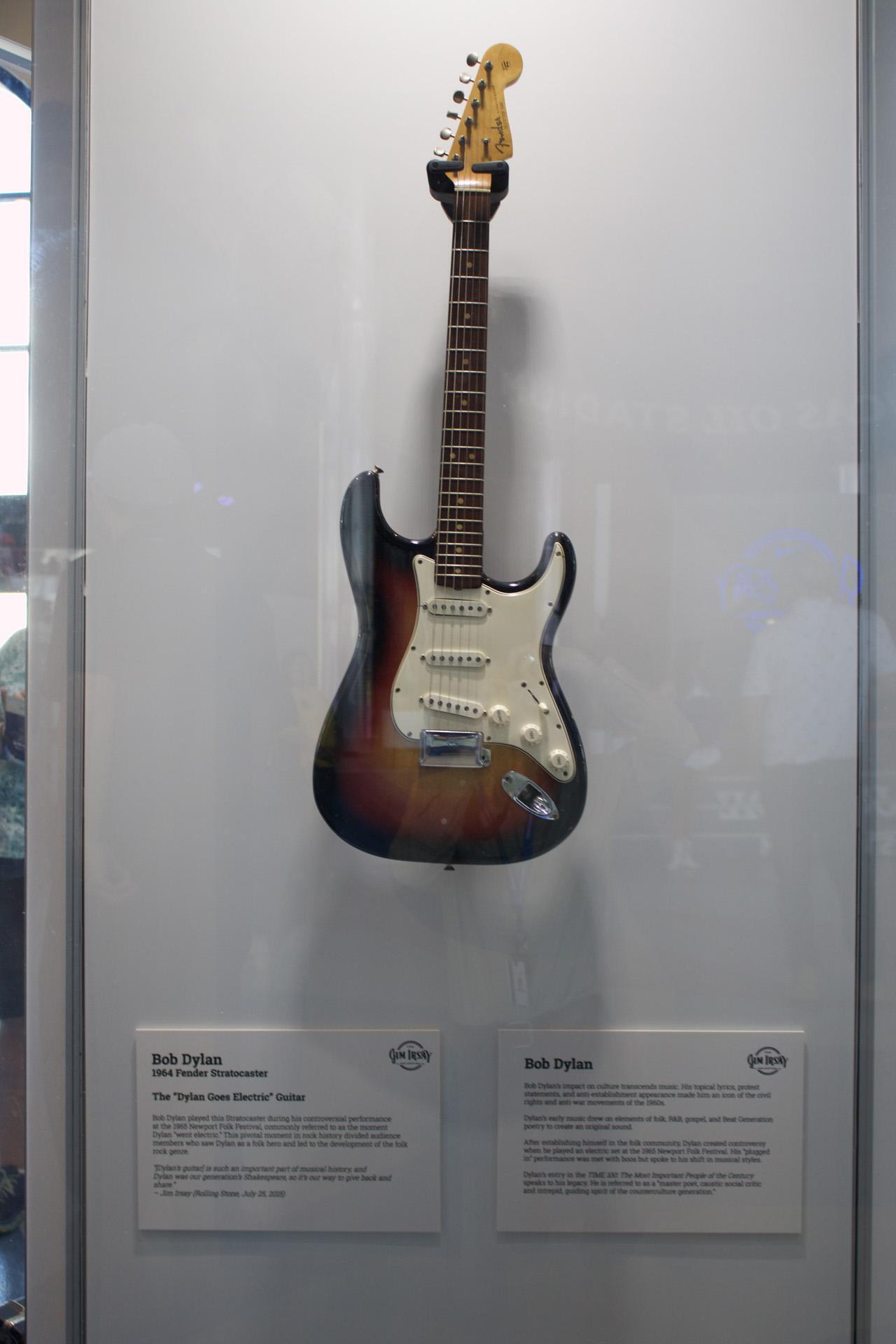
The sunburst Stratocaster used at his infamous Newport Folk Festival performance in 1965.
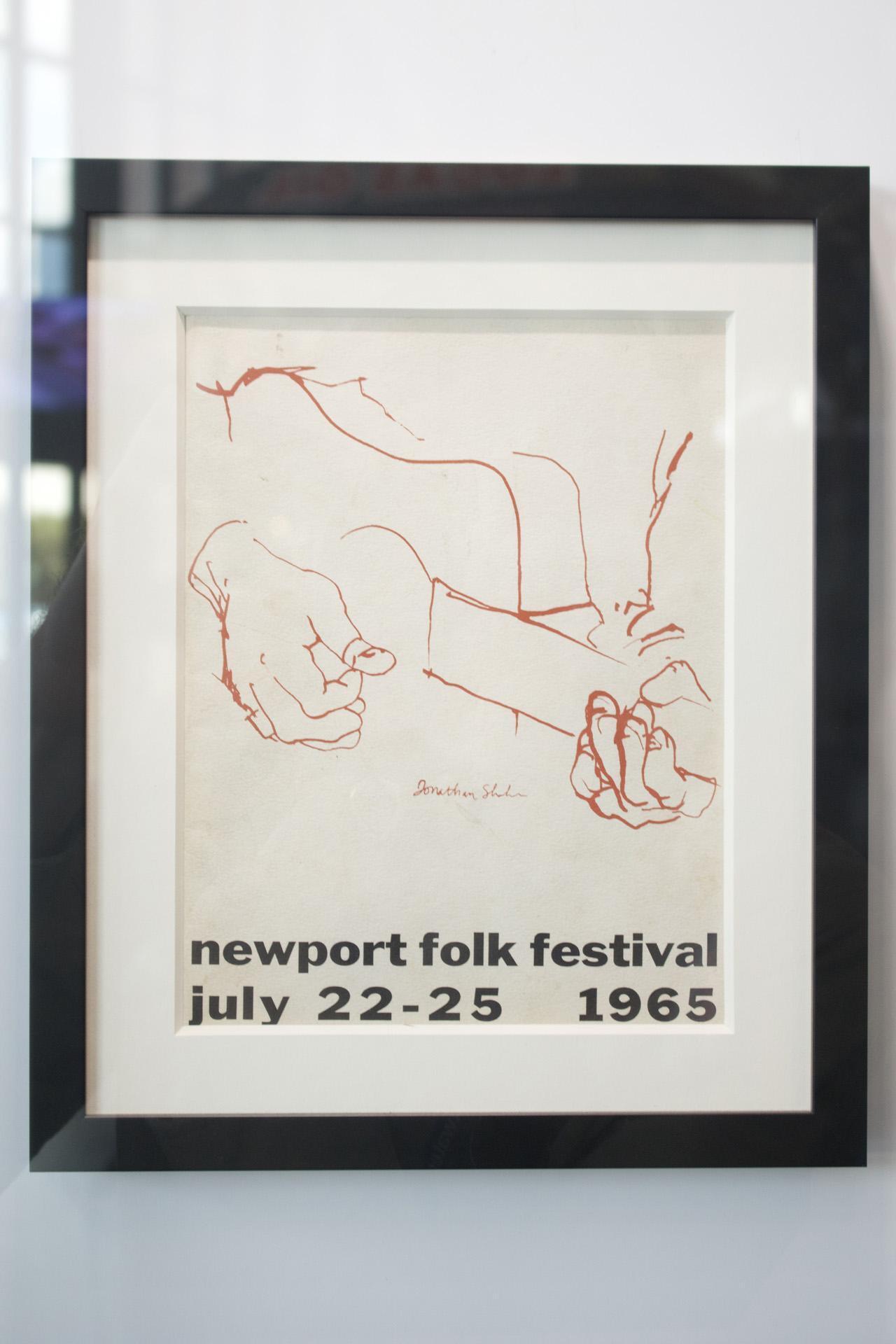
Original 1965 Newport Folk Festival flyer.
They strive to keep artifacts in excellent working condition without erasing what makes each item unique. “We want to maintain the integrity. The respect that we have for the artist and the instruments is over the top,” Hall emphasized. “We wipe them down with microcloth, replace busted strings, and tune them, that’s about it.” Johnson seconds the notion: “We do not change the fundamental hardware of the instrument. When we acquire it, we try to keep it as true to the original as possible.” Though collection exhibits are sometimes paired with concerts from the Jim Irsay Band, such as the one I attended as part of the Colts season kickoff event, “very, very few” instruments go onstage for these events. Some are safe to perform with, and many could be used for performing, but the team trends toward caution (and staying in their insurance provider’s good graces).
A few guitars in the collection are indeed unplayable, but fixing them would fundamentally destroy the aura that gives each its value and charm! Here the team points to a 1956 Martin acoustic guitar that’s not easy on the fingers but was once owned by Johnny Cash. Cash’s ownership eclipses terrible playability, which would probably otherwise render the instrument worthless.
Among the collection’s most delicate artifacts are some historically significant instruments that were never celebrity owned. The oldest of these is a Martin parlor acoustic that pre-dates the Civil War (which really flips the script on the phrase “prewar Martin” — Hall likes to poke fun by asking, “Which war?” whenever the topic comes up). Marc Johnson says this particular model, made sometime in the 1840s, is the very first guitar ever that had X-bracing. The guitar is still housed in an original coffin-shaped case and strung with gut strings. Marc Johnson says this incredible piece has never been on display. “It’s so delicate and fragile that, even with the most care in transporting the instrument, the risk is not worth the reward. We’re not going to put it in trucks traveling.”
It’s hard to argue with the team there. Such an antique rivals and even pre-dates major works by 19th- and 20th-century master painters and thus deserves a similar level of care. A future display for this unique piece isn’t out of the question, but handling a 200-year-old guitar requires meticulous planning beyond what most of the collection demands.
Curating the Big Day
Showing off guitars requires more than just popping open hard cases in a public place. These interesting artifacts do not speak for themselves, and that’s why we use spaces like museums to contextualize and explore our past. From guided tours to plaques, floor arrangement, and even a kitschy gift shop, the context we’re given often decides whether we merely see an exhibit or truly feel it.
With several road shows under their belt, the people behind the Irsay Collection are challenging themselves to step up their curation game. The exhibit revolves mainly around a nucleus of guitar walls — three to be exact. Each wall features three tiers of staggered guitar hangers with an offset design that makes it easy to focus on one instrument at a time.
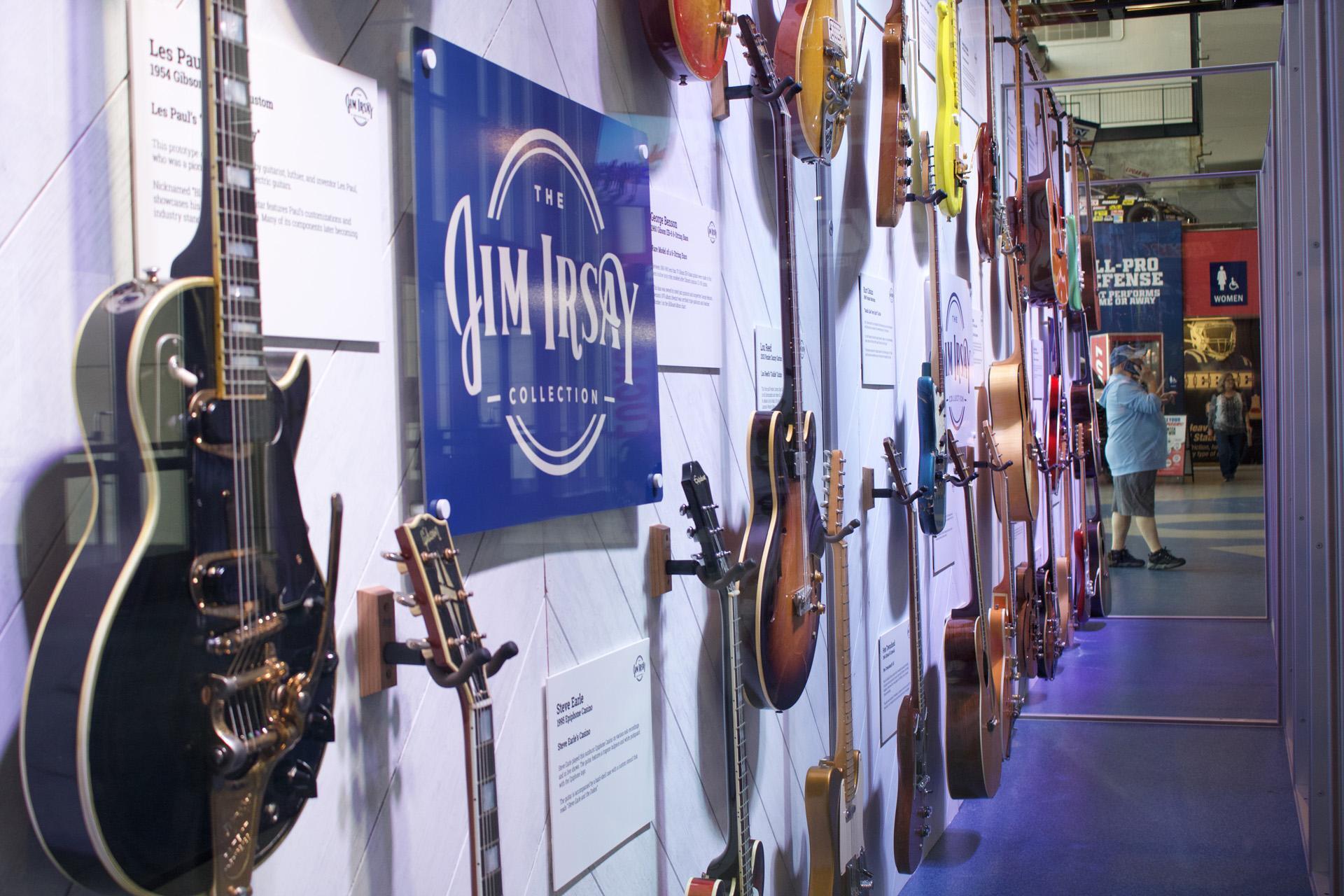
The team is also experimenting with more impactful storytelling experiences called “vignettes.” These smaller displays place multiple related artifacts in a sequence that creates a theme and enriches the overall experience. To help with this, the Irsay team recently hired Jake Sheff as assistant curator. Sheff has a wealth of curation experience, including stints at the National Air and Space Museum in Washington, D.C., and the Indiana State Museum in Indianapolis. He also brings lessons gleaned from working with significant public art.
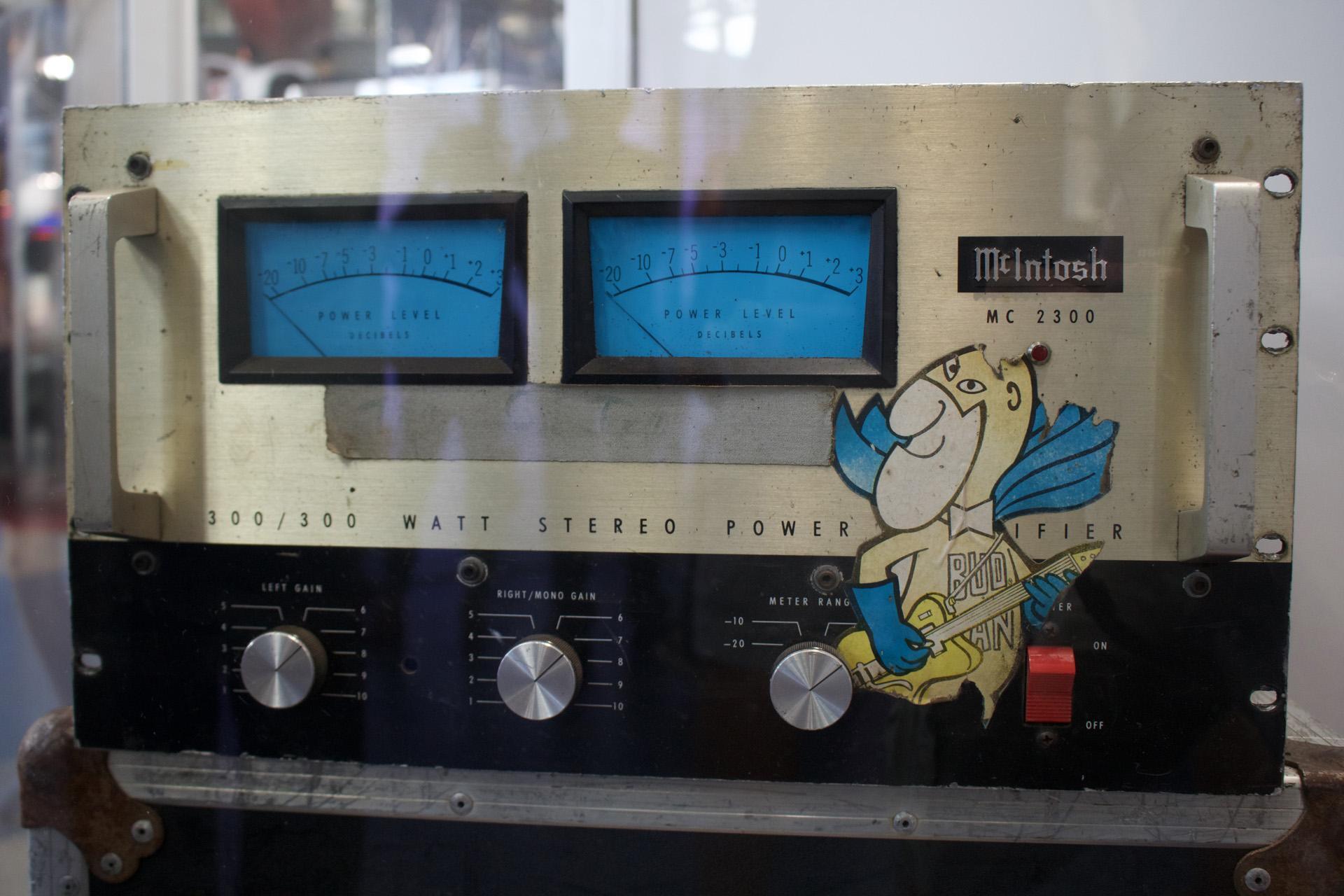
“We’re trying to contextualize for people what the collection contains, and one of the ways we’re doing that is including these guitars in a scene,” Sheff says. “It’s one thing to see these iconic guitars because they speak for themselves . . . but it’s another thing to see the other processes of how music was made.” Sheff’s vignettes often highlight valued aspects of music history, such as Jerry Garcia’s “Budman” amp, a McIntosh MC-2300 placed near Garcia’s Tiger because it was essential to the Grateful Dead’s live sound. Or a small wireless receiver used by Pink Floyd during their Wall-era tour that sits in a vignette alongside David Gilmour’s Black Strat and the Martin D-35 used on “Wish You Were Here.”
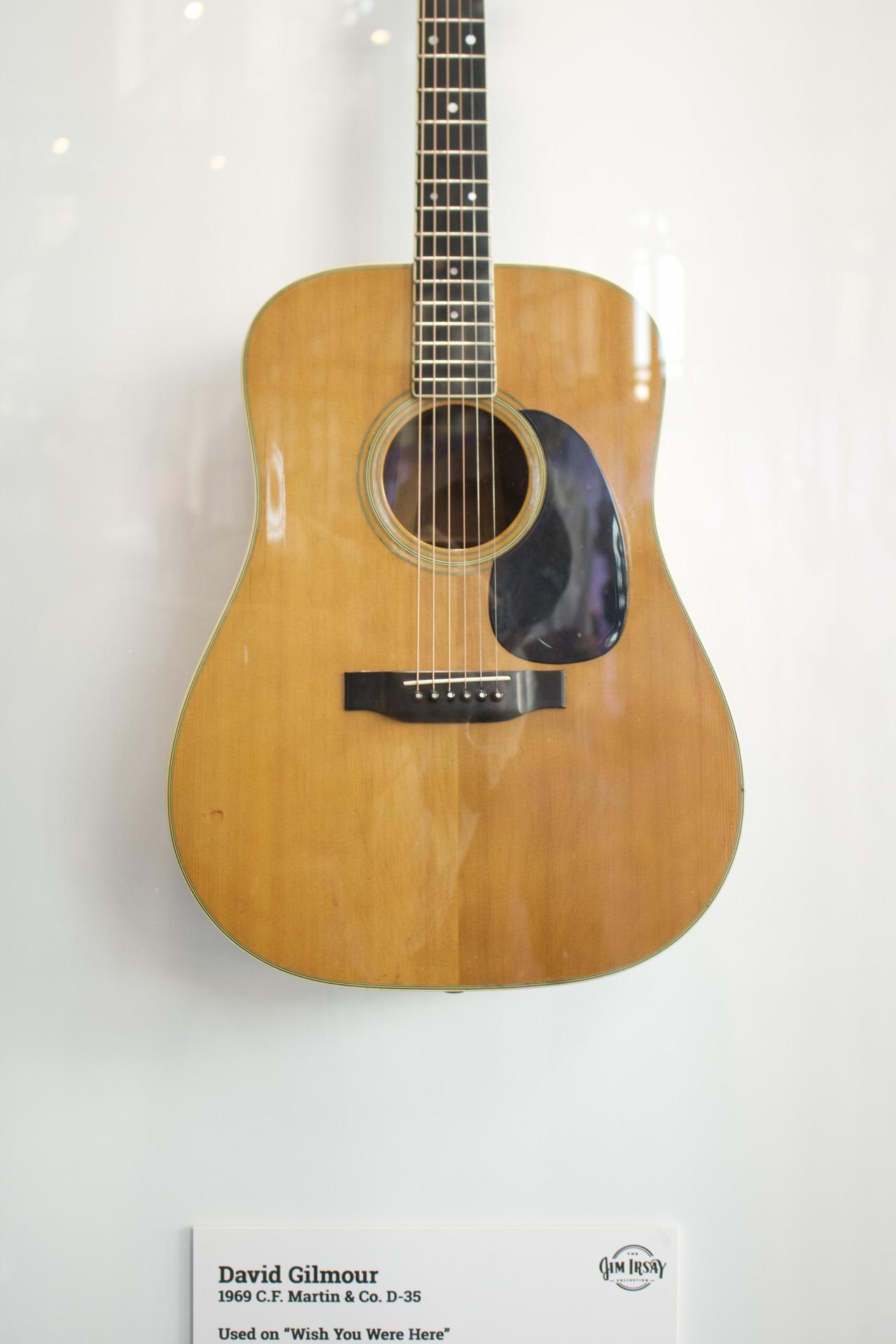
David Gilmour’s 1969 Martin D-35, used on “Wish You Were Here”

David Gilmour’s Black Strat; photo by Sarah Senseny
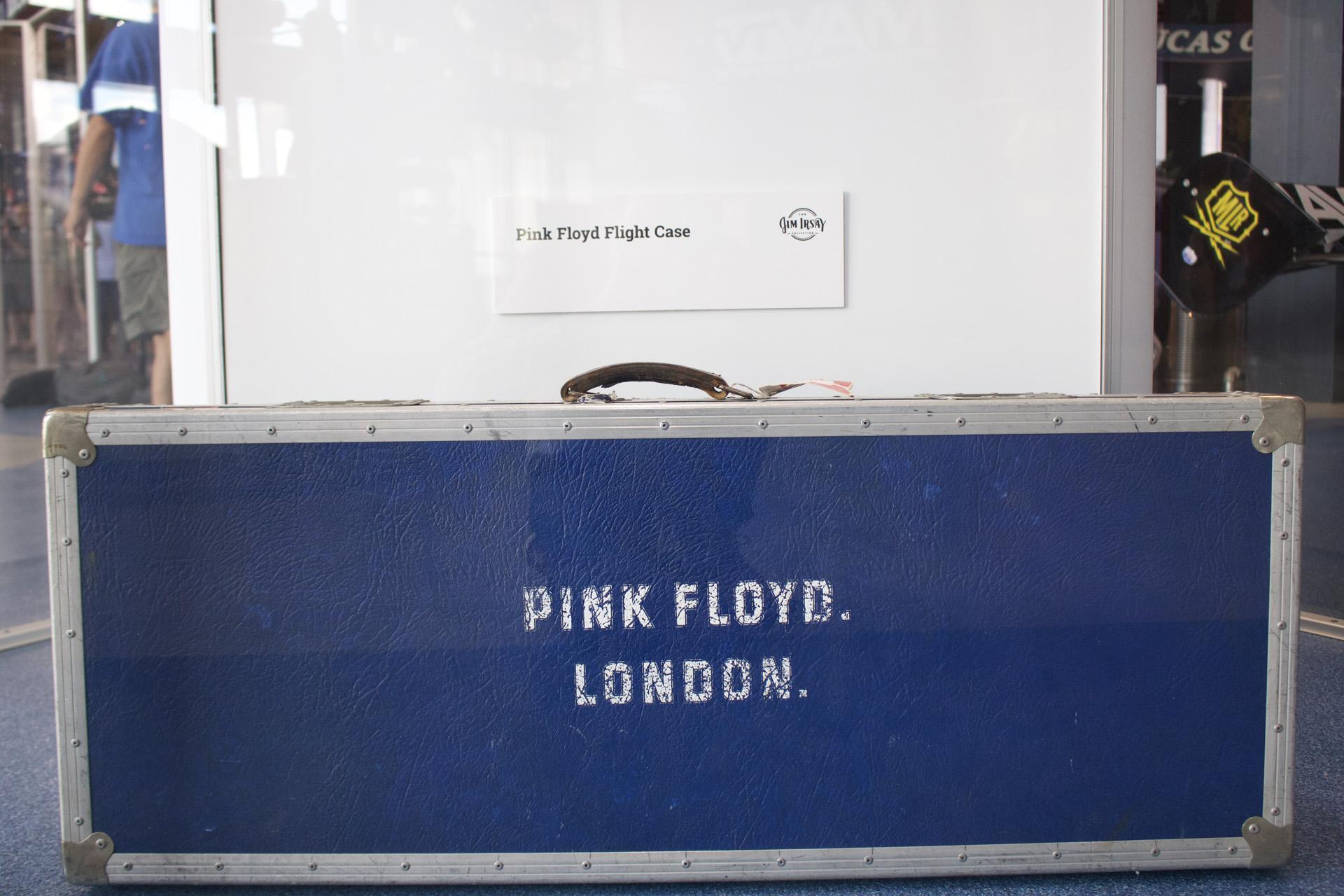
Original Pink Floyd flight case, likely painted using spray paint stencils.
Without this innovative wireless receiver, Sheff says, the choreography seen on Pink Floyd’s The Wall tour would never have been possible. It’s a subtle nod to the pro audio gear that brings immersive concerts to life but rarely gets any credit. It would be easy to simply highlight neat historic guitars, but taking this a step further to show amplifiers, receivers, and more is an authoritative flex that we here at Sweetwater can genuinely appreciate.
Plans for the Future
Mr. Irsay recently stated that he intends to take the collection further as a traveling exhibit. The team is hard at work on exhibit plans for several major American cities, and a European exhibition is looking promising down the line. Safe logistics and risk management are critical to showing off these instruments responsibly, and arranging these things takes time. “For what we do, I think we’re literally the best in the world,” Hall says. The team predominantly emphasizes stewardship — a public responsibility to give these precious antiques the precise care they might not receive without a dedicated staff and premium financing. When it comes to caretaking history, it takes a village!
While we can’t offer you David Gilmour’s Strat or Kurt Cobain’s Mustang, Sweetwater can absolutely offer thousands of worthy instruments and signature models that nail your favorite artist’s vibe to a tee. Check out our guitar listings and be sure to call your Sweetwater Sales Engineer at (800) 222-4700 for a personalized shopping experience — and keep an eye out for the Jim Irsay Collection, coming soon to a city near you!