

Bolt-on necks versus set necks: it’s an argument that stretches back to when Leo Fender first popularized the bolt-on design in the early 1950s. While the bolt-on design was initially introduced as a cost-cutting measure to scale up mass production of the electric guitar, it has proven itself over the past 70-odd years, resulting in instruments as fine as any fancy, set-neck masterwork. But what’s the difference between the two designs? They must each have desirable qualities if both are still around after all these years. Are they functionally different? Do they feel different? And, most importantly, do they sound different?
Setting the Record Straight
Before getting into the finer nuances of these two neck joints, let’s define “bolt-on” and “set neck.” Also, though most stringed instruments have a neck joint, we’re discussing electric guitars, acoustic guitars, and basses in this article.
For most of bass and guitar instrument history, set necks were the only way to attach an instrument’s body to the neck. A set neck involves crafting a woodworking joint between the guitar’s body and neck then solidifying the bond between the two parts of the joint with glue.


The joints used to connect the body and neck of a set-neck stringed instrument hail from traditional woodworking techniques — the dovetail on a fine cabinet is simply a much smaller version of the dovetail found on many set-neck acoustic guitars.
By comparison, a bolt-on neck relies on a similar joint-forming process, but the body and neck are joined with metal screws. It’s worth mentioning that this form of neck joint is very much a guitar- and bass-centric idea — other stringed instruments have flirted with the idea of bolt-on neck joints over the last century (particularly in the past few decades). Still, there’s no arguing that a bolt-on neck is the standard rather than the exception.
Set necks historically tend to have more complex neck joints than bolt-ons, even on solidbody electric guitars. Compare a finely crafted dovetail or a Les Paul long-tenon joint to a humble Fender neck pocket, and it’s relatively apparent which one takes more skill and time to make. However, the critical point is that the joint utilized is not the deciding factor between bolt-on and set necks. Instead, it’s how the joint is held together.
Both methods tend to carry misguided baggage because of how they’ve been historically utilized: Fender solidbody guitars primarily introduced the bolt-on method, so bolt-ons are usually associated with less-refined neck joints. Brands like Gibson and Martin mastered complex, glued-in dovetail joints before Leo Fender was born, so the set neck is often associated with intricate joints. We’re here to tell you that the complexity of the joint itself has no bearing on whether a neck is classified as a bolt-on or set neck. To find out what kind of neck joint a guitar or bass has, ask yourself a simple question: Is the neck glued or screwed in?
Which One Should You Choose?
You can’t go wrong either way. Bolt-on and set-neck guitars have distinct advantages and peculiarities. These can be divided into two categories, practical and tonal.
Practical Considerations
The contest of bolt-on vs. set neck is no contest at all — there’s no “winner” as both methods are equally viable choices. However, if you view things from a purely practical perspective, then bolt-on necks have many advantages not found in a set-neck design.
Bolt-on Necks Can Be Removed & Replaced
Yes, this one’s rather obvious, but it has more implications than you might think. On a set-neck instrument, the neck the guitar comes with is the neck it will keep throughout its entire life span. If you don’t like the shape or the feel or if something goes wrong, then you’re essentially out of luck — barring a substantial financial investment in a very adventurous luthier.
Often, with a bolt-on neck, swapping the neck requires little more than a screwdriver — for many vintage-style Fender guitars, you need to remove the neck to even get to the truss rod. Would you prefer your guitar’s neck to have a different shape? Simple. Go out and buy a new neck. Did your guitar’s headstock snap off after falling out of a moving van? Simple. Go out and buy a new neck. Are your frets worn down? You can swap the neck. Do you love tinkering with your guitar? Well, you get the idea.
Adjust That Angle
In addition, a bolt-on neck offers a far greater level of adjustability than a set neck, especially considering that a set neck offers no adjustability excluding the truss rod.
For example, your set-neck guitar develops a downward angle toward the body. It’s a phenomenon found on many vintage acoustic guitars and some vintage electrics caused by the strings naturally working their hundreds of pounds of tension on the body. All stringed instruments are, after all, in a constant state of self-destruction.
If the angle continues to develop downward over time (as it often does), then there’s a point where the guitar, even at its bridge’s lowest adjustment, will have very high string action. Your primary course of action on a set-neck instrument is a neck reset. This costly procedure requires removing the neck from the instrument and gluing it back at a more acceptable angle.
What if the same problem occurs on a bolt-on guitar? Changing the angle is as easy as unscrewing the neck and inserting a shim. For this reason, several modern acoustic guitar manufacturers like Taylor, Breedlove, and Yamaha have gladly switched many of their models to bolt-on neck joints. Some of the finest-sounding acoustic guitars available today utilize a dovetail-like system that holds itself together with bolts rather than with traditional glue — a compelling argument for the bolt-on believers out there.
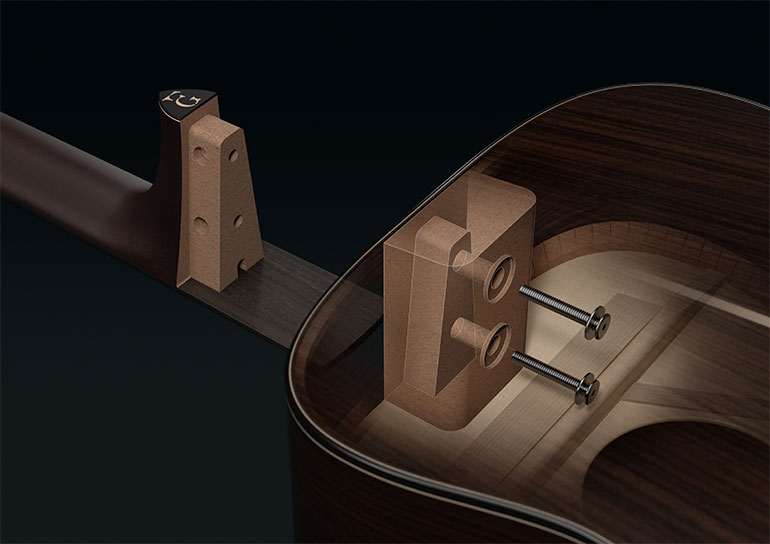
A finely crafted dovetail-style neck joint found on the high-end Yamaha FG9 acoustic guitar that forgoes traditional, glued-in construction for two removable bolts
Bolt-on Necks Are Easier & Cheaper to Manufacture
This point is a double-edged sword and honestly of more concern to the manufacturer than the player. Still, it’s a fact that bolt-on-neck instruments are easier to manufacture than set-neck instruments because most bolt-on neck joints favor a simpler attachment method. Even bolt-on dovetail-style neck joints are generally easier to craft than glued neck joints. Why? A glued-in dovetail must be precision fit and perfectly chiseled to the perfect angle; bolt-on dovetails often (not always) utilize removable shims that allow for higher tolerances since you can instantly change the neck angle with a removable piece of wood.
To Everything, Tone, Tone, Tone
Now, the million-dollar question: how do they sound? Tone, as always, is incredibly subjective, so approach this section with a healthy dose of skepticism. We’re here to provide you with a baseline of knowledge founded on conventional wisdom built around these two joinery methods over the past century.
Sustain & Resonance
Ask any well-versed guitarist what the primary difference is between a bolt-on neck and a set neck, and they’re all but guaranteed to mention sustain and resonance. The idea here is that many guitarists and luthiers see a glued-in neck joint as a superior means of sound transference from the guitar’s neck to the guitar’s body. If the body and neck are each one-half of the tonal puzzle, then it only makes sense that you want as seamless a connection between them as possible.
Any gap, no matter how small, theoretically reduces the ability to transfer energy between the neck and body. What material fills the microscopic gap between two pieces of wood to maximize energy transfer? Glue.
The best example of the set-neck style is known as neck-through. If a glued-in joint provides superior energy transfer from the neck to the body because it minimizes the gap between the two, then a neck-through does it better — on a neck-through guitar, the neck and the body are the same piece! Even more than a typical set neck, neck-through guitars are renowned for their exceptional sustain and resonance.
Proponents of this idea believe that a bolt-on neck does not form the same comprehensive bond that a glued-in set neck does — a rather tough argument to refute after hearing the nearly endless sustain of a Les Paul. Moreover, the enhanced sound transfer of a set-neck guitar is said to result in a warmer, more rounded character than a bolt-on. Some bolt-on-neck guitars boast the same level of sustain and warmth as a set-neck instrument, but we’re speaking in generalities. Wood is wood, and consistency is not its strong suit.
Pop & Attack
For many players, the more sustain, the better. Yet, the thing about choosing a tone is that there’s no such thing as a universally good one — a Les Paul with minutes’ worth of sustain is sure to please a rock lead player, but a rhythm guitarist chunking out complex chord progressions likely wants the notes to get out of the way quickly.
So, if the set-neck guitar is warm, round, and long sustaining, then what does a bolt-on neck bring to the tonal table? A fast attack and a more defined sound, oft described as a “pop” or “snap,” to your notes. That certainly fits the mold for Fender-style electric guitars. Many players believe that the bolt-on neck design is directly responsible for the Telecaster’s iconic twang or the Stratocaster’s bell-like articulation.
Trust Your Ears Above All Else
Tone is always a difficult subject to tackle, especially when considering one element of a guitar in isolation. Classic set-neck and bolt-on guitar archetypes sport more differences than just their neck joints — is the brighter attack of a bolt-on neck because of the bolts or because they usually have maple necks? Do set-neck guitars sustain more because of the glue holding the joint together or because their joints almost always contain more wood-to-wood contact from the body to the neck? What about the bridge? The pickups? Do some tonewoods transfer sound between the neck and body better than others?
There’s rarely a clear-cut answer to any tonal question. Even at Sweetwater, you could gather 10 guitar experts in the same room and get 10 different opinions on the tonal differences between bolt-on and set-neck guitars. The information in this article gives you a firm foundation, comprised of the generally accepted facts among most guitarists, but you should always trust your ears above all else!
You’ll need a guitar or two to experiment with to test out these assertions. Call your personal Sweetwater Sales Engineer at (800) 222-4700 to try out a bolt-on-neck or set-neck guitar on your terms!