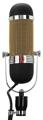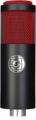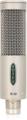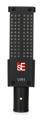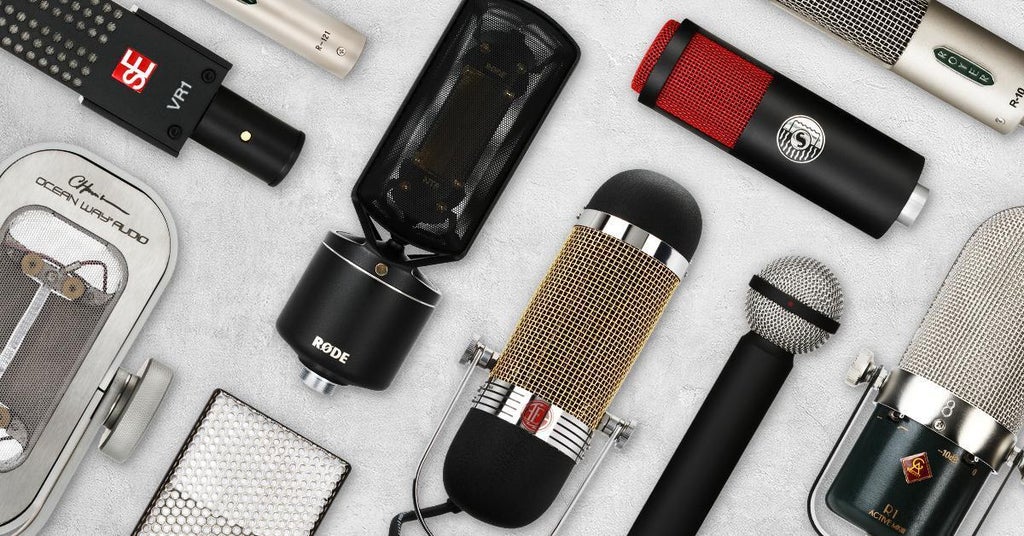
Before condenser microphones were in widespread use ribbon microphones were very popular; they remained so throughout the 1950s, but their popularity declined quickly after that. This was in part due to the low output level of their passive electronics and the fragility of their incredibly thin ribbon diaphragms compared to other types of microphones. A strong wind blast can destroy some ribbon elements, so you do have to be careful with them, but their speedy transient response and smooth, warm sound can still be very useful, especially for mellowing out the harsh edges of digital recording. Because of that, they’ve become popular again, and many new models are available today — some even include active electronics to increase their output levels. Here’s ten excellent ribbon mic models to consider.
10 Best Ribbon Mics for Recording:
Royer R-121
The Royer R-121 is a big part of the modern ribbon mic success story, and it’s been a favorite of countless pro engineers and hobby recordists since its introduction in 1998. This mic, designed by the legendary David Royer, is in no small part the mic that started the modern ribbon mic revival. And it’s no wonder — with a very natural yet warm sound, it’s a great choice for guitar amps, brass, and drum overheads. It has a figure-8 polar pattern like most ribbon mics, but it’s built to be more robust, and can handle over 135 dB SPL without damage while delivering a broad and reasonably flat 30 Hz – 15 kHz frequency response and very fast transient response. If you want similar characteristics with a higher output level, then the Royer R-122 MKII is the mic for you.

10 Best Ribbon Mics for Recording:
Beyerdynamic M 160

The Beyerdynamic M 160 is the oldest microphone on this list; this German-built mic has been in production since 1957, and there’s a reason for that — it’s an incredible sounding mic. Beyerdynamic uses a pair of aluminum ribbons in the M 160 for increased sensitivity. The M 160 has a hypercardioid polar pattern, which differs from the figure-8 pattern that is more common for ribbon mics, and it is often paired with its twin-sibling the Beyerdynamic M 130 (which has a figure-8 polar pattern) for Mid-Side recording purposes. With a frequency response from 40 Hz – 18 kHz the Beyerdynamic M 160 excels as a drum overhead mic, guitar amp mic, is great on sax and reeds, and works well on a wide variety of string instruments, from banjo to violin. If you’re not sure if you’ve ever heard an M 160, I bet you have. It is famous for being the pair of mics that were used to capture the legendary sound of John Bonham’s drums on Led Zeppelin’s “When the Levee Breaks.”
10 Best Ribbon Mics for Recording:
AEA R84A
Wes Dooley at AEA is another longtime proponent of ribbon mics, and a real expert in their design. The original R84 was one of the earlier new-generation ribbon mic models, and the AEA R84A builds on that foundation by adding phantom-powered active electronics for a 12 dB hotter output so it works with a wider range of mic preamps and on quieter sound sources than non-powered ribbon mics. It also has good high frequency response, impressive 141+ dB maximum SPL handling, and less proximity effect than some ribbon mics, making it a great mic for use at close-to-source distances without the sound becoming too boomy.

10 Best Ribbon Mics for Recording:
sE Electronics Voodoo VR1

The sE Electronics Voodoo VR1 is a surprisingly affordable passive ribbon microphone but, even if you can spend more, don’t overlook this little gem because it has a lot going for it. Like what? How about a frequency response that’s nearly flat from 20 Hz to 20 kHz for starters, with a slight boost in the 4 kHz region which helps with intelligibility. The extended high frequency response gives it a brighter sound than some other ribbons, yet it still retains the classic ribbon smoothness, without the harshness and sibilance that can plague some condenser mics. It works exceptionally well on a variety of acoustic instruments as well as on guitar cabinets, and can handle levels up to 135 dB SPL.
10 Best Ribbon Mics for Recording:
Ocean Way Audio RM1-B
Few people — or studios — have a mic collection that can even begin to rival that of Ocean Way-owner Allen Sides. When he wanted a new ribbon mic for his Ocean Way Audio brand, he turned to designer Cliff Henricksen, who reimagined what a large-format ribbon mic could be. He gave the bi-directional Ocean Way RM1-B a natural sound and full audio bandwidth, along with exceptionally low noise and uncommon pop resistance. The ribbon is positioned in a very strong neodymium magnetic field to increase the microphone’s output, while the active, phantom-powered electronics boost it even more, making it compatible with all of your favorite mic preamps. The external aluminum case has a matte surface with an anodized outer coating for durability, and a beautiful high-quality design.

10 Best Ribbon Mics for Recording:
Royer R-10

Another mic from Royer that you should check out is the R-10. More affordable than the R-121, it brings Royer ribbon quality to a wider audience while maintaining all the advantages that make ribbon mics so desirable. This American-made mic has a 2.5 micron ribbon element and the quick transient response you expect from ribbon mics, while a three-layer internal grille keeps it well protected from wind blasts and vocal plosives. Proximity effect is also reduced, and the R-10 can handle up to 160 dB SPL at 1 kHz, making it a good choice for close miking applications, even on loud sound sources. An internal shock mount reduces stand-borne vibration, and the Royer R-10 is one of the few ribbon mics purposely designed not only for studio recording, but for on-stage use too.
10 Best Ribbon Mics for Recording:
Shure KSM313/NE
The Shure KSM313‘s black body and distinctive red grille makes it a visual standout, but the real news is the incredibly strong Roswellite® ribbon material, Acoustic Nanofilm that was developed by Soundwave Research using carbon nanotube technology. No other ribbon mic manufacturer uses this failure-resistant ribbon material. It allows the KSM313/NE to handle levels as high as 146dB SPL. The KSM313/NE is also a dual voice design, with two discrete sonic signatures, depending on whether you aim the front or the rear of this bi-directional mic at your sound source. The front side has a warmer and fuller sound that can really thicken up instrumental recordings, while the back side’s brighter character is great for bringing out vocal nuances and detail.

10 Best Ribbon Mics for Recording:
Golden Age Project R1 Active MKIII

Another mic to look into if you’re on a tighter budget is the Golden Age Project R1 Active MKIII. It is an exceptionally affordable ribbon mic, but despite its accessible price point it includes an active FET buffer amp. This phantom-powered circuit gives the mic a hotter output signal and allows the Golden Age Project R1 Active MKIII to be used with longer cable runs, as well as with more affordable, low-gain mic preamps; something that you can’t do with many passive ribbon microphones. It can even handle impressively loud sound sources up to 160 dB SPL, making it a good choice for drum overhead miking duties, loud guitar amps, as well as vocals and horns.
10 Best Ribbon Mics for Recording:
Rode NTR
Rode Microphones have been bringing high-quality condenser mics to the masses for decades now, and it was inevitable that they’d eventually release a modern ribbon mic design — and the NTR is a very good one at that. The Australian-built Rode NTR is equipped with active electronics, along with a custom transformer that gives it not only enough output level to make it a good match with practically any phantom-power-equipped microphone preamp, but also excellent high frequency response. That means it doesn’t need as much EQ as some other ribbon mics require in order to achieve a more balanced and detailed sound. The NTR is an outstanding choice for guitars, horns, and vocals.

10 Best Ribbon Mics for Recording:
Cloud Microphones 44-A

The design of the Cloud 44-A was influenced by the legendary RCA 44 ribbon mic that has been an industry standard since the 1930s. It uses the same specs for the ribbon itself, while the rest of the mic is thoroughly modern, with built-in Cloudlifter active electronics for a more robust output level and low-noise performance. The Cloudlifter circuit even provides dual mode Voice/Music response curves that controls the proximity effect and optimizes the performance for different sound sources. As with other figure-8 mics, the exceptional side rejection of the Cloud 44-A can be very useful when trying to avoid picking up bleed from nearby sound sources, such as when recording someone who is playing acoustic guitar while simultaneously singing.
If you’re looking to take your mic locker to the next level, adding a few ribbon mics is a great way to do it. They’ll provide the speedy transient response you’re familiar with from condenser mics, but typically have a much warmer sound and smoother, less edgy high frequency response that makes them great for modern digital recording. You’ll need to be a bit more careful with them; they won’t take as much abuse as your live performance mics, but if given reasonable care they’ll last for decades while providing you with a very cool sound that condenser and moving coil dynamic mics just can’t match.
To find out more about ribbon mics, call your Sweetwater Sales Engineer at (800) 222-4700.